
 By Asro
As the global social commerce market hurtles toward a historic $1 trillion milestone, the pressure on marketing departments to justify every cent of digital spend has reached a fever pitch. Once considered a playground for "vanity metrics" like likes and follows, social media has evolved into a sophisticated revenue engine. However, a new report from industry leader Hootsuite reveals a startling disconnect: while the medium is more lucrative than ever, 68% of marketers remain deeply concerned about their ability to prove Return on Investment (ROI) to their stakeholders.
This tension between massive market potential and measurement anxiety defines the current era of digital strategy. With social media users expected to swell to 5.75 billion by 2026, the question is no longer whether social media works, but rather how precisely it can be measured against the bottom line.

Main Facts: The ROI Equation and the Modern Marketer’s Dilemma
Social media ROI is defined as the value a business reaps from its social media marketing and advertising relative to the resources—time, money, and effort—invested. In its most clinical form, the formula is straightforward:
Social Media ROI = ((Value Generated – Costs) / Costs) x 100

Despite the simplicity of the math, the "Value Generated" variable has become increasingly complex. Modern ROI is no longer restricted to direct sales. It now encompasses a hybrid of monetary and non-monetary outcomes, including brand sentiment, share of voice, and long-term customer lifetime value (CLV).
The Current Landscape
Current market data paints a picture of high stakes. Social commerce is projected to generate $908.5 billion in 2026, representing a 10.7% year-over-year increase. By 2028, the market is expected to surpass the $1 trillion mark. For enterprise-level organizations, this growth necessitates a shift from experimental spending to rigorous fiscal accountability. Data indicates that 46% of marketers already see a direct improvement in sales through social channels, yet the "proof" required by CFOs and executive boards remains a significant hurdle.

Chronology: The Evolution of Social Media Measurement
To understand the current state of ROI, one must look at the three distinct eras of social media marketing:
- The Era of Awareness (2008–2014): In the early days of Facebook and Twitter, success was measured by the size of an audience. Reach and impressions were the primary KPIs. ROI was often dismissed as "unmeasurable," with social media treated as a digital billboard.
- The Era of Engagement (2015–2020): As algorithms shifted, the focus moved to how users interacted with content. Likes, comments, and shares became the currency of choice. While more tangible than reach, these metrics still struggled to correlate directly with revenue.
- The Era of Conversion and Commerce (2021–Present): The integration of in-app shops (Instagram Shopping, TikTok Shop) and advanced tracking (UTM parameters and Pixels) has turned social platforms into full-funnel ecosystems. Today, the expectation is "closed-loop measurement," where a single post can be tracked from initial impression to the final checkout.
Supporting Data: Breaking Down the Metrics by Funnel Stage
Effective ROI tracking requires a granular approach. Industry experts suggest categorizing metrics into three distinct "funnel stages" to provide a holistic view of value:
1. Awareness and Reach (Top of Funnel)
These metrics indicate how many potential customers are entering the brand’s orbit.
- Key Metrics: Impressions, reach, brand mentions, and follower growth rate.
- Business Value: These serve as leading indicators for future market share and "share of voice" within a specific industry.
2. Engagement and Consideration (Middle of Funnel)
These metrics measure the resonance of the brand’s message.
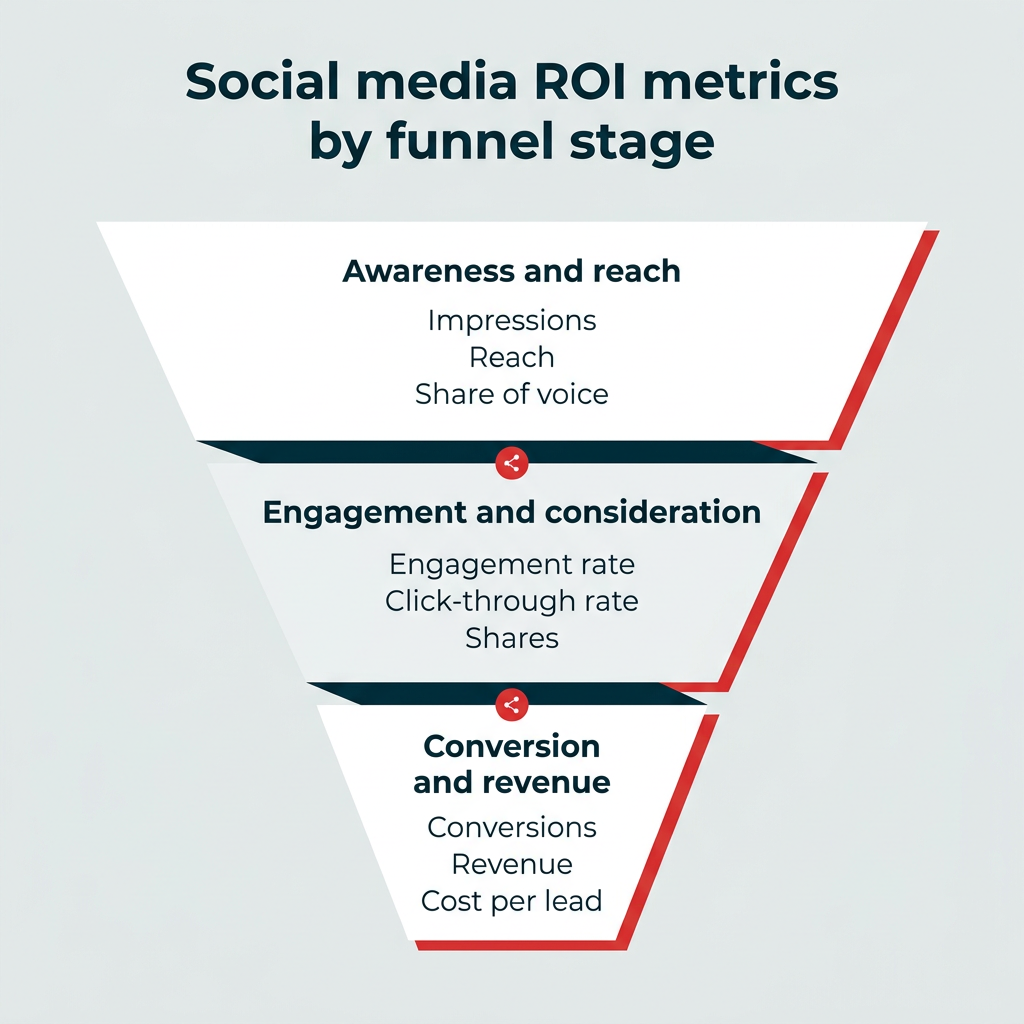
- Key Metrics: Engagement rate, click-through rate (CTR), saves, and video completion rates.
- Business Value: High engagement signals brand health and reduces the cost of future acquisition by building a "warm" audience.
3. Conversion and Revenue (Bottom of Funnel)
This is where the ROI calculation becomes concrete.
- Key Metrics: Total conversions, attributed revenue, Cost Per Lead (CPL), and Return on Ad Spend (ROAS).
- Business Value: These figures connect social activity directly to the company’s balance sheet.
Real-World Performance Benchmarks
According to Hootsuite’s analysis, ROI varies significantly by sector:
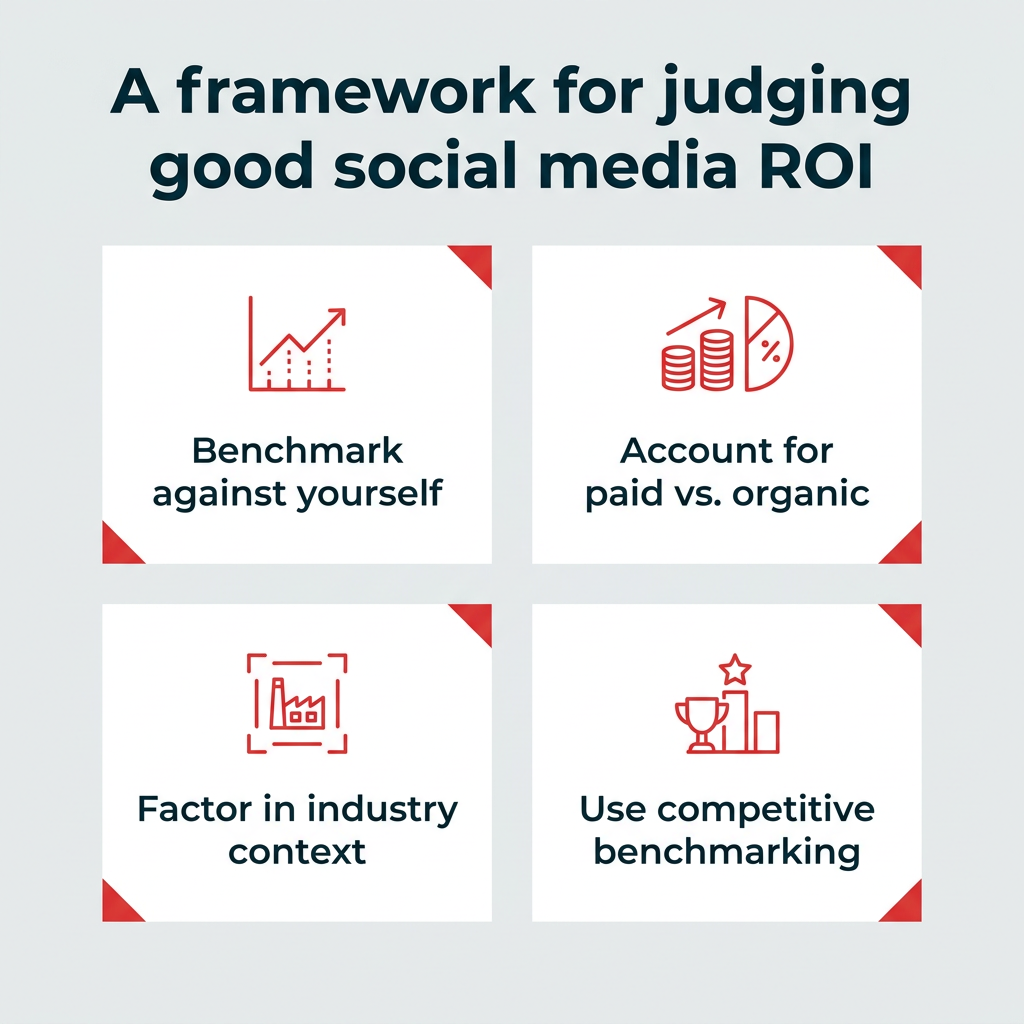
- E-commerce: A typical successful campaign might see a 178% ROI by focusing on direct sales and attributed web traffic.
- B2B Enterprises: Companies focusing on lead generation via LinkedIn often report ROI as high as 400%, calculated by the "estimated value" of a qualified lead versus the cost of content production and ad spend.
Official Responses: Expert Perspectives on Proving Value
Marketing leaders emphasize that the "fear" of ROI often stems from a lack of goal alignment at the start of a fiscal year. Eileen Kwok, a former Social & Influencer Marketing Strategist at Hootsuite, suggests that flexibility is as important as accuracy.
"The goals you have set at the start of the year could have already changed," Kwok noted. "Depending on the shifts your organization is making, or the changing social landscape, make sure you are revisiting your goals every quarter."

This sentiment is echoed by broader industry research, including Nielsen’s 2025 Marketing Report, which identifies "data silos" as the primary barrier to ROI calculation. When social data is trapped within a platform’s native dashboard and not integrated with the company’s CRM (Customer Relationship Management) or web analytics, the "multi-touch attribution" is lost.
Experts argue that social media rarely acts in isolation. A consumer may see an Instagram post (Touchpoint 1), receive an email (Touchpoint 2), and then search for the brand on Google (Touchpoint 3) before purchasing. Without sophisticated tracking, the "last click" (Google) gets 100% of the credit, while social media’s crucial role in the discovery phase is erased from the ROI equation.
Implications: The Future of Social Investment
The shift toward rigorous ROI measurement has profound implications for the future of the digital workforce and corporate budgeting.
1. The Death of the "Siloed" Social Media Manager
The role of the social media manager is transitioning into that of a data analyst. Understanding UTM parameters, Urchin Tracking Modules, and API integrations is now as critical as writing a compelling caption. Organizations are increasingly looking for "T-shaped" marketers who can bridge the gap between creative execution and financial reporting.

2. Budget Security in Volatile Markets
In times of economic uncertainty, "unproven" budgets are the first to be slashed. By establishing a clear ROI framework, social media teams can defend their spend. When a team can demonstrate that $1.00 of social spend results in $2.78 of value (as seen in the e-commerce example), the conversation shifts from "cutting costs" to "optimizing investment."
3. The Rise of Social Commerce and "Closed-Loop" Data
As platforms like TikTok and Instagram further integrate checkout processes, the difficulty of measurement will decrease. Social commerce allows for "closed-loop" reporting, where the platform knows exactly which ad led to which purchase. This will likely lead to a massive migration of ad dollars from traditional "open web" display ads to in-app social commerce environments.

4. Strategic Experimentation
A robust ROI framework actually allows for more creativity, not less. By using A/B testing—such as Hootsuite’s experiment comparing Instagram Carousels to Reels—brands can quickly identify high-performing formats. This data-driven approach ensures that creative energy is funneled into formats that actually move the needle, rather than chasing trends for the sake of novelty.
Conclusion
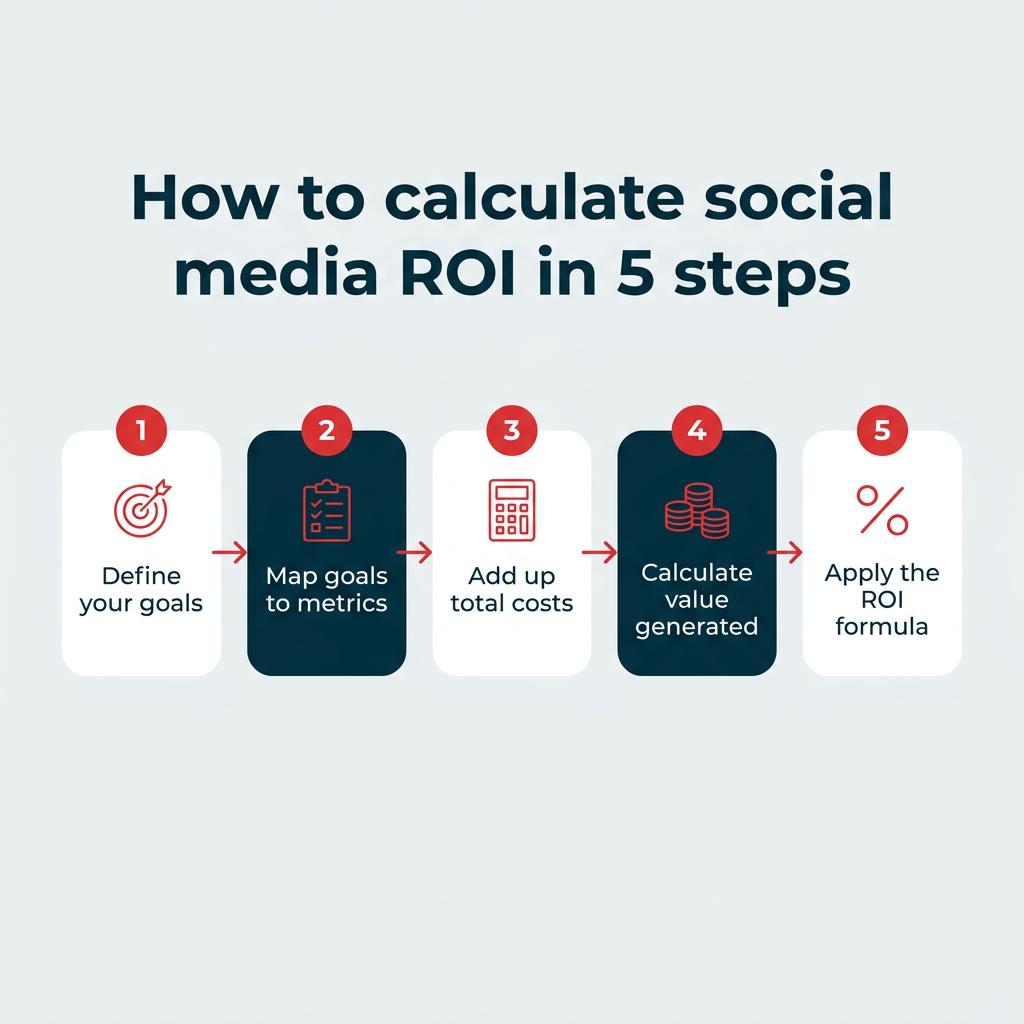
The journey toward a $1 trillion social commerce market is paved with data. For the 68% of marketers who worry about proving their worth, the solution lies in a return to fundamentals: defining clear goals, adding up every granular cost, and utilizing unified analytics tools to bridge the gap between a "like" and a "lead."
As social media continues to dominate the global attention economy, the brands that master the art of the ROI calculation will be the ones that survive the next era of fiscal scrutiny. In the modern marketplace, the most powerful tool a social media manager possesses isn’t a camera or a hashtag—it’s a spreadsheet.
About the Research: This report was synthesized from data provided by Hootsuite, Statista, and Nielsen, incorporating market projections through 2028 and internal social media performance experiments conducted by industry strategists.
 Basiran
  Nana Muazin
  Nila Kartika Wati