
 By Pevita Pearce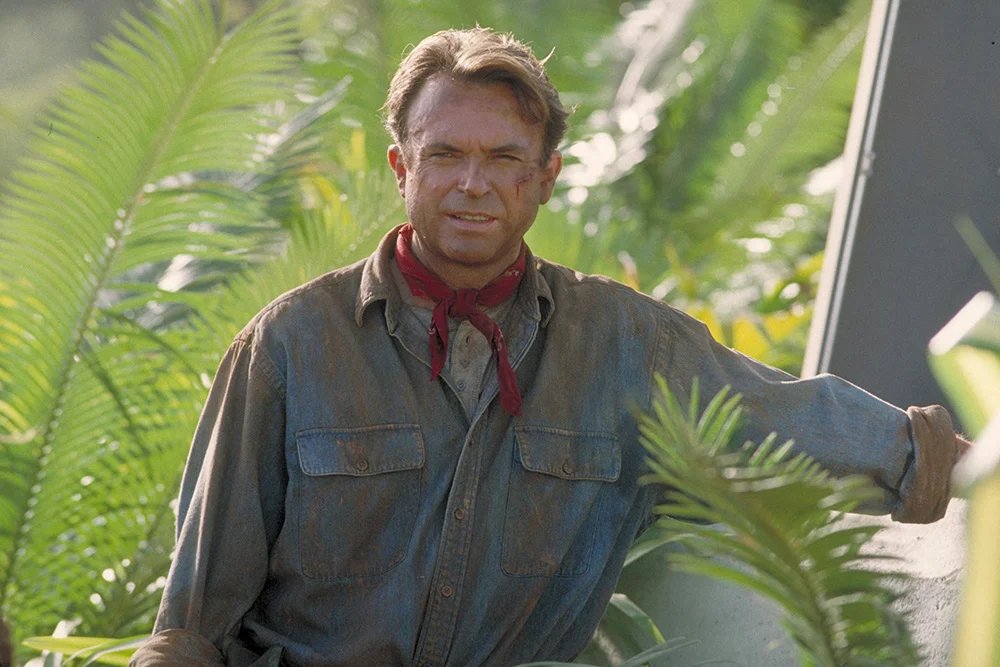
For nearly two decades, Sam Neill existed in the Hollywood ecosystem as a fixture of quiet reliability—a performer who possessed the rare ability to command a scene without ever demanding to own it. To the audience, he was a face they recognized but perhaps couldn’t immediately name; to his peers and legendary directors, he was the industry’s most coveted "supporting pillar."
It was only at the age of 45, in the seismic year of 1993, that Neill was thrust into the stratosphere of global stardom. Yet, even as he stood at the center of the biggest cinematic event of the decade, Neill remained an anomaly: a man who achieved A-list status while simultaneously rejecting the trappings of the "leading man" archetype. His career trajectory serves as a fascinating study of how an actor can master the art of being essential to a film’s success while maintaining the humility of a character player.
The Architecture of a Career: Early Years and the Art of Elevation
Before he was Dr. Alan Grant, Sam Neill was the quintessential "everyman" of international cinema. Possessing a range that spanned from a soft-spoken, masculine decency to a chilling, steely detachment, the New Zealander built his reputation by serving the visions of others.
In the 1980s, Neill became the secret weapon for some of the most formidable actresses in the industry. He was the perfect foil for Judy Davis in My Brilliant Career, the steady presence beside Isabelle Adjani in the unsettling Possession, and the measured partner to Nicole Kidman in the taut thriller Dead Calm. Whether working with Meryl Streep in Plenty or A Cry in the Dark, Neill’s performances were surgically precise. He understood that his primary duty was to modulate his own screen presence to ensure his co-stars shone brighter.
This professional modesty made him an industry favorite. He was not a star who would "pull focus" or derail a production with ego; he was a craftsman who viewed his contribution as part of a larger, collaborative tapestry.
1993: The Year of the Dual Identity
The year 1993 remains the most pivotal juncture in Neill’s career, defined by two diametrically opposed projects that premiered simultaneously.
The Blockbuster: Jurassic Park
When Steven Spielberg cast Neill as paleontologist Dr. Alan Grant in Jurassic Park, he was looking for more than just an actor; he was looking for a stabilizer. As producer Kathleen Kennedy noted at the time, the role of Grant "isn’t an intensely complicated part." The film’s true stars were the animatronic and CGI-rendered dinosaurs, and Spielberg required an anchor who could ground the audience’s awe and terror.
Neill was the ideal choice. He was professional, affordable, and possessed an innate, lived-in authenticity that made the fantastical elements feel grounded. Despite being first-billed in a global cultural phenomenon—complete with his own action figure—Neill approached the role with a clear-eyed understanding of the hierarchy. He was, as he would later concede, "second banana" to a horde of prehistoric creatures.
The Auteur Choice: The Piano
While the world was captivated by the spectacle of Isla Nublar, Neill was simultaneously appearing in Jane Campion’s The Piano. In this colonial-era drama, Neill played the antithesis of the heroic Dr. Grant. As the priggish, violently abusive husband of Holly Hunter’s mute protagonist, Neill delivered a performance of "petty, poignantly impotent rage."
While Harvey Keitel represented a kind of raw, liberated masculinity in the film, Neill was the stiff, cold counterpoint. It was an unflattering, difficult role that required a deep well of vulnerability—the kind of work that Hollywood leading men usually shy away from for fear of damaging their brand.
The Philosophy of "Serving" the Film
The contrast between these two roles—the heroic paleontologist and the villainous colonialist—highlights the core of Neill’s philosophy. When asked about his career path during the press tour for Jurassic Park, he famously shrugged off the potential for a traditional leading-man trajectory.
"I have this penchant for small films—my agents complain about it from time to time—because I like to play a lot of different things," Neill told the Los Angeles Times.
This choice was not merely a stylistic preference; it was a career strategy that favored longevity over the fleeting, high-pressure demands of the A-list. For Neill, The Piano—despite the lack of an Oscar nomination for his work—was a "medal on his chest." He viewed his participation in such projects not as a stepping stone, but as a duty to the craft. He famously remarked, "It’s a film that will always have a place in cinema history. And I served in it."
Supporting Data: A Career of Unpredictable Collaborations
Neill’s ability to move between the commercial and the intimate is reflected in the diverse list of directors he has partnered with over the decades. By leveraging the financial security and name recognition granted by the Jurassic Park franchise, Neill was able to curate a filmography that defies easy categorization.
- The Genre Edge: John Carpenter’s In the Mouth of Madness showcased his ability to carry a psychological horror film with grit and gravitas.
- The Intimate Drama: Sally Potter’s Yes demonstrated his capacity for complex, dialogue-driven emotional work.
- The Global Perspective: Warwick Thornton’s Sweet Country underscored his commitment to projects that address heavy, historical narratives with nuance.
- The Modern Comedy: Taika Waititi’s Hunt for the Wilderpeople reminded audiences of his impeccable, dry comedic timing.
In each of these films, Neill’s performance was rarely the "selling point." Instead, he functioned as a reliable, highly intelligent conduit for the director’s vision, allowing the artistic whole to supersede his own ego.
Official Responses and Industry Perception
Within the industry, Sam Neill is often cited as the "nice guy" of cinema—a reputation solidified in his later years by his candid, wryly humorous social media presence. Whether he is sharing videos of his vineyard, his ducks, or his candid reflections on his health, the public has gravitated toward his authentic, unpretentious persona.
However, to label him merely a "nice guy" is to underestimate the complexity of his screen presence. Throughout his career, directors have consistently sought him out for his ability to handle ambiguity. He does not play "good" or "bad"; he plays "human." His performances are characterized by a sense of mystery—a feeling that there is always something more happening behind the eyes, even when he is playing the most straightforward of roles.
Implications: The Legacy of the Reluctant Star
What does the career of Sam Neill tell us about the nature of stardom in the 21st century?
First, it suggests that there is a sustainable path for actors who reject the standard "celebrity" pipeline. By prioritizing artistic integrity over the pursuit of consistent blockbuster billing, Neill managed to avoid the burnout and the pigeonholing that often afflict actors who find themselves "trapped" by a single massive franchise.
Second, Neill’s career provides a blueprint for the "supporting lead." He proved that an actor can be the face of a marketing campaign while still functioning as an ensemble player. In an era where the industry is increasingly focused on franchise-driven content, Neill’s ability to remain "unpredictable" and "interesting" is a rare, hard-won victory.
Finally, his legacy is one of service. By his own definition, he is a man who "serves" in the films he chooses. This humility, far from hindering his success, has allowed him to become one of the most respected figures in global cinema. Whether he is running from a T-Rex or navigating the complex emotional landscapes of a period drama, Sam Neill remains, as he has always been, the industry’s most reliable, fascinating, and intentionally reluctant star.
As he continues to work, appearing in both big-budget spectacles and intimate, independent projects, Neill stands as a reminder that the most compelling performances are often the ones that prioritize the story over the ego. He didn’t chase the limelight; he let the limelight find him, and he handled it with the same quiet, steely decency that has defined his entire professional life.
 Nila Kartika Wati
  Siti Muinah
  Ammar Sabilarrohman