
 By Suro Senen
In a significant transformation of the global geopolitical landscape, the United States has seen a sharp decline in its international standing, with many nations now viewing China more favorably than the U.S. This shift marks a dramatic departure from historical norms, as a newly released report from the Pew Research Center reveals that the U.S. is no longer the default preferred global partner in the majority of 36 countries surveyed.
The findings, based on data collected between February and May 2026, illustrate a complex reality where the "soft power" of the United States—historically buoyed by its perceived commitment to individual liberties and democratic values—is experiencing a profound erosion. Simultaneously, China’s influence is deepening, particularly across the Global South and in middle-income nations where economic and diplomatic partnerships are increasingly prioritizing reliability and non-interference.
Main Facts: A Global Reversal of Favorability
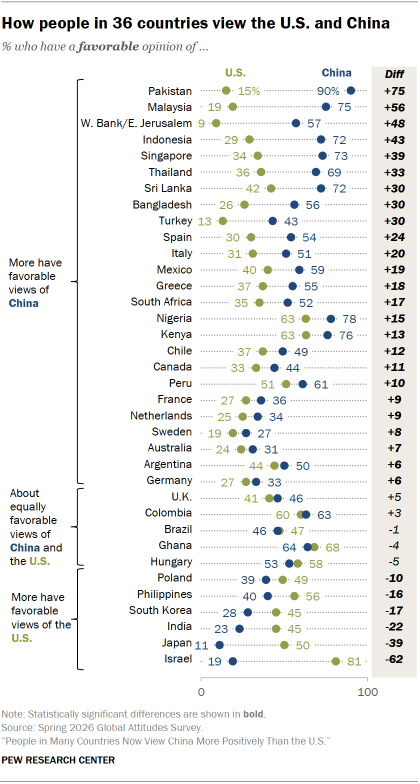
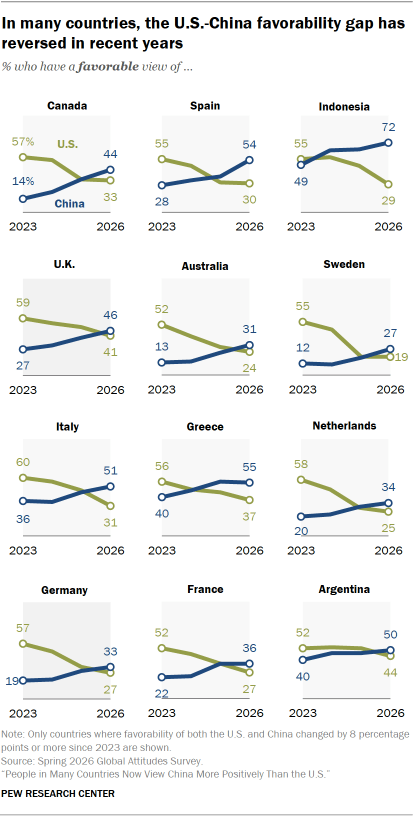
The core takeaway of the 2026 research is clear: the gap between favorability toward the U.S. and China has not only closed; it has inverted. In most of the 36 countries analyzed, China now commands higher favorability ratings than the United States.

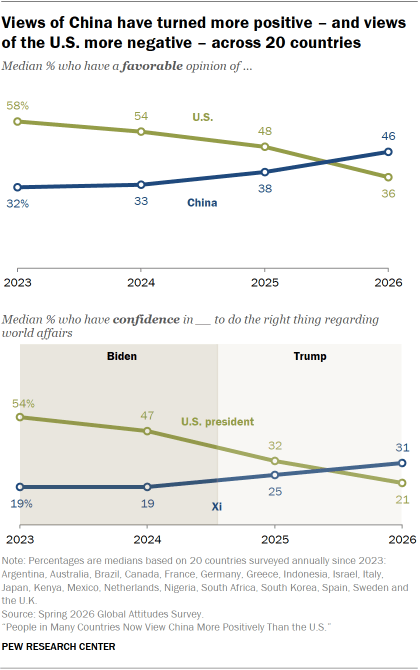
This trend is not merely a byproduct of rising support for Beijing, but rather a dual phenomenon: a sustained deterioration in the global reputation of the United States, coinciding with a gradual improvement in how China is perceived. While the U.S. previously held a commanding lead in international public opinion, the onset of President Donald Trump’s second term has accelerated a decline that began in the latter half of the decade.
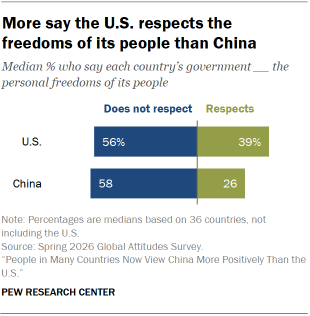
Perhaps most striking is the erosion of the U.S. "moral advantage." For over a decade, international respondents consistently identified the U.S. as a defender of personal freedoms compared to the Chinese government. That distinction is rapidly vanishing. Data shows that in nations across Europe and the Americas, public confidence in the U.S. government’s commitment to human rights has plummeted, creating a landscape where the two superpowers are increasingly viewed as being on equal—and often low—footing.
Chronological Context: The Erosion of Influence
To understand the current state of international relations, one must look at the trajectory of public sentiment over the past several years.
2023–2024: The Biden Years
During the latter portion of Joe Biden’s presidency, the U.S. maintained a higher, albeit declining, degree of global confidence compared to Chinese President Xi Jinping. While ratings for the U.S. were already beginning to dip between 2023 and 2024, the U.S. remained the preferred global actor in most surveyed nations. The international community largely viewed the Biden administration as a return to traditional, alliance-based diplomacy.
2025: The Turning Point
As the U.S. entered a new political cycle, the perception of the country as a "reliable partner" began to falter significantly. The 2025 survey cycle recorded the first major signs of a reversal, with public opinion in several key nations—including Canada and Mexico—shifting from a pro-American bias to a state of near-parity between the two superpowers.
2026: The Current Reality
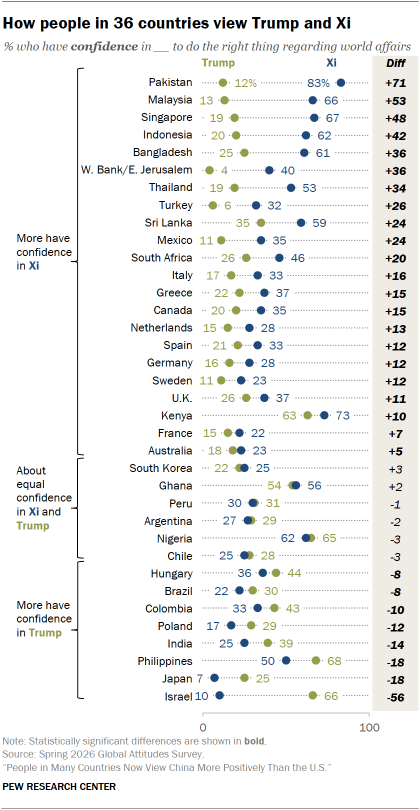
The 2026 survey data confirms that the shift has matured into a trend. The "Trump-Xi" dynamic has fundamentally altered the global calculus. In the first two years of Donald Trump’s second term, international confidence in the U.S. president dropped sharply. In contrast, while confidence in President Xi remains modest, it has become more widespread than confidence in the American leadership, effectively flipping the script that characterized the early 2020s.
Supporting Data: By the Numbers
The Pew Research Center surveyed 42,151 adults across 36 countries, providing a granular look at the data:
- Favorability Gaps: In Canada, a nation that historically leaned heavily toward the U.S., the shift is stark. In 2023, 57% of Canadians held a positive view of the U.S. compared to just 14% for China. By 2026, the numbers have converged, with 44% favoring China and only 33% favoring the U.S.
- The Freedom Index: The decline in perceived respect for personal freedoms is the most concerning data point for U.S. policymakers. In Sweden, the percentage of citizens who believe the U.S. respects personal freedoms dropped from 61% in 2021 to 27% in 2026. Similar 25-point drops were recorded in Germany, Italy, Spain, and the Netherlands.
- Middle-Income Skepticism: In 17 middle-income countries, 75% of respondents feel the U.S. interferes in the affairs of other nations, whereas only 45% feel the same about China.
- Regional Outliers: The U.S. maintains a positive image in only six of the 36 countries, specifically in nations with strategic security concerns regarding China, such as Japan, South Korea, the Philippines, and India.
Official Responses and Strategic Perspectives
While the White House has not issued a formal statement on this specific report, the administration’s 2025 National Security Strategy provides a clear lens through which to view their response. The strategy explicitly emphasizes the need to counter China’s economic and security exports to Southeast Asia, Latin America, and the Middle East.
Government officials often argue that the "interference" cited by international publics is, in fact, a necessary engagement to maintain global stability and democratic order. However, the data suggests a disconnect: while Washington views its actions as "stabilizing," local populations in the Global South increasingly perceive them as "hegemonic."
Conversely, Beijing has leaned into its "non-interference" narrative. By positioning itself as a reliable economic partner that does not attach democratic or human rights "strings" to infrastructure investment, China has successfully rebranded its foreign policy as a more pragmatic, neutral alternative to Western influence.
Implications: A World in Transition
The implications of this shift are profound for the future of international cooperation.
1. The Decline of Soft Power
The United States has long relied on its identity as a beacon of freedom to build coalitions. If the global public no longer perceives the U.S. as significantly more protective of personal freedoms than China, the ideological basis for American alliances will weaken. This makes it harder for the U.S. to rally international support for sanctions, trade blocks, or security initiatives.
2. The Rise of "Transactional" Diplomacy
The data from middle-income nations suggests that the world is moving toward a more transactional model of international relations. Countries are less interested in the geopolitical "alignment" of their partners and more interested in the immediate, tangible benefits of infrastructure investment and economic cooperation. China’s ability to provide this—without the perceived baggage of American political interference—is a significant advantage in the current climate.
3. The Security Dilemma in Asia-Pacific
The fact that Japan, South Korea, India, and the Philippines remain strongholds of pro-American sentiment highlights a hardening of the "security divide." While the rest of the world may be drifting toward a neutral or pro-China stance, the Asia-Pacific region remains the primary theater of geopolitical competition. This suggests that the U.S.-China rivalry is becoming increasingly regionalized and military-centric, rather than based on broad global consensus.
4. A New Reality for Global Governance
With the U.S. losing its status as the singular preferred partner, the ability of the U.S. to dictate international agendas—whether through the UN, the IMF, or other multilateral bodies—is likely to face unprecedented friction. A world that is skeptical of American interference is a world that is more likely to pursue "multi-aligned" policies, playing the two superpowers against each other to secure the best possible deal.
Conclusion
The 2026 data serves as a sobering reality check for U.S. foreign policy. The "Washington Consensus" is no longer the default setting for the international community. As the world navigates the mid-2020s, the U.S. faces a dual challenge: it must address the domestic perceptions that have led to a decline in its reputation for respecting human rights, while simultaneously re-evaluating its foreign policy toolkit to compete in an era where "reliability" is defined not by democratic alignment, but by economic, non-intrusive partnership.
For the international order, this shift suggests a transition away from the post-Cold War era of American hegemony toward a more fractured, multipolar, and intensely competitive future. Whether the United States can reclaim its standing or whether China will continue to solidify its gains as the preferred partner for the Global South remains the defining question of the decade.
 Pevita Pearce
  Neng Nana