
 By Raul Delapena Setiawan
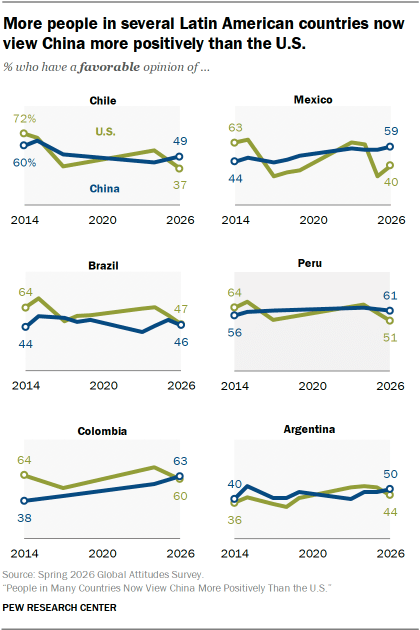
As the geopolitical landscape enters a period of profound recalibration, a comprehensive new study from the Pew Research Center has revealed a striking trend: the traditional dominance of the United States in Latin American public opinion is waning. Across six major nations in the region, the once-unassailable perception of the U.S. as the primary moral and political touchstone is being challenged by a rising, more favorably viewed China.
The data, collected between February and May 2026, paints a complex portrait of a region caught between two superpowers. For policymakers in Washington, the findings serve as a stark warning that the “Shield of the Americas” doctrine and other diplomatic efforts are struggling to gain traction among the very populations they aim to influence.
Main Facts: The New Geopolitical Equilibrium
The survey, which encompassed over 6,000 respondents across Argentina, Brazil, Chile, Colombia, Mexico, and Peru, highlights a dramatic departure from the status quo of the early 2010s. In four of these six nations—Argentina, Chile, Mexico, and Peru—China is now viewed more favorably than the United States. In Brazil and Colombia, the two superpowers are essentially neck-and-neck in the court of public opinion.
This represents a generational shift in sentiment. As recently as 2014, the United States maintained a commanding lead in regional favorability across nearly every nation surveyed. Today, however, that lead has evaporated, replaced by a climate of skepticism toward U.S. foreign policy and a growing, albeit cautious, openness to Chinese economic and political engagement.
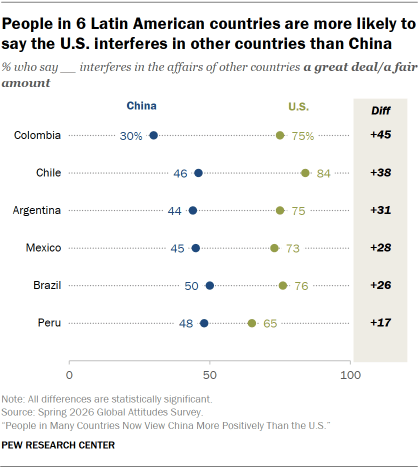
Perhaps most damning for Washington is the widespread perception of interference. In every country surveyed, large majorities characterize U.S. foreign policy as interventionist, with significantly fewer respondents applying the same critique to Beijing. This perception persists despite China’s aggressive expansion of trade and infrastructure projects throughout the continent, suggesting that for many Latin Americans, the U.S. "footprint" is viewed as a more direct challenge to national sovereignty.

A Chronology of Declining Influence
To understand how the current sentiment crystallized, one must look at the historical trajectory of U.S.-Latin American relations over the last decade.
2014–2017: The Widening Gap
In the mid-2010s, the U.S. enjoyed a significant "freedom premium." Across the region, the U.S. government was widely perceived as a champion of personal liberties, a perception that stood in stark contrast to the opaque governance model of China. Even in countries with left-leaning governments, the U.S. remained the preferred partner for trade and security.
2018–2023: The Erosion of Trust
The late 2010s saw the beginning of a steady decline in U.S. favorability. As the U.S. adopted more isolationist or nationalist rhetoric, the perceived reliability of Washington as a partner began to falter. During this period, China began to aggressively position itself as a "neutral" economic partner, investing heavily in South American mining, telecommunications, and energy sectors. By 2023, data began to show that while the U.S. remained a known entity, it was increasingly viewed as an unreliable one.
2026: The Inflection Point
The current year marks a critical juncture. The "Shield of the Americas" summit in March 2026 served as a flashpoint. President Donald Trump’s declaration that the U.S. would not permit "hostile foreign influence" in the hemisphere—a thinly veiled reference to Beijing—appears to have backfired in terms of public perception. Rather than rallying the region behind a common front, the rhetoric intensified discussions about sovereignty and the cost of choosing sides.
Supporting Data: By the Numbers
The Pew research provides granular insight into the demographic and ideological divides fueling these shifts.
The Ideological Split
In Brazil and Colombia, the view of the superpowers is deeply polarized along political lines. In Brazil, respondents on the ideological right are nearly twice as likely to hold a positive view of the U.S. (58%) compared to those on the left (30%). Conversely, those on the left are significantly more likely to view China favorably. This suggests that in some nations, the "U.S. vs. China" debate has been absorbed into domestic culture wars, turning foreign policy into a domestic political wedge issue.
The Youth Factor
Age is perhaps the most significant predictor of future sentiment. Younger adults (ages 18–34) are markedly more open to both superpowers than their elders. In Mexico, for instance, a staggering 70% of young adults view China positively. This suggests that as these cohorts age into positions of political and economic influence, the traditional U.S. alliance structure may face even greater challenges.
Confidence in Leadership
Perhaps the most sobering statistic for both Washington and Beijing is the lack of confidence in their respective leaders. In none of the six countries does either President Trump or President Xi Jinping garner a majority-confident rating. However, the distribution of that lack of confidence is telling: in Mexico, residents are three times more likely to trust Xi than Trump. In contrast, Colombians—historically one of the strongest U.S. allies in the region—still lean toward trusting the U.S. leadership, though by a slim margin.
Official Responses and Diplomatic Fallout
The reaction from the diplomatic community has been swift. Following the March 2026 summit, China’s foreign ministry issued a strongly worded statement, framing U.S. policy in Latin America as "relics of the Monroe Doctrine" and "an attempt to force sovereign nations into an outdated Cold War binary."
Washington, meanwhile, has doubled down on the argument that its engagement is based on "shared values," particularly regarding human rights and personal freedoms. However, the Pew data suggests this narrative is losing potency. While the U.S. still holds an advantage when it comes to the perception of respecting personal freedoms, the gap has shrunk considerably since 2018. In some nations, the U.S. advantage in this category is no longer statistically significant, as residents increasingly view the U.S. as a nation suffering from its own internal democratic volatility.
Implications: A Region at a Crossroads
The implications of this survey are profound for the future of global power dynamics.
The End of Hegemony
For decades, the U.S. operated under the assumption of "geographic entitlement"—the belief that Latin America was a natural, permanent sphere of influence. This survey suggests that era is effectively over. Latin American nations are increasingly adopting a pragmatic, "à la carte" approach to foreign policy, balancing the security ties they maintain with the U.S. against the economic necessities provided by China.
The Challenge of "Reliability"
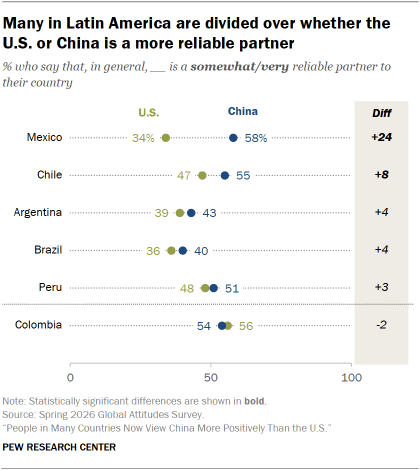
The most significant finding may be the question of who is the "more reliable partner." The lack of a clear consensus across the six countries suggests that the U.S. is no longer the default choice. If Washington cannot convince its neighbors that it is a consistent, non-interventionist, and reliable partner, it risks being sidelined in favor of an economic relationship with Beijing that, for many, feels less intrusive.
Strategic Adjustments
The U.S. government now faces a dilemma. If it continues to frame its presence in Latin America through the lens of "anti-China" security initiatives, it risks alienating populations that prioritize economic development and national autonomy. To regain lost ground, Washington may need to pivot away from high-level, summit-based rhetoric and toward a more sustained, grassroots-level investment in regional infrastructure and economic integration.
In conclusion, the 2026 Pew Research Center survey does not necessarily indicate an anti-American shift, but rather a move toward a more multipolar mindset. Latin American citizens are looking for partners who will treat them as equals rather than pawns in a superpower struggle. As the world moves further into the 21st century, the ability of the U.S. to adapt to this new, more skeptical regional reality will be a defining test of its global influence.
The data is clear: the "backyard" is no longer a monolith, and the influence that was once taken for granted must now be earned.
 Pevita Pearce
  Neng Nana