
 By Pevita Pearce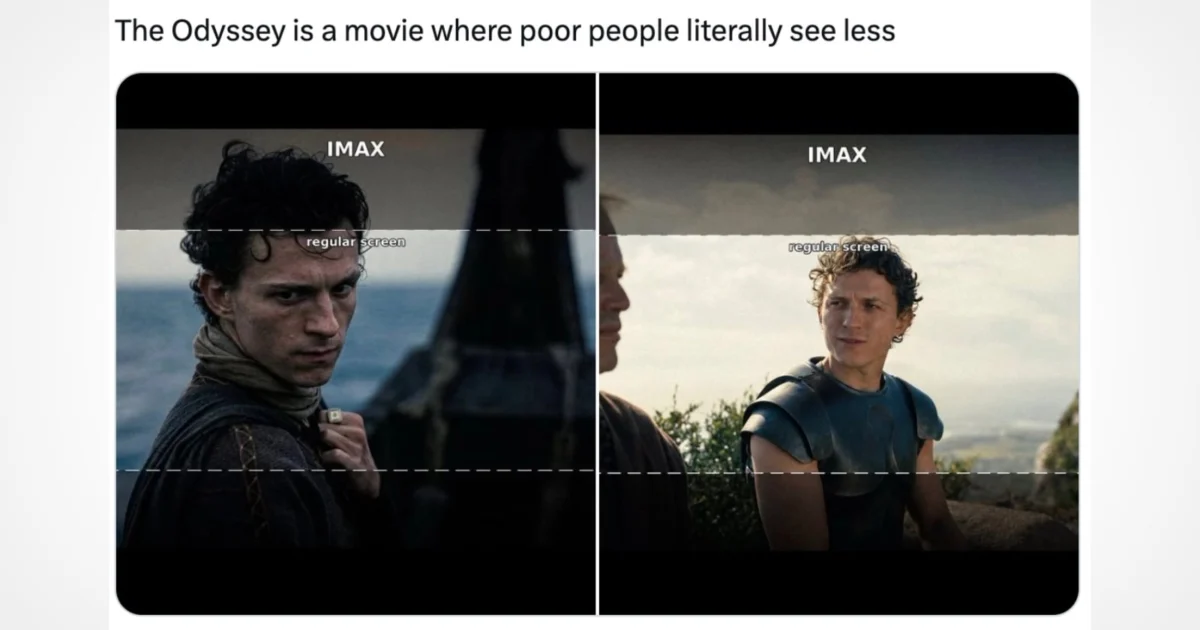
The release of Christopher Nolan’s latest magnum opus, The Odyssey, was intended to be a celebration of the pinnacle of celluloid filmmaking. Instead, it has ignited a fierce, global debate regarding accessibility, elitism, and the widening chasm between the “cinematic haves” and “have-nots.” By shooting the entire feature on IMAX 70mm film—a format so rare that only 41 theaters worldwide possess the specialized projectors to display it in its full glory—Nolan has inadvertently turned the movie-going experience into a flashpoint for social and economic grievances.
As Gen Z audiences take to social media to voice their frustrations, the discourse has moved beyond simple film criticism. It has become a critique of a medium that, in its pursuit of “purity,” is accused of leaving the vast majority of its audience behind.
The Pursuit of Perfection: A Technological Milestone
Christopher Nolan has long been the industry’s most vocal champion of large-format film. With The Odyssey, he has pushed the boundaries of the medium further than ever before. For the first time in Hollywood history, a major feature was captured entirely using IMAX 70mm cameras.
The format is, by all technical accounts, a marvel. It offers an aspect ratio of 1.43:1, providing a vertical field of view that is significantly taller than the standard widescreen format used in most modern multiplexes. When projected, it delivers unparalleled resolution, depth, and color fidelity. Throughout the film’s press tour, stars Matt Damon and Anne Hathaway have echoed Nolan’s insistence that The Odyssey is not merely a movie, but an “event” that demands to be seen in the specific format for which it was engineered.
However, this uncompromising vision has collided with the harsh reality of modern infrastructure.
Chronology of a Viral Backlash
The controversy began to simmer shortly after the film’s press junket, but it reached a boiling point in mid-July 2026.
- June 2026: The marketing campaign for The Odyssey centers heavily on the “IMAX 70mm experience,” with a dedicated website allowing users to compare formats.
- Early July 2026: Reports surface of tickets for 70mm screenings being scalped on secondary markets like eBay for as much as $1,500, signaling a massive supply-demand imbalance.
- July 14, 2026: The Twitter account @TheCineprism posts a viral critique: "Only 40 cinemas on EARTH could show what NOLAN actually filmed," highlighting the geographic exclusivity of the experience.
- July 15, 2026: User @arkavx shares a viral comparison meme depicting the "regular" vs. "IMAX" image, with the caption: "The Odyssey is a movie where poor people literally see less." The post garners over 26 million views, cementing the narrative of an economic divide.
- July 17, 2026: Social media sentiment shifts from aesthetic disappointment to systemic criticism, with users labeling the release strategy "anti-art" and "elitist."
The Anatomy of the “Visual Gap”
The core of the frustration lies in the physical loss of information. When a 1.43:1 IMAX frame is adapted for a standard cinema screen (usually 2.39:1), a significant portion of the image is essentially discarded or cropped.
For the average moviegoer, the difference is stark. In a standard theater, the frame feels claustrophobic compared to the immersive, panoramic experience promised by the promotional materials. This "lost detail" is exactly what has fueled the viral comparisons online. Audiences are now hyper-aware that they are paying full ticket prices for what they perceive to be an "incomplete" version of the film.
This is particularly acute in regions like the Southern Hemisphere, where IMAX Melbourne stands as the sole beacon of the 70mm experience. For millions of viewers, geography is no longer just a hurdle; it is an insurmountable wall preventing them from seeing the film as the director intended.
The Economic and Geographic Divide
The debate has taken on a distinctly class-based dimension. Critics argue that the prestige of 70mm film has transformed a communal art form into a luxury good. Because these specialized projectors are concentrated in major metropolitan hubs or affluent districts, lower-income viewers and those living in rural areas are effectively barred from the "premium" experience.
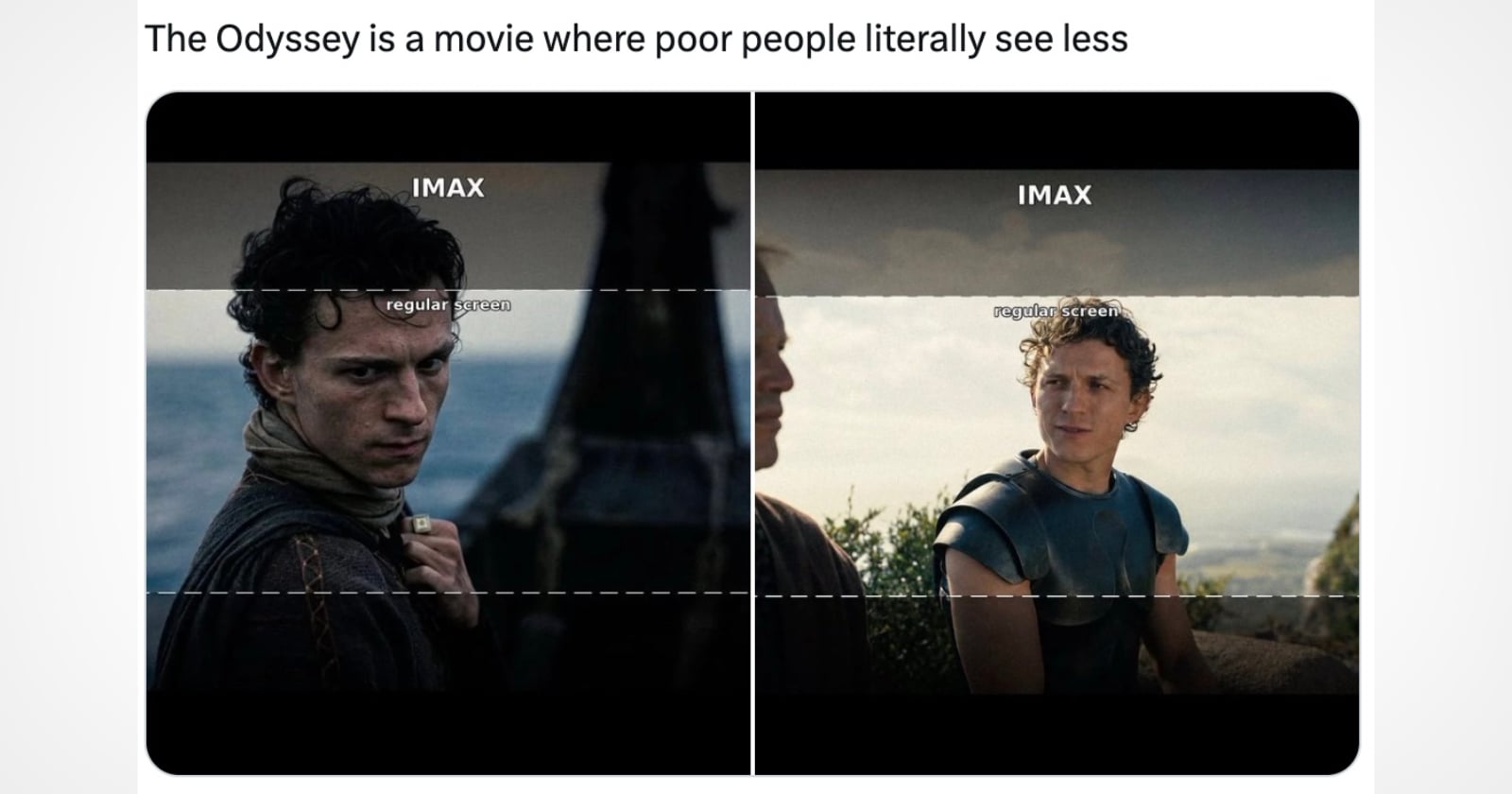
"The Odyssey is a movie where poor people literally see less," wrote user @arkavx. While intended as hyperbole, the statement resonates with a generation that is increasingly sensitive to the ways in which luxury experiences are gated by wealth and geography. The sentiment among the online community is that by prioritizing a niche, high-cost format, Nolan has alienated the very public that keeps the cinema industry alive.
The Industry Perspective: Why More Screens Aren’t Coming
In response to the growing outcry, industry leaders have attempted to clarify the logistical nightmare of scaling 70mm projection. Richard Gelfond, CEO of IMAX, recently spoke with Variety to address the limitations.
“There’s certainly more demand,” Gelfond noted. “The problem is they haven’t made new IMAX film projectors in about 50 years. So we retrofit them, rebuild them and part of our strategy is to see how far we can take it. But certainly, demand-driven, I’d like to see more.”
The "analog" nature of the format is its greatest strength and its primary weakness. These projectors are not digital plug-and-play devices; they are mechanical beasts that require expert technicians to operate. They are relics of a bygone era of cinema, and the specialized parts and labor required to maintain them mean that increasing the number of screens is a multi-year, if not decade-long, endeavor—not a decision that can be made in response to a viral social media trend.
Implications for the Future of Cinema
The backlash to The Odyssey raises fundamental questions about the future of filmmaking. If a director of Nolan’s stature continues to push for formats that are inaccessible to 99% of the population, are they creating a new standard for excellence, or are they inadvertently signaling the death of the "shared" cinematic experience?
1. The Death of the "Universal" Film
Historically, a movie was a movie, regardless of the theater. Today, the "format" has become a tier of status. We are seeing a move toward a stratified cinema experience, where the "true" film is only available to those who have the time, money, and proximity to reach a specialty theater.
2. The Backlash Against "Prestige"
There is a growing resentment toward the idea that technical specifications define artistic quality. By tying the legitimacy of the experience so closely to the hardware (IMAX 70mm), the studio has invited a critique of the hardware itself. If the format is inaccessible, the art is perceived as exclusionary.
3. The Digital Pivot
While Gelfond and Nolan are committed to the magic of film, the sheer scale of the backlash may force studios to reconsider their distribution strategies. If the "prestige" of a film is tied to a format that no one can access, it risks alienating the audience rather than inviting them in. Future blockbusters may favor high-end digital formats (like IMAX Laser) that offer a more consistent, scalable experience, even if they lack the "analog" pedigree of 70mm.
Conclusion: The Price of Vision
Christopher Nolan’s dedication to his craft is undisputed. He remains one of the few directors with the leverage to demand such high technical standards. However, The Odyssey serves as a cautionary tale for an industry balancing the desire for technical perfection with the realities of global access.
As the dust settles, the debate leaves us with an uncomfortable realization: in an era of global connectivity, the most "immersive" experiences are becoming increasingly exclusive. Whether this will lead to a renaissance of theater infrastructure or a retreat into more accessible digital formats remains to be seen. For now, The Odyssey remains a beautiful, towering achievement—one that many are being told is essential, yet most will never truly be able to see.
 Raul Delapena Setiawan
  rifanmuazin
  Ammar Sabilarrohman