
 By Sagoh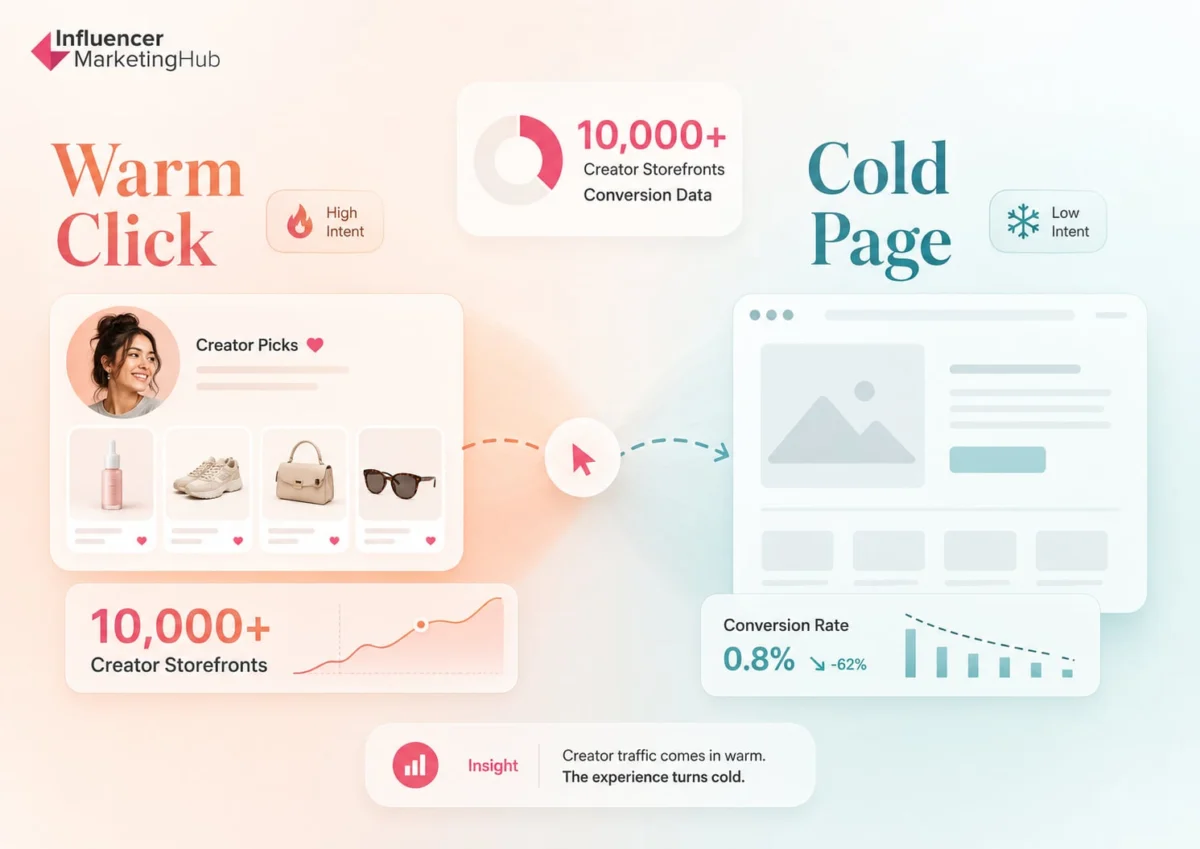
In the high-stakes world of influencer marketing, brands are obsessively auditing their roster. They spend millions analyzing engagement rates, vetting creator demographics, and negotiating complex commission structures. Yet, despite these efforts, many marketing directors are left staring at stagnating conversion rates.
According to recent industry analysis, the culprit is rarely the creator’s ability to influence, nor the competitiveness of the discount code. Instead, the problem is structural: the "warm click" generated by a creator is hitting a "cold" digital wall the moment it reaches the brand’s website. This phenomenon, dubbed the "Warm Click, Cold Page" problem, is responsible for massive revenue leakage, with some brands seeing conversion rate lifts of 30%, 40%, and in some cases, as high as 214%, simply by changing where that traffic lands.
The Anatomy of the Conversion Gap
The influencer marketing funnel is predicated on trust. A creator spends months or years building a relationship with their audience, curating a specific context—whether it be skincare, high-performance athletics, or culinary arts. When that creator makes a recommendation, the audience clicks with a pre-existing sense of affinity and intent. The click is "warm."
However, the industry standard for handling that click is fundamentally flawed. In most affiliate programs, the traffic is routed to the brand’s generic homepage, a standard product page, or a one-size-fits-all discount landing page. This page is functionally "cold." It has no memory of the creator who sent the traffic, no acknowledgment of the context that drove the click, and no continuity of the relationship.
For the consumer, the transition is jarring. They move from an intimate, personalized recommendation to a sterile, transactional storefront that treats them as if they arrived from a generic Google search. When the creator’s identity and context vanish the moment the page loads, the trust—and the conversion—often vanishes with it.
Chronology of a Failed Handoff
To understand why this is happening, one must look at the evolution of e-commerce infrastructure.
Phase 1: The Affiliate Era
In the early days of influencer marketing, brands treated creators like traditional banner ads. The focus was on "tracking" rather than "experience." Affiliate links were designed primarily to ensure the brand knew which creator to pay. The landing experience was an afterthought, largely because the infrastructure didn’t exist to personalize the destination without significant manual engineering.
Phase 2: The Scale Challenge
As influencer programs grew from five creators to 500, the "manual" approach became impossible. Brands defaulted to their existing web infrastructure. If a brand had 1,000 creators, they couldn’t feasibly create 1,000 custom landing pages. Consequently, the "cold handoff" became the industry default.
![What Conversion Data From 10,000+ Creator Storefronts Reveals [Warm Click, Cold Page Problem]](https://influencermarketinghub.com/wp-content/uploads/2026/07/5a619d4d-chatgpt-image-jul-3-2026-12_33_04-pm.jpg)
Phase 3: The Era of Contextual Commerce
Over the past 18 months, data has begun to reveal the cost of this convenience. As the market reaches maturity, the "easy wins" of simple influencer awareness have evaporated. Brands are now finding that the only way to squeeze more ROI from the same creator spend is to optimize the "last mile" of the customer journey. We are currently witnessing a shift toward "Creator-Led Storefronts," where the landing experience is as curated as the creator’s content.
Data-Driven Evidence: The ROI of Continuity
The evidence supporting a shift toward creator-specific landing pages is overwhelming. Four brands across distinct sectors provide a blueprint for what happens when the "Cold Page" problem is solved.
1. The 214% Lift: Cozy Earth
Cozy Earth serves as the primary case study for the power of the creator page. By moving traffic from standard affiliate links to dedicated, co-branded creator storefronts on their own domain, they observed an average conversion rate lift of 214%. Even more impressive, the Average Order Value (AOV) rose by 67%. The takeaway is clear: when the landing experience matches the creator’s editorial voice, the consumer is more inclined to spend.
2. The Healf Benchmark
UK-based health and wellness marketplace Healf, which manages over 1,700 creator partnerships, reports a 40.8% conversion rate on creator-referred traffic. This figure significantly outperforms the standard e-commerce baseline for the health category. According to their affiliate team, the ability to offer creators a page they are proud to share—one that reflects their personal brand—has become a competitive advantage in recruiting top-tier talent.
3. Beauty and Aesthetics: Buttah Skin
Buttah Skin transitioned from standard product pages to dedicated creator-led landing pages. The result was a 30% increase in conversion and a 78% jump in AOV. By allowing creators to curate their specific "must-haves" in a branded environment, the brand effectively turned the landing page into an extension of the influencer’s content.
4. The Electro Phenomenon
Electrolyte gum brand Electro reports that 81% of their total e-commerce revenue now originates from creator-led storefronts. Crucially, this was achieved without increasing their total spend on creator fees; the revenue growth was entirely driven by optimizing the destination of the traffic.
The Mechanics of a High-Converting Page
What differentiates a page that converts from one that plateaus? Two core patterns have emerged:
Curation Depth vs. Catalog Breadth
The "more is better" philosophy fails when it comes to creator landing pages. Pages that present a curated selection of 6–15 products consistently outperform those that display the full brand catalog. The shopper has already been sold on the creator’s taste; the landing page’s role is to confirm that choice, not to re-introduce the burden of choice. A focused, curated list allows the customer to maintain their momentum through the checkout process.
![What Conversion Data From 10,000+ Creator Storefronts Reveals [Warm Click, Cold Page Problem]](https://s.influencermarketinghub.com/imaginary/convert?type=webp&url=https://influencermarketinghub.com/wp-content/uploads/2026/07/d15fc009-image3-1024x490.jpg)
Trust Continuity
The creator’s visual and tonal identity must remain visible through the entire checkout process. If the creator disappears once the "Add to Cart" button is pressed, the psychological "warmth" of the click dissipates. The most successful brands ensure that the creator’s name, image, and voice are present on the landing page, bridging the gap between the influencer’s content and the brand’s checkout.
Implementing the 30-Day Test
For marketing teams looking to pivot, a full-scale rebuild is unnecessary. A diagnostic 30-day test can provide the data necessary to justify the infrastructure shift.
The Methodology:
- Select 5–10 active creators: Choose a mix of high and mid-tier performers.
- Build Creator-Specific Pages: Use a landing page builder to create destinations that feature the creator’s branding, their curated product list, and a seamless checkout experience.
- A/B Test: Keep all other variables constant. Compare the traffic from these pages against the historical conversion data of generic affiliate links.
The Success Metrics:
- Conversion Rate (CVR): Expect a 20–30% lift in the first month. If it fails to meet this, the page is likely still acting as a generic catalog rather than a personalized store.
- Average Order Value (AOV): If AOV remains flat despite a conversion lift, it indicates a lack of "editorial layer." Ensure the creator is describing why they chose each product.
- 30-Day Repeat Rate: This is the ultimate metric of audience fit. If the repeat rate underperforms, the creator’s audience may not be the right fit for the product, regardless of the landing page quality.
Implications for the Future of Creator Commerce
The "Warm Click, Cold Page" problem is a byproduct of the rapid, chaotic growth of the creator economy. As the industry matures, the brands that win will be those that view the landing page not as an IT requirement, but as a critical component of the creator relationship.
For large-scale programs with hundreds of creators, the challenge is operational. How do you build 500+ unique, high-performing pages without an army of developers? The emergence of specialized creator-commerce infrastructure and "landing page agencies" suggests that the industry is moving toward a model where high-fidelity, personalized storefronts are the standard, not the exception.
Brands that continue to route creator traffic to a generic homepage are essentially burning the bridge they’ve paid to build. In an era where customer acquisition costs are rising, the most cost-effective marketing strategy is no longer about finding more creators—it’s about ensuring that the creators you already have are finishing the job they started. The data is clear: the path to higher conversion isn’t found in better influencers; it’s found in better destinations.
 Iffa Jayyana
  Siti Muinah
  Asro
Asro 