
 By Lina Irawan
The digital landscape for local businesses is undergoing a seismic shift. For years, the "Local SEO playbook" relied on a predictable set of variables: consistent NAP (Name, Address, Phone) citations, a steady stream of reviews, and a well-optimized Google Business Profile (GBP). However, the rise of generative AI and conversational search is rewriting the rules of engagement. Today, local SEO is no longer just about "ranking"; it is about providing the precise, authoritative, and conversational answers that AI models—and human searchers—crave.
To cut through the industry noise, we sat down with Bill Ross, a 20-year SEO veteran and strategist for some of the world’s most recognizable global brands. His insights reveal a stark reality: the era of cutting corners is over. Google’s algorithms are increasingly punishing businesses that ignore the fundamentals while rewarding those that prioritize real-world conversions over hollow vanity metrics.
The Core Philosophy: Back to Basics
For a business just launching its digital presence, the temptation to chase "hacks" is high. Ross advises against this. "It’s not always difficult to do, but it is time-consuming," he notes. "Knowing what not to do is often more important than knowing what to do."
Before a business can compete for high-intent local keywords, it must build a foundation of trust. This means ensuring your business information is accurate across all aggregators and that your website serves as a genuine hub of utility rather than a billboard of sales jargon.
Strategic Citation Management
When resources are limited, businesses often fall into the trap of trying to be everywhere at once. Ross emphasizes a strategic approach to citations:
- The Baseline: Utilize automated tools like Moz Local to handle the "boilerplate" citations that establish your existence in the digital ecosystem.
- The Strategic Tier: Beyond the basics, choose citations based on geographic and industry relevance. A niche directory for local contractors or a regional chamber of commerce link carries more weight than a generic listing on an irrelevant site.
Link Building and the Art of the Pitch
Link building in a local context is often misunderstood. It is not about quantity; it is about geographic and thematic authority.
"The key is getting on sites that are about or located in your geographic area," Ross explains. He highlights local news outlets, television station websites, and regional publications as the gold standard. But how does a small business get featured in these outlets?
The answer lies in the pitch. "A lot of businesses think they’re unique," says Ross. "But what you really want to think about is the angle you’re taking on a problem."
If your pitch isn’t genuinely newsworthy, don’t waste time on $99 press release services that provide no tangible SEO value. If your story isn’t worth an interview or a feature, the problem isn’t your marketing—it’s your market positioning.

Measuring What Matters: Conversions Over Clicks
Perhaps the most significant transition in modern SEO is the move away from vanity metrics. Rankings, traffic, and "likes" are directional, but they do not pay the bills.
The Hierarchy of Metrics
- Conversion Metrics: These are the primary indicators of success. Are users submitting lead forms? Are they calling the phone number on your GBP? Are they booking appointments?
- Engagement Data: Google Business Profile analytics are a goldmine that many business owners ignore. By scrolling through the analytics, one can identify the exact keywords that triggered a business to appear in a user’s feed.
- Brand-Building Metrics: These are long-term indicators that show your content is resonating with your local audience.
"Focus on the data directly from your Google Business Profile," Ross urges. "It can provide basic data such as calls from someone clicking your phone number, bookings, and website clicks. That is the heartbeat of your local performance."
The "Invisible" Mistakes That Erode Rankings
One of the most profound insights from our discussion is that local SEO is largely impacted by factors outside of the search engine interface.
"One of the biggest mistakes is not what most would consider a traditional SEO focus: the experience you provide and consistency across all customer touchpoints," Ross says. If a user clicks through from a high-ranking search result to a poorly designed website, or if the tone of your website doesn’t match the reality of your in-store customer service, they will bounce.
High bounce rates and low click-throughs from search results signal to Google that the user didn’t find what they wanted. Consequently, the search engine stops recommending you. Your "SEO" isn’t failing; your business operations are.
Navigating the AI-Driven Search Revolution
The most pressing question for any business owner today is how AI will change the search experience. Ross believes the shift is toward a more conversational paradigm.
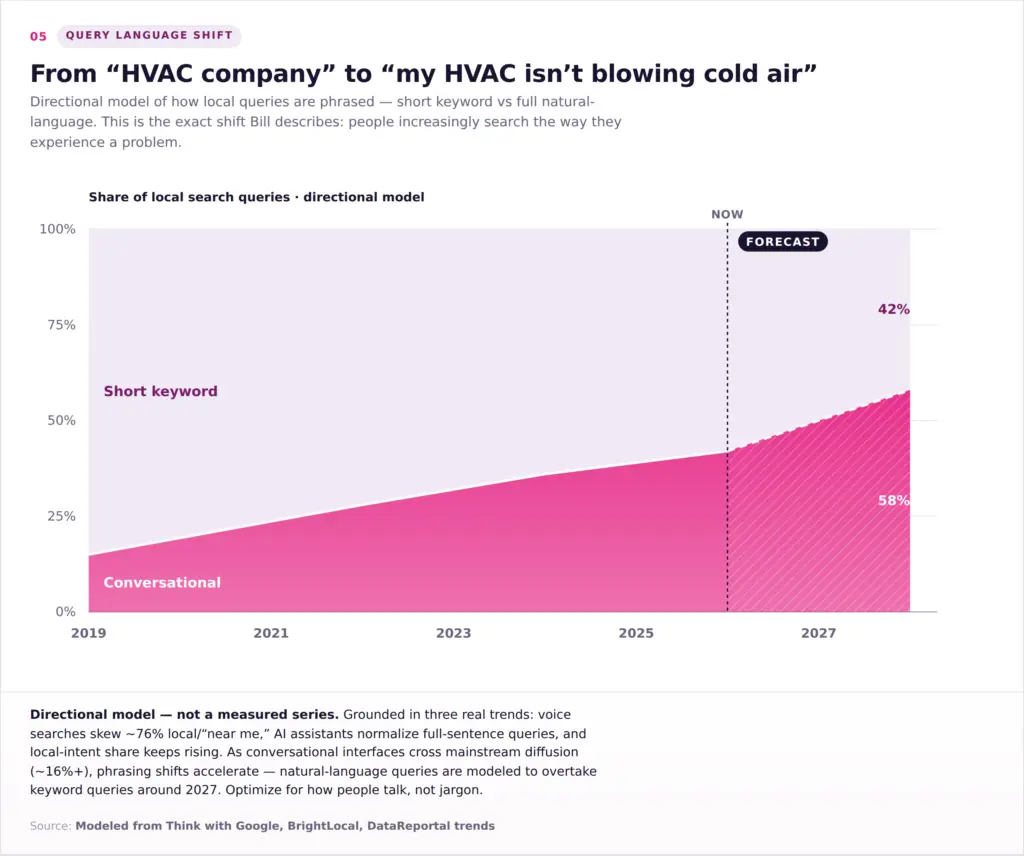
"Fewer people will search ‘HVAC company,’ and more will search the way they experience the real world," he predicts. A user is more likely to ask an AI tool, "My HVAC system is making a clicking noise and it’s hot upstairs but cool downstairs," rather than searching for a generic company name.
Implications for Strategy
- Optimize for Natural Language: Your content must answer the problem, not just the service. Stop targeting technical industry jargon that normal customers don’t use.
- AI as a Feed: AI models compile information from existing search engine results. By providing the best, most direct answers to common customer problems on your website, you are effectively "feeding" the AI and positioning your brand as the expert source.
- The End of the "Map Pack" Dominance? While the map pack remains a staple, the integration of AI overviews means that businesses must be more descriptive in their local content.
Review Management: The Social Proof Engine
Reviews are not just for customer feedback; they are a critical ranking factor. However, collecting generic reviews like "great job" provides little value to both the consumer and the search algorithm.
"Good review management means two things," Ross says. "First, you must actively encourage your customers to be specific about the problem they had and the solution you provided. Second, you must engage with every single review—positive or negative."
When a business responds to a review, it signals to Google that they are an active, attentive operation. It also provides an opportunity to insert local keywords naturally into the conversation.
Scaling to New Markets: The "Proof First" Approach
Many businesses are eager to expand their service areas, but they often attempt to "trick" the algorithm by creating dozens of landing pages for cities where they don’t actually operate.
Ross warns against this: "You can target additional markets once you have proof that you actually do work in them. You have to do the work and prove it before you start targeting the area."
Google is increasingly adept at identifying "service area" fraud. If your website claims you serve five cities but all your reviews, project photos, and local links originate from one, your site will eventually be penalized.
Conclusion: Agility as a Strategy
The final takeaway from our conversation is that there is no "silver bullet" in local SEO. The strategy must be fluid.
"We review data monthly and adjust quarterly," Ross explains. "The most important thing is to be agile because not everything works the same way for all businesses."
For businesses without the budget for an agency, the best approach is to maintain a simple, actionable checklist. Regularly update your Google Business Profile with fresh photos, solicit specific reviews, and write content that addresses the real-world problems your customers are facing.
As AI continues to redefine how we search, the brands that remain authentic, prioritize the customer experience, and provide direct, helpful answers will be the ones that thrive. The future of local SEO is not about outsmarting the algorithm; it’s about being the most helpful entity in your local community.
 Iffa Jayyana
  Siti Muinah
  Asro
Asro 