
 By Ammar Sabilarrohman
Main Facts: The Modern Compliance Landscape
In the contemporary digital ecosystem, social media platforms have transcended their origins as casual spaces for connection to become critical infrastructure for public communication, citizen engagement, and brand outreach. However, for organizations operating in regulated sectors—such as government agencies, financial institutions, healthcare providers, and educational entities—this digital footprint brings profound legal accountability.
Social media archiving is no longer a peripheral IT task; it is a foundational risk management strategy. Defined as the systematic process of capturing, preserving, and storing all social media content in a secure, legally defensible format, archiving encompasses much more than static snapshots. It covers posts, comments, direct messages, multimedia files, edits, deletions, hidden interactions, and the complex metadata that verifies their authenticity.
Public-sector organizations face strict mandates under the Freedom of Information Act (FOIA) and state open records laws, which treat official social media forums as public property. Simultaneously, financial institutions must adhere to SEC Rule 17a-4 and FINRA regulations, healthcare providers are bound by the HIPAA Privacy Rule, and educational bodies must comply with FERPA. Without automated, real-time archiving solutions, institutions face severe regulatory penalties, failed audits, vulnerability in eDiscovery, and an inability to defend against First Amendment or off-channel communication challenges.
Chronology: The Evolution of Social Media Regulations and Enforcement
The intersection of social media and regulatory compliance has evolved rapidly over the past two decades, transitioning from a misunderstood "wild west" to a heavily policed corporate and government environment.
- Early 2000s: Social media emerges as a mainstream marketing and communication tool. Initial regulatory frameworks focus primarily on email and traditional electronic records, leaving social channels largely unmonitored.
- Late 2000s to Early 2010s: Regulatory bodies begin recognizing social channels as official communication conduits. The SEC and FINRA issue formal guidance clarifying that business communications conducted via social media are subject to the same retention rules as traditional correspondence.
- Mid-2010s: Landmark court rulings and administrative decisions establish that government social media pages function as public forums. Consequently, the deletion of critical or controversial comments by public officials triggers First Amendment challenges, emphasizing the urgent need for comprehensive record retention.
- Late 2010s to 2020s: Global privacy regulations, including the European Union’s GDPR and regional data residency mandates (such as Australia’s strict local hosting requirements and British Columbia’s public sector guidelines), complicate cross-border data collection and storage.
- The 2020s Surge (Present Day): Regulatory scrutiny intensifies dramatically. Financial watchdogs crack down on "off-channel communications" on consumer messaging apps and social platforms, resulting in multi-million-dollar settlements against major firms. Simultaneously, FOIA appeals surge—witnessing a 59% jump by fiscal year 2025—driving home the necessity for automated, real-time archival workflows.
Supporting Data and Regulatory Frameworks
Regulatory requirements differ significantly by industry, but the overarching principle remains uniform: preserve everything relevant, make it searchable, and maintain its integrity.
| Industry | Key Regulation | Governing Body | What Must Be Archived | Typical Retention Period |
|---|---|---|---|---|
| Government | FOIA, State Open Records Laws | NARA, State Archives | Posts, comments, DMs, edits, deletions, metadata | Varies by jurisdiction (frequently permanent) |
| Finance | SEC Rule 17a-4, FINRA Rules 3110/2210 | SEC, FINRA | All business communications, social posts, DMs, promos | Minimum 3 years (6 years for specific categories) |
| Healthcare | HIPAA Privacy Rule | HHS Office for Civil Rights | Any content containing or referencing PHI | 6 years from creation or date last in effect |
| Education | FERPA | U.S. Department of Education | Social communications concerning students as education records | Duration of enrollment + defined institutional policy period |
Government Agencies and FOIA Compliance
Federal, state, and municipal agencies utilize social channels to disseminate vital updates, foster community engagement, and field constituent inquiries. Because these platforms function as public forums, agencies are legally prohibited from arbitrarily blocking users or scrubbing critical feedback. Under FOIA and state equivalents, every comment—even those hidden or deleted by page administrators—must be preserved. Furthermore, when agencies face First Amendment challenges regarding content removal, an unblemished, legally defensible archive provides the necessary proof that moderation was executed under established, lawful acceptable-use policies.
Financial Institutions and SEC/FINRA Mandates
For financial services firms, the stakes are exceptionally high. SEC Rule 17a-4 and FINRA Rules 3110 and 2210 mandate the rigorous archiving of all business-related electronic communications. This includes static marketing content and interactive, real-time dialogues with third parties across social networks. Crucially, regulatory reach extends to employee personal accounts when utilized for business purposes. Recent enforcement actions targeting off-channel communications on unmonitored messaging platforms highlight the regulatory intolerance for compliance gaps.
Healthcare Providers and HIPAA
Healthcare organizations navigate a delicate balance between public engagement and patient privacy. Sharing Protected Health Information (PHI) on social media without explicit authorization violates HIPAA, carrying severe financial penalties—such as monetary fines reaching up to $2,190,294 for uncorrected violations driven by willful neglect. When patients initiate contact or disclose sensitive health details within public comments or direct messages, healthcare providers must archive the interaction to maintain regulatory compliance, even if the content is immediately removed to protect patient privacy.
Education and FERPA
Schools, colleges, and university athletic departments leveraging social media must remain vigilant regarding the Family Educational Rights and Privacy Act (FERPA). Any online communication that identifies a student or references academic performance, disciplinary records, or enrollment status is classified as part of that student’s educational record and must be retained and protected accordingly.
Official Responses and Strategic Implementations
As compliance demands tighten, organizations are moving away from manual archiving methods—such as sporadic screenshots and PDF exports—which fail to capture background metadata, cannot be authenticated in court, and inevitably miss deleted content. Instead, institutions are adopting automated, real-time archiving systems integrated directly into enterprise software ecosystems.
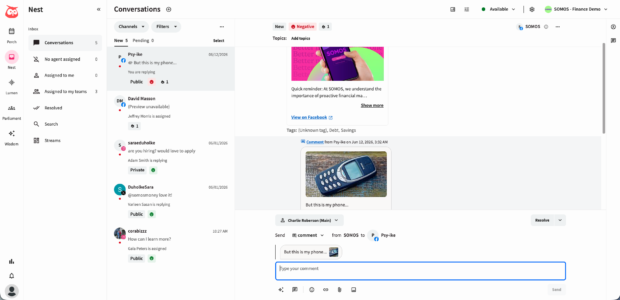
Industry leaders and software providers have responded by embedding compliance layers directly into workflow management tools. For instance, platforms like Hootsuite have achieved significant security milestones—such as FedRAMP authorization—making them trusted solutions for federal agencies managing sensitive citizen data. By integrating specialized archival applications like Brolly and Proofpoint, organizations can capture real-time social data, including edits, deletions, multimedia attachments, and deep context.
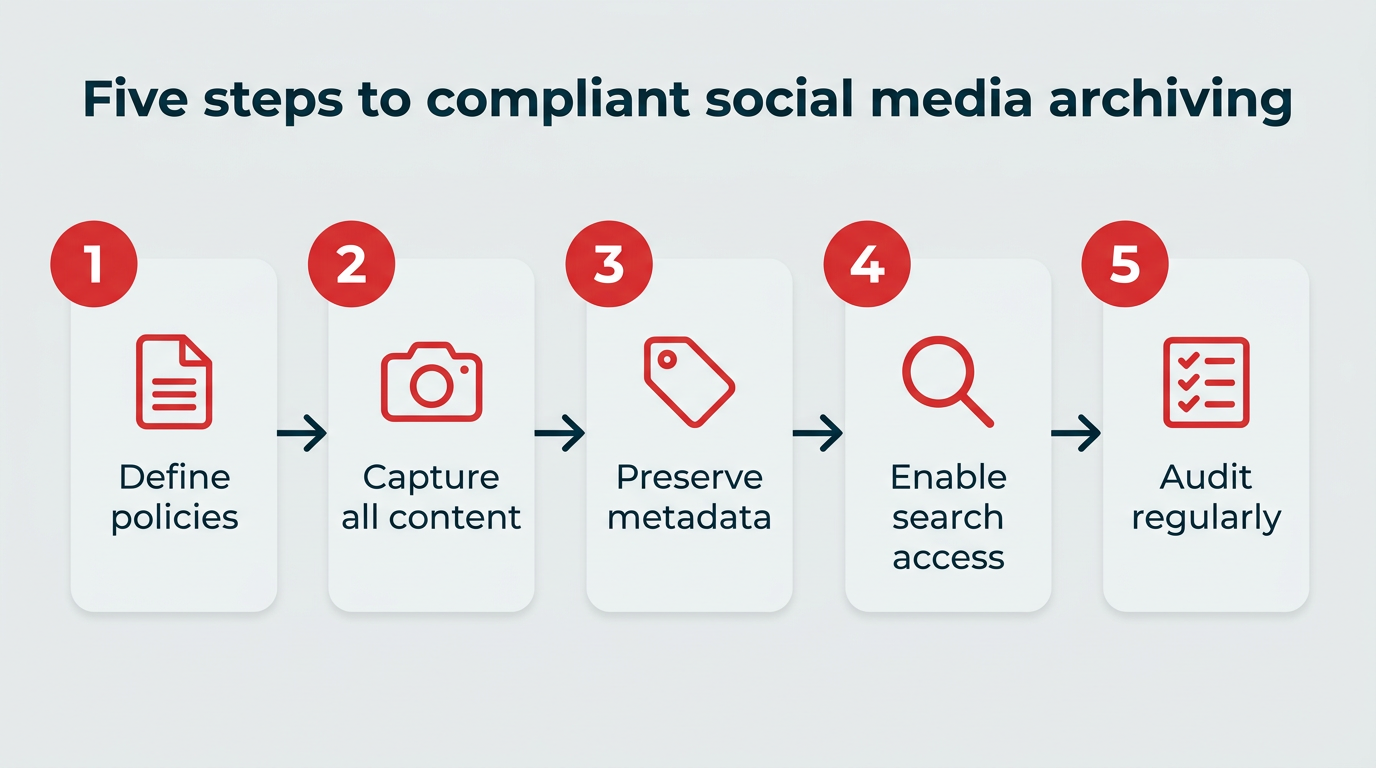
To implement a bulletproof archiving program, compliance and communications teams generally adhere to a five-step workflow:
- Define Archiving Policies and Procedures: Ground your recordkeeping in clear governance plans, accounting for regional data residency laws and account approval workflows.
- Capture and Preserve All Content: Deploy automated tools to secure posts, comments, direct messages, and tagged mentions before they can be altered or scrubbed.
- Incorporate Metadata and Context: Ensure timestamps, author IDs, device specs, and edit histories are logged to establish legal defensibility.
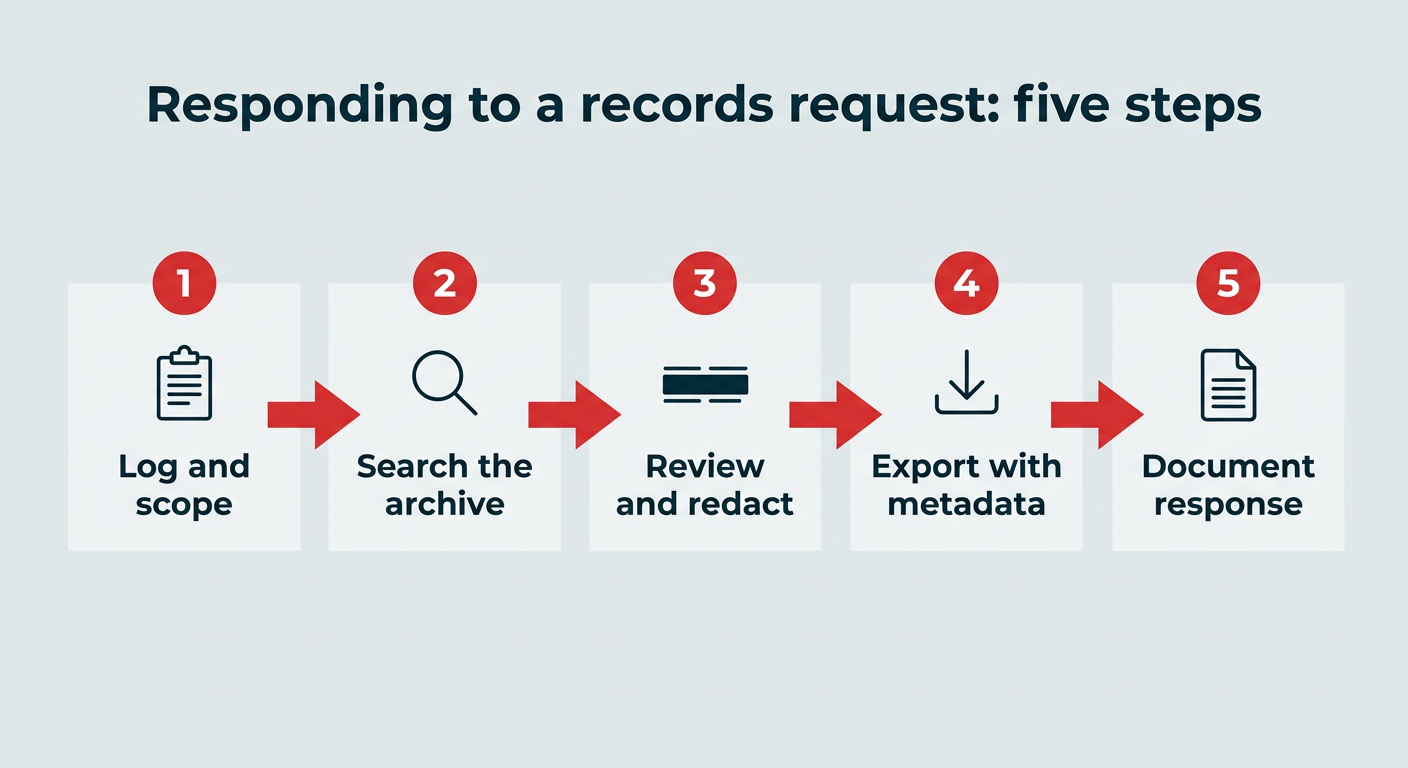
- Maintain Accessibility and Searchability: Utilize advanced search, tagging, and export capabilities to ensure rapid response times during eDiscovery or FOIA requests.
- Audit Regularly: Conduct quarterly reviews of archiving processes, platform API integrations, and staff training to adapt to evolving regulations.
Implications: The Risks of Non-Compliance and the Path Forward
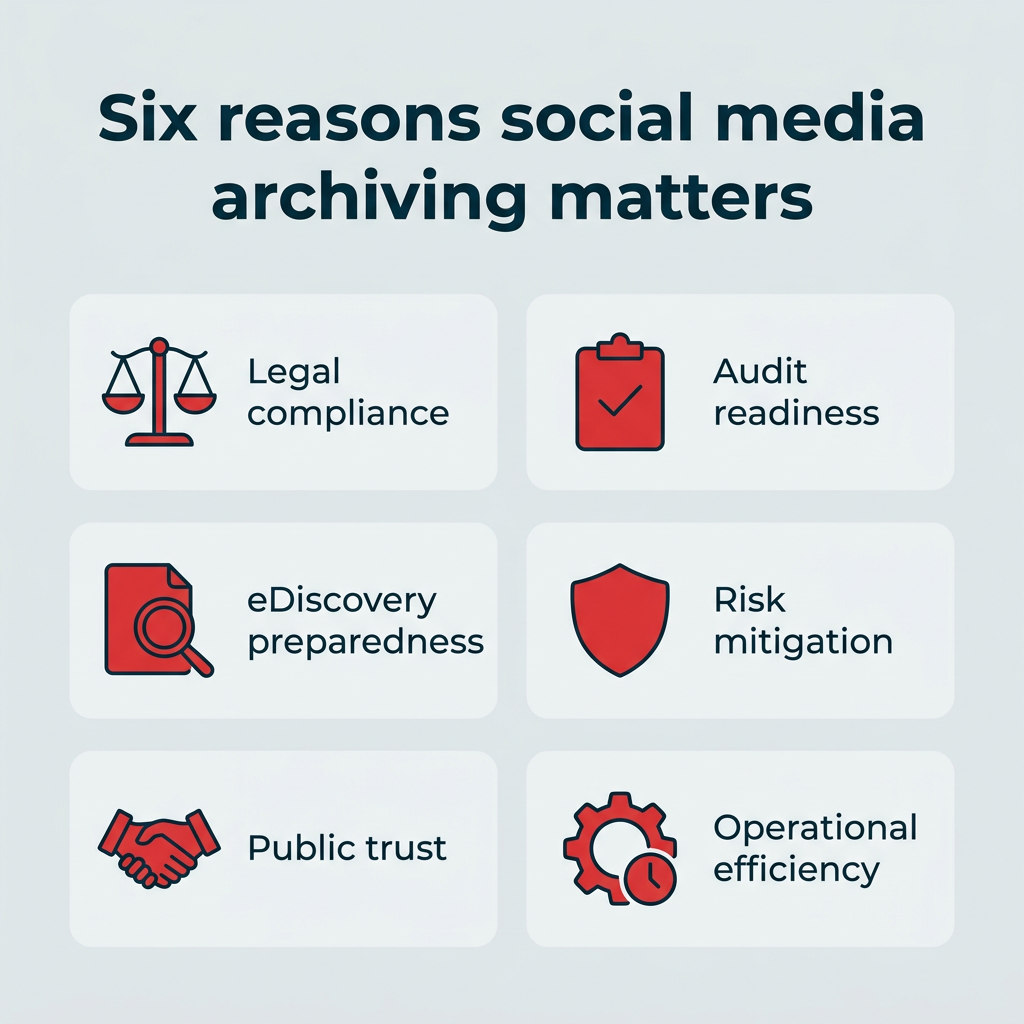
The consequences of failing to implement robust social media archiving extend far beyond administrative inconvenience. Organizations face a cascade of severe risks:
- Legal Exposure and Sanctions: Inability to produce requested records during litigation can lead to court sanctions, adverse inference rulings, and severe financial liabilities.
- Regulatory Fines: Non-compliance with SEC, FINRA, HIPAA, or FOIA mandates routinely results in substantial monetary penalties and intense regulatory scrutiny.
- Reputational Damage: The loss of public trust resulting from opaque governance, mishandled public records requests, or data privacy breaches can severely impair an institution’s credibility.
Ultimately, social media archiving is much more than a defensive shield against litigation; it is an active enabler of transparency and public trust. By shifting from reactive, manual record-keeping to automated, real-time compliance frameworks, modern institutions can safely leverage the power of social communication while remaining fully audit-ready.
 Asep Darmawan
  Muslim
  Nana
Nana 