
 By Layla Zulfa
As the United States observes Grandparents Day—celebrated annually on the first Sunday after Labor Day—the landscape of aging and family dynamics in the country is undergoing a profound transformation. Far from the traditional caricature of rocking chairs and occasional weekend visits, modern grandparenthood is defined by active caregiving, complex multi-generational households, frequent digital communication, and deep emotional bonds.
Recent data drawn from the U.S. Census Bureau’s Survey of Income and Program Participation (SIPP), the University of Michigan’s Health and Retirement Study (HRS), and comprehensive Pew Research Center surveys paint a detailed portrait of what it means to be a grandparent in contemporary America. This comprehensive analysis explores six defining facts about U.S. grandparents, charting the historical evolution of the role, examining hard demographic data, and looking at the broader societal implications of these multi-generational connections.
1. Main Facts: The Demographics of U.S. Grandparents
Grandparenthood is a nearly ubiquitous milestone for older Americans, yet the journey into the role spans several decades of life. According to data from the U.S. Census Bureau, roughly two-thirds (66%) of U.S. adults ages 65 and older held the title of grandparent in 2024.
The probability of entering grandparenthood scales predictably with age. Among Americans in their 30s, fewer than 1% are grandparents. However, that figure climbs significantly to 27% for those in their 50s and crosses the majority threshold to 51% for individuals in their 60s. By the time Americans reach their 70s, 68% are grandparents, peaking at 74% among those aged 80 to 90. On average, the typical American grandparent was 68 years old in 2024.
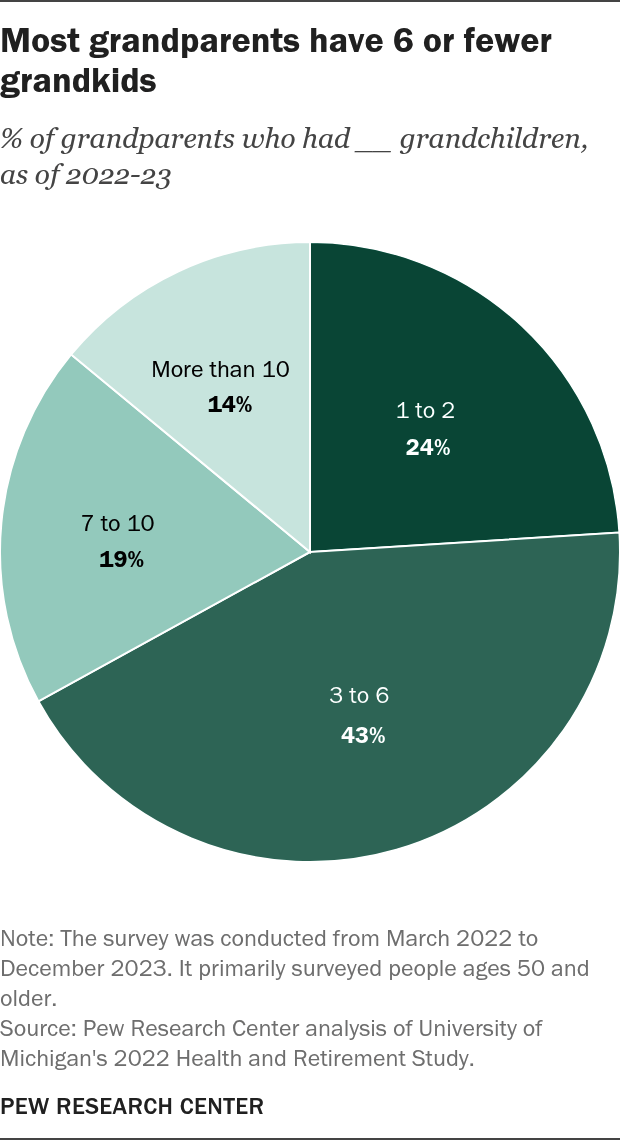
When it comes to family size, most American grandparents preside over a modest-to-large brood. Data from the University of Michigan’s Health and Retirement Study indicates that the average grandparent has roughly six grandchildren. Specifically:
- 24% of grandparents have 1 to 2 grandchildren.
- 43% have 3 to 6 grandchildren.
- 19% have 7 to 10 grandchildren.
- 14% have more than 10 grandchildren.
2. Chronology: The Evolution of Modern Multi-Generational Families
To fully understand the state of grandparenthood today, it is helpful to look at how family structures and communication have evolved over the decades.
The Mid-20th Century Shift
For much of the early and mid-20th century, grandparenthood was viewed through a more distant lens. Families were often geographically dispersed following post-war suburbanization, and life expectancies meant that grandparents and grandchildren shared fewer overlapping years of life compared to today.
The Rise of Multi-Generational Co-Residence
In recent decades, economic pressures, shifting cultural norms, and housing market realities have brought generations back under one roof. Data from the Census Bureau’s American Community Survey shows that 8% of American children lived with a grandparent who served as the head of the household in 2024.

Among these co-residing children:
- 48% lived in households headed by two married grandparents.
- 43% lived with a grandmother without a spouse present.
- 9% lived with a grandfather without a spouse present.
The Digital Era of Grandparenting
In the 21st century, geographical distance is routinely bridged by technology. The rise of smartphones, video-calling applications, and instant messaging has altered the chronological timeline of communication. Grandparents no longer have to wait for monthly phone calls or holiday visits; instead, daily check-ins have become a cornerstone of modern familial engagement.
3. Supporting Data: Communication, Caregiving, and Closeness
Quantitative data gathered across multiple national studies highlights the active nature of the relationship between grandparents and their grandchildren.
Communication Habits
Communication is remarkably frequent. A Pew Research Center survey conducted in September 2025 revealed that 7 in 10 grandparents ages 65 and older communicate with their grandchildren at least a few times a month. This includes in-person visits, phone calls, and text messages.
- 15% of older grandparents are in touch at least once a day.
- 27% connect a few times a week.
- 28% connect a few times a month.
- 10% connect once a month.
- 20% communicate less than once a month.
Caregiving Contributions
Beyond communication, many grandparents serve as vital childcare providers. Data from the 2022–2023 Health and Retirement Study shows that 21% of grandparents reported that they or their spouse had spent 100 hours or more taking care of a grandchild or great-grandchild over the preceding two years—averaging out to roughly one hour per week.
Researchers note an important caveat: Because the HRS data collection coincided partially with the COVID-19 pandemic (March 2022 to December 2023)—a period when many families restricted in-person contact—these figures may underrepresent the true volume of caregiving provided under normal circumstances.
Emotional Closeness and Demographic Variations
Emotional bonds remain strong across the board, though with notable cultural nuances. While 36% of U.S. adults with a living grandparent report being extremely or very close to them, and 27% feel somewhat close, the degree of closeness varies significantly by race and ethnicity.
- Black Americans report the highest levels of closeness, with 49% stating they are extremely or very close to their grandparents.
- Hispanic adults follow at 36%.
- Asian adults stand at 34%.
- White adults stand at 32%.
Interestingly, statistical analyses show no significant differences in emotional closeness based on gender, age, or household income.
4. Official Responses and Research Perspectives
Sociologists and demographers emphasize that understanding grandparenthood is no longer just a matter of domestic curiosity; it is a vital component of public health and economic policy.
Pew Research Center researchers, alongside academic institutions like the University of Michigan and the U.S. Census Bureau, regularly track these metrics to inform policymakers, journalists, and the public. Family relationship studies consistently demonstrate that robust intergenerational ties contribute positively to the psychological well-being of older adults.
When older Americans are surveyed about what excites them regarding aging into their 70s and beyond, spending time with grandchildren ranks among the most frequent open-ended responses. Conversely, public health officials look closely at caregiving data to understand the physical and financial strains placed on older adults who take on primary or secondary caregiving roles for younger generations.
5. Implications for Society, Policy, and Future Generations
The shifting dynamics of grandparenthood carry profound implications across several sectors of American society:
Economic and Workforce Impacts
With 21% of grandparents providing substantial regular childcare—and 8% of children sharing a home with their grandparents—grandparents function as an informal, multi-billion-dollar social safety net. They enable parents to remain in the workforce, mitigate skyrocketing daycare costs, and provide stability during family transitions. Policies affecting eldercare, healthcare access, and retirement ages directly ripple down to affect the capacity of grandparents to support their families.
Healthcare and Longevity
As life expectancy rises, the overlap in lifespan between generations expands. This creates both opportunities for sustained emotional support and challenges regarding elder health. Policymakers must consider how programs supporting aging populations—such as Medicare, Social Security, and community-based senior services—indirectly support the health of entire family ecosystems.
Social Cohesion and Cultural Transmission
Grandparents serve as living archives of family history, cultural heritage, and resilience. The high degree of closeness reported among diverse racial and ethnic groups—particularly within Black and Hispanic communities—underscores the role of extended family networks in preserving cultural identity and providing mutual aid.
As Grandparents Day reminds the nation of the contributions made by older generations, the data makes one thing clear: grandparents are not merely peripheral figures in family life, but central pillars supporting the emotional, logistical, and economic framework of modern American society.
 Nana Wu
  Reynand Wu
  Pevita Pearce