
 By Nana Wu
By Global News Desk
Published: September 2026
Main Facts
A comprehensive new multinational research study released by the Pew Research Center sheds light on the complex, deeply entrenched attitudes held by Israelis and Palestinians regarding the prospect of peaceful coexistence. The study, which incorporates data gathered from nationally representative surveys conducted throughout Israel, the West Bank, and East Jerusalem, seeks to move beyond binary polling numbers by capturing the nuanced, in-their-own-words reasoning of everyday citizens.
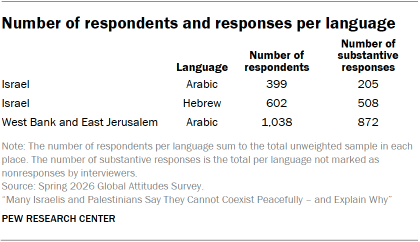
Between late March and early May 2026, researchers surveyed 1,001 Israeli adults and 1,038 Palestinian adults via face-to-face interviews managed under the direct supervision of Gallup. These responses were carefully weighted to ensure accurate representation of the adult demographic populations in both territories. Following an initial query on whether peaceful coexistence between Israel and an independent Palestinian state is achievable, respondents who provided definitive stances—answering "Yes," "No," or volunteering "It depends"—were asked a crucial qualitative follow-up: "In your own words, can you tell us why you feel that way?"
The resulting dataset yielded over 1,500 substantive open-ended text responses in Arabic and Hebrew. These transcripts were meticulously translated by the professional linguistic firm cApStAn and subjected to a rigorous qualitative coding process by Pew Research Center analysts. The study avoids treating these text replies as generalized statistical point estimates; instead, it leverages direct quotes alongside a detailed thematic codebook to map the psychological, political, and historical barriers—and pathways—to peace as perceived by those living on the ground.
Chronology
The timeline of the research project reflects an intensive methodological framework designed to capture public sentiment during a period of acute regional sensitivity:

- March 30 – April 28, 2026: Field interviewers conduct face-to-face surveys with 1,038 Palestinian adults across the West Bank and East Jerusalem.
- April 5 – May 6, 2026: Gallup-directed teams interview 1,001 Israeli adults across Israel.
- May – June 2026: Transcripts of over 1,500 Arabic and Hebrew open-ended responses are professionally translated into English by cApStAn.
- June – July 2026: Three Pew Research Center researchers engage in "open coding," reading through English translations to identify recurring themes and draft an initial codebook.
- July 2026: Researchers test the preliminary codebook on a random sample of 149 responses to evaluate conceptual validity. Disagreements are ironed out, and the codebook is refined.
- August 2026: The total set of 1,585 responses is divided among the primary researchers, with each response evaluated independently by two coders to ensure consistency and reliability. Discrepancies are reviewed and reconciled.
- September 2026: The final Pew Research Center report is published, detailing thematic insights, item nonresponse metrics, and selected qualitative quotations.
Supporting Data and Methodological Framework
To parse the vast array of human sentiment captured in the open-ended text, the Pew Research Center developed a robust, two-tiered qualitative codebook. Because respondents were permitted to have multiple thoughts or layers to their reasoning, researchers were not restricted to a single code per response, allowing a single individual’s reply to touch upon several thematic categories simultaneously.
The "Yes, Can Coexist" Codebook Themes
For those respondents who expressed a belief that peace is attainable, researchers categorized their rationales into four core buckets:
- Interest in Peace: Expressions centered on a personal or collective desire for peace, the material benefits of a stable environment, shared mutual interests, interpersonal relationships, and historical examples of past coexistence serving as proof that a peaceful framework can function.
- Inevitability of Peace: Pragmatic arguments asserting that neither group is going to leave the land, rendering learning to coexist the only viable option to minimize harm. Proponents of this view noted that all historic wars eventually terminate in peace, external pressure from the international community remains a constant driver, and fundamentally, there is no alternative path forward.
- Diplomatic Solution: Direct engagement with the mechanics of the peace process, explicit affirmations of Palestinian claims to statehood, lessons learned from historical diplomatic engagements, border demarcations, and an explicit rejection of a single-state reality.
- Conditional Frameworks: Explicitly utilizing conditional phrasing (e.g., using the word "if"). These responses highlighted prerequisites such as the presence of genuine political will, mutual compromises from both sides, reliance on specific future proposals, international intervention, the re-education of younger generations, and significant transformations in political leadership.
The "No, Cannot Coexist" Codebook Themes
Conversely, respondents who argued that peaceful coexistence is impossible were categorized across eight distinct thematic codes:
- Land: Philosophical and physical assertions that the contested land cannot—and should not—be divided, emphasizing rightful historical ownership and a persistent belief that the opposing side is actively attempting to usurp the entire territory.
- Occupation of the West Bank: Pointing to harsh material realities on the ground, including house demolitions, military checkpoints, the continuous expansion of Israeli settlements, and systemic policies targeting Palestinians.
- Threat to Israel: The conviction that the establishment and maintenance of a sovereign Palestinian state inherently compromises the security and existence of Israel, leaving it geographically and politically surrounded by hostile actors.
- Violence: Deeply rooted traumas stemming from a long history of intermittent warfare and violence between the two populations, with explicit references to the devastating impact of the October 7 attacks and the subsequent war in Gaza.
- Distrust: Total absence of faith in the opposing side, characterized by prevailing fear, mutual accusations of betrayal, and the perception of the other national group as untrustworthy or deceitful.
- Fundamental Incompatibility: Irreconcilable religious, cultural, and ideological divides, coupled with an outright rejection of the opposing side’s national identity, civil rights, or foundational claims to statehood, often fueled by deep-seated animosity.
- No Interest in Peace: Broad declarations that neither the individual, their immediate community, nor the broader public on either side harbors any genuine desire to achieve a peaceful resolution.
- Lack of Leadership and Political Will: Direct criticisms targeting political figures by name, broader government structures, and the perceived absence of any political constituency willing to champion peace.
Official Responses and Item Nonresponse Metrics
Understanding the validity of survey data requires a close examination of "item nonresponse"—instances where participants declined to answer or stated they "didn’t know." The Pew Research Center report revealed notable structural differences in nonresponse rates between the surveyed regions:
- In Israel: 20% of total respondents chose not to answer the initial question regarding peaceful coexistence. A demographic breakdown shows that 14% of Jewish respondents declined to answer, compared to 46% of Arab respondents. Furthermore, an additional 2% provided a substantive answer to the core question but opted out of the open-ended qualitative follow-up.
- In the West Bank and East Jerusalem: 10% of respondents either stated they "didn’t know" or outright refused to answer the initial coexistence question. An additional 6% offered a substantive "Yes" or "No" to the core inquiry but declined to provide an open-ended explanation.
These figures highlight underlying hesitations, political fatigue, and the sensitive nature of the subject matter among specific demographics within both populations.
Implications of the Study
The insights unearthed by the Pew Research Center carry profound implications for policymakers, international diplomats, and peacebuilding organizations operating in the Middle East.
First, the prevalence of conditional optimism among those who believe coexistence is possible suggests that peace is no longer viewed as an inevitable historical inevitability or a sentimental dream. Instead, it is increasingly seen by its proponents as a transactional, highly demanding project reliant on systemic reforms, structural leadership changes, and international guardrails. Without concrete shifts in political will and educational curricula, the baseline conditions required by hopeful respondents are unlikely to be met.
Second, the structural weight given to material realities and security threats—such as the occupation of the West Bank, historical traumas like October 7, and the fundamental incompatibility of land claims—illustrates that public sentiment is hardened by daily lived experiences. For those who reject coexistence, peace is not merely a conceptual disagreement over diplomacy; it is viewed through the lens of existential survival and historical injustice.
Ultimately, by prioritizing qualitative, open-ended responses over reductive quantitative metrics, this study provides a vital human dimension to the Israeli-Palestinian conflict. It demonstrates that any future diplomatic initiatives must reckon not just with borders and security pacts, but with the deeply entrenched fears, distrust, and narratives held by the individuals living in the region.
 Layla Zulfa
  Reynand Wu
  Pevita Pearce