
 By Asep Darmawan
In the hyper-competitive arena of high-end camera optics, manufacturers are constantly challenged to push the boundaries of physics while maintaining fiscal and manufacturing responsibility. Developing a single world-class super-telephoto prime lens requires millions of dollars in research and development, exhaustive optical simulations, precise glass molding, and robust logistical pipelines.
Yet, Sony has recently pulled off a manufacturing and engineering marvel that has caught the attention of the entire photographic community. Upon closer inspection of the recently released Sony FE 400mm f/4.5 GM OSS and Sony FE 600mm f/6.3 GM OSS lenses, industry experts and optical engineers have uncovered a startling reality: beneath their exterior shells, these two ostensibly distinct flagship telephoto lenses are, in large part, the exact same piece of optical engineering.
This deep dive examines how Sony leveraged brilliant shared architecture to bring two powerhouse telephoto primes to market, exploring the engineering parallels, the commercial strategy, and what this means for wildlife and sports photographers worldwide.
Main Facts: Two Lenses, One Genetic Code
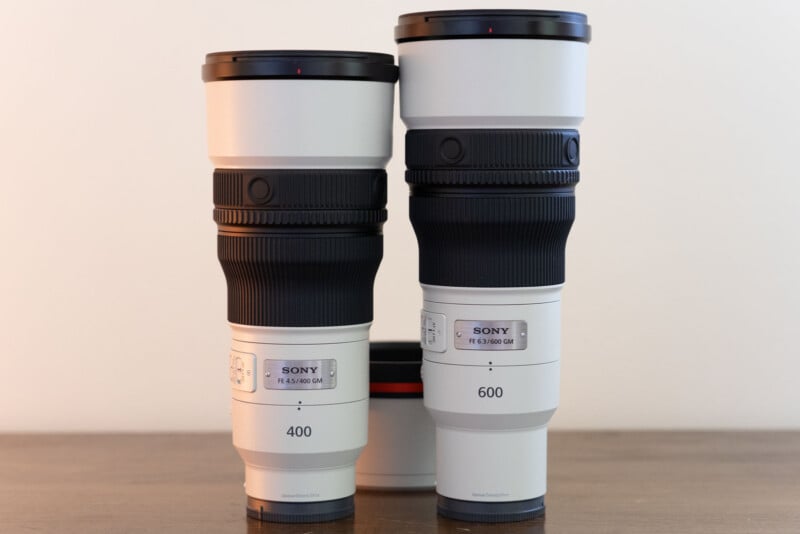
At first glance, the Sony FE 400mm f/4.5 GM OSS and the FE 600mm f/6.3 GM OSS appear to be standard additions to Sony’s prestigious G Master (GM) lineup. They share the iconic white heat-resistant finish, robust magnesium alloy construction, identical weather-sealing protocols, and layout of on-barrel physical controls.
However, the similarities go far deeper than skin-deep aesthetics:
- Near-Identical Weight: The two lenses are separated in weight by a mere single gram—equivalent to the weight of a standard paper clip, a U.S. dollar bill, or a small pinch of salt.
- Minimal Physical Dimensions: The 600mm f/6.3 model is physically longer than its 400mm sibling by less than an inch, maintaining an exceptionally compact and portable footprint for a super-telephoto optic.
- Shared Performance Architecture: Both lenses utilize the exact same advanced autofocus drive systems, feature identical minimum focusing distances, and deliver the same uncompromising, razor-sharp G Master image quality.
Despite these striking parallels, one lens is tailored for faster light-gathering capabilities at a shorter reach (400mm f/4.5), while the other provides extended reach with a slightly narrower aperture (600mm f/6.3). For most photographers, the handling characteristics are virtually indistinguishable. But looking at the internal blueprints reveals a fascinating look at modern optical design efficiency.
Chronology: From Concept to Optical Twinship
The development timeline of Sony’s modern super-telephoto lineup reflects a calculated evolution in manufacturing strategy.
Phase 1: The Blueprint and the Foundation
Historically, camera manufacturers designed lenses from scratch for every specific focal length and maximum aperture combination. This traditional approach meant that a 400mm f/4.5 and a 600mm f/6.3 would share virtually no internal component DNA. Every glass element, spacer, barrel thread, and autofocus group would require unique tooling and custom prototyping.
However, Sony’s optical engineers recognized an opportunity in modular lens architecture. By designing a robust core optical assembly capable of resolving ultra-high-resolution sensors cleanly, they laid the foundation for a multi-focal platform.
Phase 2: The Core Sharing Phase
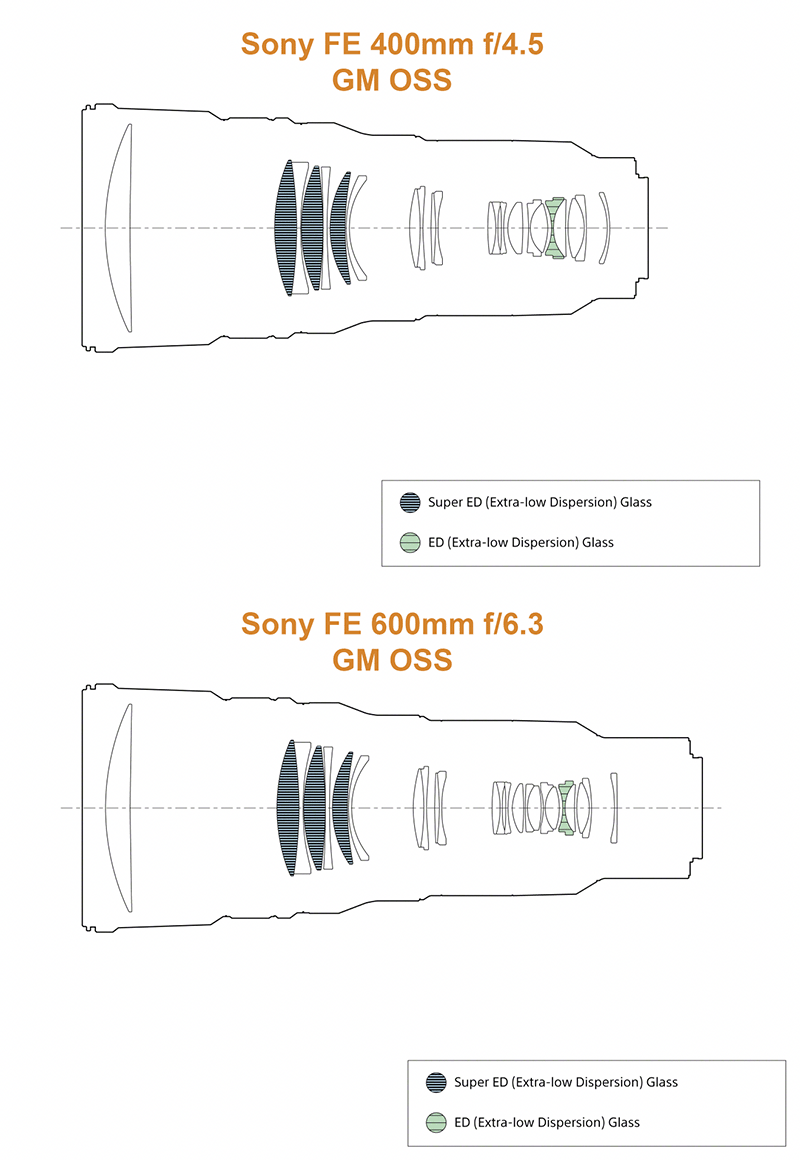
From the single large front element straight back through the central focusing group, the FE 400mm f/4.5 GM OSS and FE 600mm f/6.3 GM OSS operate as literal fraternal twins. This shared section includes the critical optical groupings containing premium Super ED (Extra-low Dispersion) glass elements, which are vital for suppressing chromatic aberration and delivering high-contrast, edge-to-edge sharpness.
Phase 3: The Divergence Point
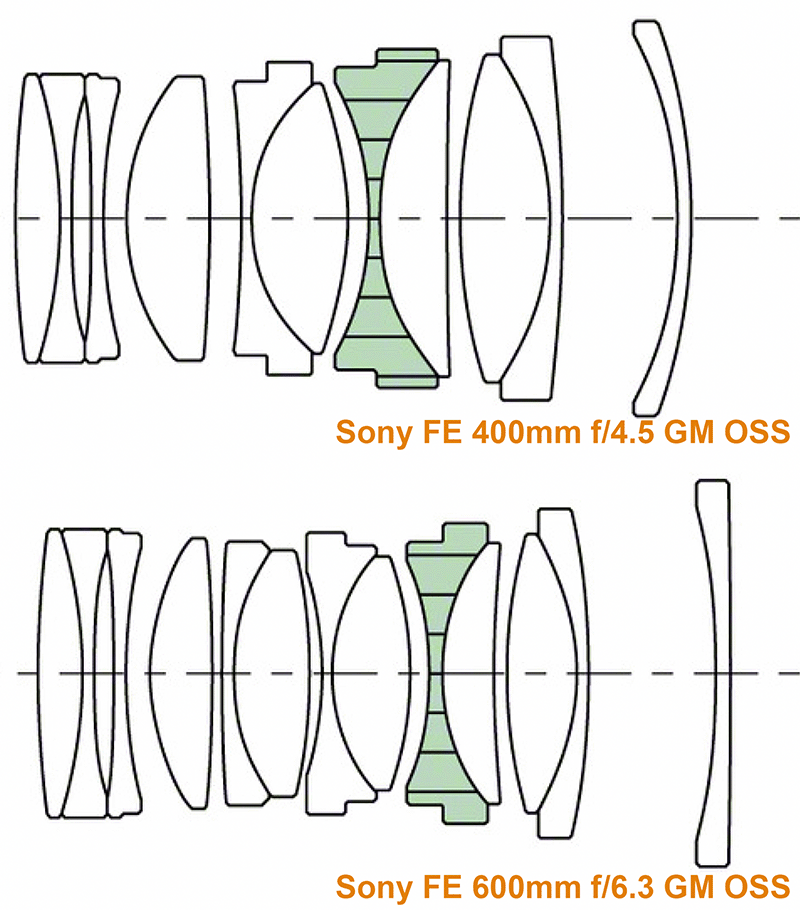
As the light path moves closer to the camera’s lens mount, the two designs begin to diverge. To achieve the extra magnification and focal length of the 600mm model without scaling up the physical size or weight exponentially, Sony’s engineers introduced a single extra optical group containing two additional elements. This brings the total construction of the 600mm f/6.3 to 24 elements arranged in 17 groups.
The adjustment in aperture (moving from f/4.5 to f/6.3) is a direct mathematical result of maintaining the same physical entrance pupil size while extending the focal length. Rather than engineering an entirely new optical train, Sony simply scaled and adapted the rear grouping to alter the focal multiplier.

Supporting Data: By the Numbers
To truly appreciate the engineering feat achieved by Sony, one must look at the specifications side-by-side and consider historical industry precedents.
| Specification | Sony FE 400mm f/4.5 GM OSS | Sony FE 600mm f/6.3 GM OSS |
|---|---|---|
| Focal Length | 400mm | 600mm |
| Maximum Aperture | f/4.5 | f/6.3 |
| Weight | ~994 grams | ~995 grams (+1 gram difference) |
| Length Difference | Baseline | < 1 inch longer |
| Optical Construction | Shared front/middle groups | Shared front/middle + 2 extra elements (24 elements in 17 groups) |
| Autofocus & OSS | Identical linear motor systems | Identical linear motor systems |
This level of physical parity is virtually unprecedented in super-telephoto prime lenses. Historically, stepping up from a 400mm lens to a 600mm lens involved a massive weight penalty, larger front filter threads, and a significantly larger tripod footprint. Sony’s modular approach breaks this paradigm entirely.
Precedents in the Industry
Sony is not entirely alone in recognizing the power of cross-platform modularity. A notable parallel occurred when Fujifilm developed the Fujinon GF 500mm f/5.6 R LM OIS WR lens for its medium-format GFX system. Recognizing the brilliance of the design, Fujifilm effectively adapted the optical train to fit an X-mount, instantly providing a portable 750mm-equivalent super-telephoto prime for its APS-C X-Series cameras.
However, what Sony has achieved within a single mount ecosystem—offering two entirely specialized focal lengths built largely on the same internal chassis—represents an even higher level of manufacturing efficiency.

Official Responses and Expert Analysis
Industry reviewers, including veteran tech and photography analysts Chris Niccolls and Jordan Drake, have evaluated both lenses extensively in the field, testing them against demanding wildlife and sports subjects.
According to joint evaluations, the real-world performance of both lenses leaves little room for criticism. "There’s really no downside here," industry reviewers noted. "Neither lens is a compromise of any kind, and photographers who buy either are destined to be happy campers."
Field tests involving erratic subjects—such as fast-moving border collies, hovering hummingbirds, and quick-moving woodpeckers—demonstrated that the shared autofocus tracking algorithms and optical image stabilization (OSS) systems perform with flawless consistency on both platforms.
When questioned about the distinct pricing models for lenses that share so much internal architecture, industry experts point out that retail pricing is dictated by a complex matrix of market positioning, specialized glass manufacturing yields, and R&D recovery rather than raw material costs alone. While buyers of the higher-priced model are essentially purchasing much of the same foundational lens structure twice, the resulting performance profile easily justifies the investment for working professionals who require specific reach.
Implications: What This Means for the Future of Optics
Sony’s clever engineering gambit carries profound implications for the future of camera lens design, commercial manufacturing, and consumer photography.
1. The Death of the "Heavy Telephoto" Stereotype
For decades, shooting at 600mm meant hauling heavy, cumbersome glass that required a monopod or sturdy tripod for extended sessions. By proving that a 600mm prime can be engineered to weigh under a kilogram and share the lightweight footprint of a 400mm lens, Sony has fundamentally altered ergonomic expectations for wildlife and sports shooters. Photographers can now hike deep into the wilderness with a true super-telephoto setup without experiencing debilitating physical fatigue.
2. Radical R&D Efficiency
Research and development costs are among the steepest barriers to entry in the camera industry. By sharing half of the optical design and numerous mechanical components between two distinct products, Sony drastically reduces its production overhead. This efficiency allows the company to invest more heavily in cutting-edge sensor technology, AI-driven autofocus processing, and future optical innovations while passing refined, high-yield products down to the consumer market.
3. A Strategic Dilemma for Consumers
For photographers caught between focal lengths, this engineering crossover creates an interesting psychological and financial dilemma. Knowing that the FE 400mm f/4.5 GM OSS and FE 600mm f/6.3 GM OSS share a massive percentage of their internal architecture means buyers are paying a premium for the specialized rear optical group that delivers the extra reach.
Ultimately, however, ignorance is bliss. Photographers who invest in either system gain access to world-class, uncompromising G Master performance. Whether you choose the wider aperture and slightly shorter reach of the 400mm, or the extended reach of the 600mm, Sony has delivered a masterclass in optical engineering that proves smart design is just as important as brute-force physics.
 Nana Muazin
  Raul Delapena Setiawan
  Jia Lissa