
 By Siti Muinah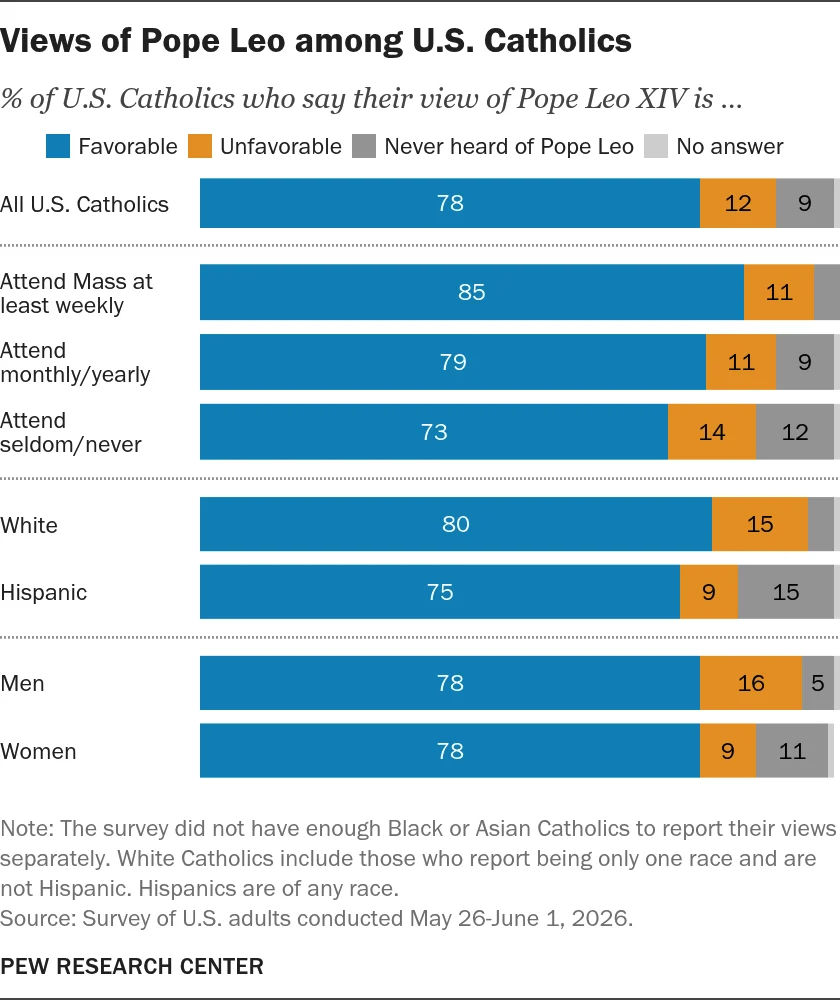
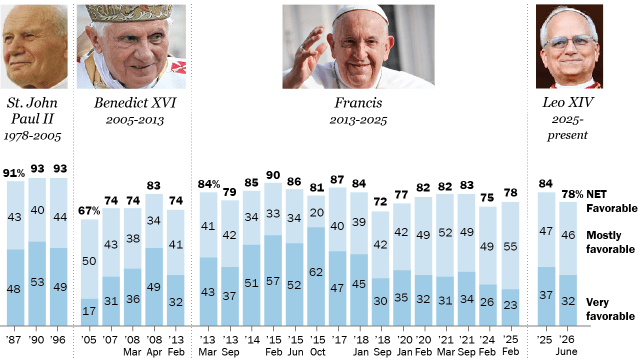
In the delicate intersection of faith and American political discourse, few figures occupy as complex a position as the current pontiff. According to a new, comprehensive survey released by the Pew Research Center on June 18, 2026, roughly eight-in-ten U.S. Catholics (78%) maintain a favorable view of Pope Leo XIV. While this figure demonstrates broad, persistent support for the American-born pope, it marks a subtle decline from the summer of 2025, when his favorability rating reached a high of 84%.
This data arrives at a moment of palpable tension. The survey, conducted between May 26 and June 1, 2026, captures the pulse of a Catholic population navigating the fallout from public, high-profile disagreements between the Holy See and the White House. The schism—centered on foreign policy and the morality of global conflict—has highlighted a deepening divide within the American pews, pitting partisan identity against traditional religious alignment.
A Chronology of Conflict: From Theological Disagreement to Social Media Skirmishes
The recent dip in favorability is best understood through the lens of the escalating rhetoric between the Vatican and the Trump administration. The friction began in earnest during the spring of 2026, as the conflict in Iran became a focal point of global concern.

In April, Pope Leo XIV issued a strong condemnation of the ongoing hostilities. During an address, the Pope warned against the "delusion of omnipotence" that he argued had seized unnamed world leaders, suggesting that the drive for total military dominance was antithetical to human dignity and the preservation of peace. While the address did not name specific nations or individuals, the implicit critique of the current American administration’s foreign policy was not lost on observers.
President Donald Trump, known for his direct engagement on social media, did not leave the critique unanswered. Within days, the President fired back on his preferred digital platform, labeling the Pope as being "WEAK on Crime, and terrible for Foreign Policy."
This public exchange marked a significant departure from the usual protocol of diplomatic silence or measured, private negotiation. For the average American Catholic, the spectacle of a sitting U.S. President openly sparring with the head of the Catholic Church has created a disorienting environment, forcing many to weigh their political allegiances against their spiritual reverence.
Supporting Data: The Favorability Breakdown
The Pew Research Center’s latest survey provides a granular look at how these tensions have settled into the collective consciousness of American Catholics.
Consistency Across Demographics
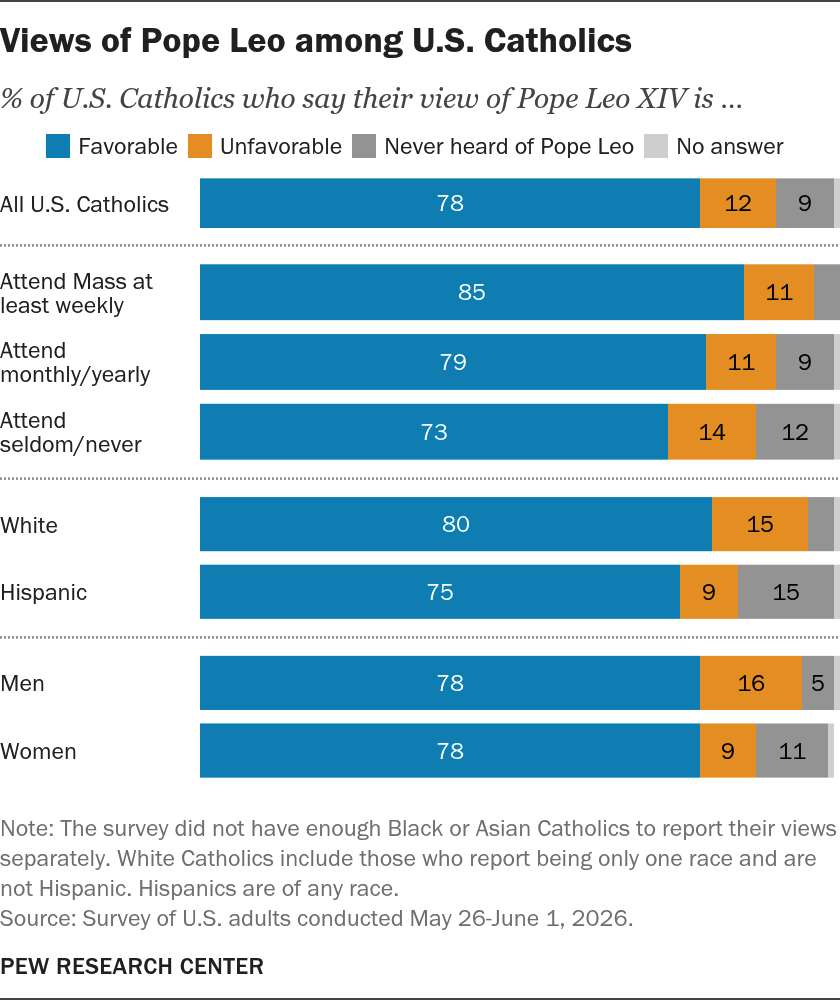
Despite the political noise, the bedrock of support for Pope Leo remains remarkably resilient across most demographic categories. When examining frequency of worship, the data reveals that those who attend Mass at least weekly hold the highest regard for the pontiff (85%). Even among those who rarely or never attend Mass, a clear majority (73%) still views him favorably.
Ethnically and culturally, the support is similarly broad. Both White and Hispanic Catholics report high levels of favorability (80% and 75%, respectively). While the sample size was insufficient to isolate distinct findings for Black or Asian Catholic populations, the data suggests that Pope Leo XIV’s popularity transcends the usual fault lines of age, gender, and geography.
The Partisan Divide
The most significant shifts in opinion occur when the lens is turned toward party affiliation. The survey highlights a growing divergence between Catholic Democrats and Catholic Republicans.
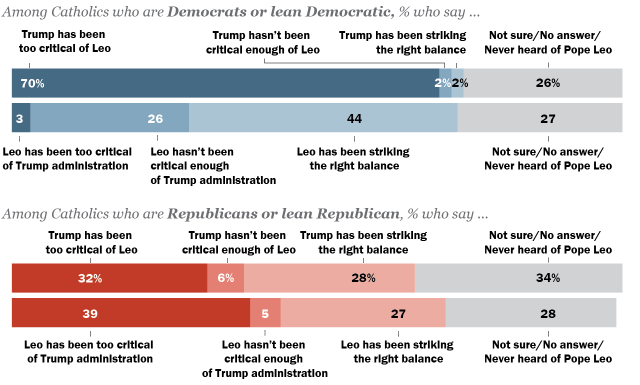
- Catholic Democrats: Among those who identify as or lean toward the Democratic Party, 84% hold a favorable view of the Pope. Furthermore, a staggering 70% of this group believes that President Trump has been "too critical" of the Pope.
- Catholic Republicans: Among Republican-leaning Catholics, the favorability rating for the Pope stands at 72%. However, this group is far more divided regarding the nature of the conflict. While 32% believe Trump has been too critical of the Pope, a nearly equal segment (39%) believes that the Pope has been too critical of the Trump administration.
The Weighing of Roles: Who is "Too Critical"?
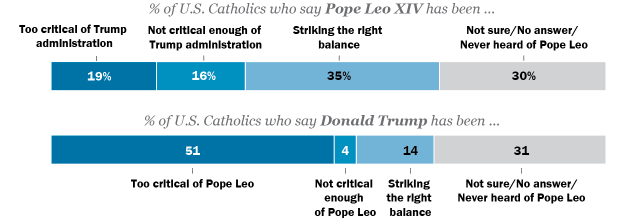
The survey asked respondents to place themselves in the position of arbiter between the two leaders. When asked about Pope Leo’s approach to the current administration, the U.S. Catholic population is remarkably fractured:
- 19% believe the Pope has been too critical of the White House.
- 16% argue he has not been critical enough.
- 35% believe the Pope is striking the correct, measured balance.
- 30% are unsure, have no opinion, or—notably—have never heard of Pope Leo XIV, a finding that underscores the challenges of modern religious engagement in a secularizing society.
When the question is flipped to evaluate President Trump’s treatment of the pontiff, the results become more one-sided. A majority of U.S. Catholics (51%) believe that Trump has been too critical of the Pope. Only 4% suggest the President hasn’t been critical enough, while 14% believe he is striking the right balance.
Implications for the Future of American Catholicism
The implications of these findings are profound. For the Catholic Church in America, the challenge lies in maintaining its prophetic voice—speaking out on moral issues like war and peace—without becoming a casualty of American political polarization.
The data confirms that for many Catholics, the church is not a monolith. The fact that a significant portion of the faithful feels compelled to defend the Pope against a sitting President, while another segment feels the Pope has overstepped into political territory, suggests that the "culture war" is now firmly entrenched within the internal life of the Church.
Furthermore, the "Don’t Know/Never Heard Of" statistic (30%) provides a sobering reminder to ecclesiastical leaders. In a world where the Pope is increasingly becoming a lightning rod for political opinion, there is a risk that his spiritual message is being obscured by the noise of the news cycle. When the faithful are asked more about their opinion of a conflict between a Pope and a President than about the teachings of the Church itself, the mission of the institution is tested.

Navigating the Tensions
As we look toward the remainder of 2026, the relationship between the Vatican and Washington will likely remain a key indicator of the broader health of religious influence in American politics. The ability of the Church to navigate these waters will depend largely on whether it can reframe the conversation.
Pope Leo XIV, in his recent addresses, has attempted to shift the focus back to the "human cost" of global conflict. However, the Pew survey shows that for the average American, these moral imperatives are being filtered through the screen of party politics. The challenge for the Church in the coming months will be to reach those who are currently alienated or confused by the political skirmishes, ensuring that the papal voice is heard as one of moral guidance rather than political agitation.
Ultimately, the data suggests that while the American Catholic Church remains a powerful and largely supportive body, the bonds of that support are being stretched by the gravitational pull of partisan conflict. Whether this is a temporary dip or a sign of a permanent shift in how American Catholics relate to their leadership remains to be seen.
Methodology Note
This analysis is based on a survey of 9,750 U.S. adults, including 1,848 Catholics, conducted by the Pew Research Center’s American Trends Panel from May 26 to June 1, 2026. The margin of error for the Catholic sample is +/- 3.2 percentage points. Full methodological details, along with the specific survey instruments and topline responses, are available through the Pew Research Center’s public archives.
 Muslim
  Nana Muazin