
 By Iffa Jayyana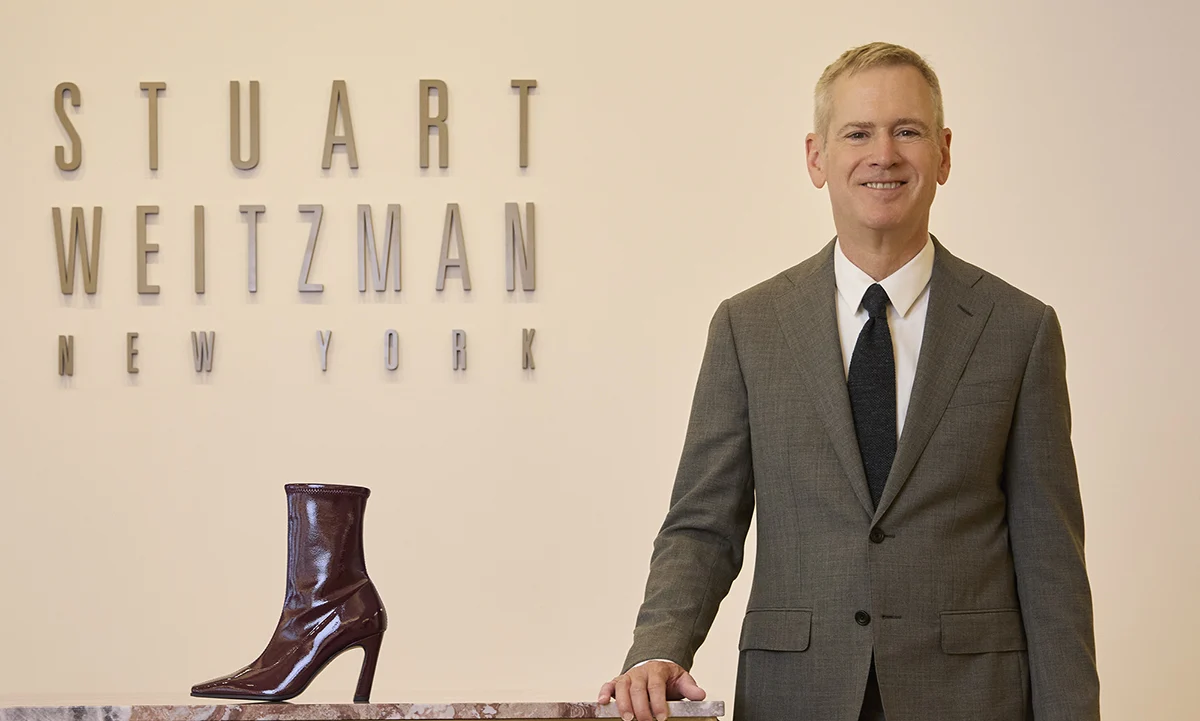
Nearly one year has elapsed since St. Louis-based footwear powerhouse Caleres Inc. finalized its $120.2 million acquisition of the luxury icon Stuart Weitzman from Tapestry Inc. In the months that have followed, the transition has moved from a complex operational integration to a period of strategic refinement. For Caleres, the acquisition was never intended to be a mere portfolio addition; it was a calculated move to secure a global luxury asset, stabilize a brand that had lost its footing, and unlock long-term, scalable growth.
The Strategic Rationale: A Third Time’s the Charm
In his first in-depth interview regarding the acquisition, Jay Schmidt, president and chief executive officer of Caleres, described the deal as a “transformational step” for the company. While the brand currently occupies a significant space in the luxury fashion footwear market, the path to ownership was far from a sudden decision.
“It is an iconic brand, has unique consumer relevance, and a long-standing position in the luxury fashion footwear market,” Schmidt remarked. “For all those reasons, it’s not really just an add-on for us; the deal was more about taking a transformational step with Caleres and building a new globally recognized lead brand in our portfolio as an owned asset.”
Perhaps most revealing is the company’s history with the label. Schmidt disclosed that this was actually the third time Caleres had explored acquiring Stuart Weitzman. Previous attempts occurred under the tenure of former CEO Diane Sullivan, though they did not reach fruition. Reflecting on the timing, Schmidt noted that the current iteration of Caleres is far better equipped to manage the brand’s specific needs. “We’ve built an incredible amount of capability, structure, and sourcing. We’ve really assembled a great team here to grow Stuart Weitzman,” he added.
Chronology of the Turnaround
The integration process was designed with surgical precision to ensure the brand could maintain its luxury identity while benefiting from the logistical backbone of a larger conglomerate.
Phase 1: Stabilization (August 2025 – February 2026)
Following the August closure, the immediate six-month priority was twofold: clearing out legacy inventory and re-aligning the team. “A major piece of that six-month transition was really trying to shed a lot of the inventory that had built up, and that was done fairly well as we reassembled a team both here and in Asia,” Schmidt explained. This period was crucial for shedding the "noise" of the previous business model and preparing the brand for a fresh start under Caleres’ operational discipline.
Phase 2: Digital and Physical Integration (February 2026)
On the first day of the fiscal quarter in February, the brand underwent a complete migration. This included a comprehensive systems implementation and a physical move of the team from Hudson Yards to a new, dedicated showroom in the same building as Caleres’ Sam Edelman division.
“We like that everyone’s close enough, but still, they maintain their own showroom,” said Schmidt. “We want each brand to stand for itself. We’re proud of the team here that really executed the transition; it was on time, on budget, and it allowed us to go forward with minimal disruption.”

Phase 3: Operational Streamlining (Current Status)
The company has since focused on eliminating duplicative costs by folding Stuart Weitzman’s finance, logistics, marketing, and planning into Caleres’ broader infrastructure. By offloading these “back-of-house” functions, the brand is now leaner and capable of faster decision-making.
Leveraging Global Footprint and Data
A key driver for the acquisition was the immediate expansion of Caleres’ international footprint. Before the deal, Caleres was arguably underpenetrated in global markets. Stuart Weitzman, with its significant direct-to-consumer (DTC) and international presence, changed the equation overnight.
“About two-thirds of the Stuart Weitzman business are direct-to-consumer and international, so when we brought in the brand, we increased our international penetration by about 50 percent,” Schmidt noted.
China, in particular, remains a focal point. Unlike the Sam Edelman brand, which operates in China via a joint venture, Stuart Weitzman maintains wholly owned retail operations there. This provides Caleres with a unique laboratory to test two distinct operational models. Schmidt expressed high confidence in the Chinese market, indicating that the company is currently studying the data from both models to optimize future expansion. Furthermore, the Middle East has been identified as a territory with “great opportunity long-term” for the brand, serving as a primary target for future market penetration.
Product Innovation: Breaking the Mold
One of the most significant shifts in strategy involves the product assortment. While the company remains committed to the brand’s heritage—specifically its manufacturing base in Spain, which accounts for two-thirds of production—Caleres is not afraid to break from tradition to meet modern demand.
A prime example is the introduction of sneakers. Historically, Stuart Weitzman struggled to gain traction in the athletic-casual space. By leveraging Caleres’ existing sourcing expertise in Asia—the same factories used for their other premium brands—the company has successfully rolled out a new sneaker collection. “The product is resonating with the consumer, particularly in Asia, but also in the United States,” Schmidt noted. This is part of a larger plan to capture a greater “share of wallet” by expanding into lifestyle, casual, and sport-leisure categories.
Leadership and Organizational Alignment
To spearhead this transformation, Caleres appointed Jonathan Lelonek as brand president. Lelonek, a veteran of the brand since 2012, brings deep institutional knowledge combined with prior luxury experience at Prada and Salvatore Ferragamo.
His mandate is clear: stabilize the foundation, align the team, and manage global retail partners. Schmidt describes Lelonek as being deeply involved in the product execution and having a global outlook, which is essential for a brand of this stature. The goal for leadership is to ensure the brand feels "at home" under new management while retaining the prestige that has defined it for four decades.

Financial Outlook: The Path to Profitability
Financial transparency has been a cornerstone of Schmidt’s messaging. During the company’s third-quarter earnings call in December, he set a clear objective: breakeven by 2026, followed by profitability.
“I’ve committed to it and I’m not going backwards on it,” the CEO stated firmly. “This year was just to stabilize volume; it wasn’t to grow. We wanted to get the operating discipline and cost structure together and push very hard on the pieces of the business that are working.”
By focusing on gross margin improvements, inventory control, and retail productivity, Caleres believes it can turn the brand into a consistent contributor to the company’s operating margins. Schmidt draws parallels to past successes, citing the Vionic and Allen Edmonds acquisitions as proof that the Caleres playbook for integrating and scaling premium brands is effective.
Future Implications: The 40th Anniversary and Beyond
As the industry looks toward the latter half of 2026, the 40th anniversary of the Stuart Weitzman brand serves as a strategic inflection point. It is not merely a milestone for celebration but a marketing catalyst for a global reintroduction.
Looking further ahead, the company is eyeing "meaningful brand extension opportunities" through licensing. While the primary focus remains on footwear to ensure organizational stability, the potential for expansion into accessories or other luxury categories is clearly on the horizon.
Ultimately, the acquisition of Stuart Weitzman represents the maturation of Caleres. By moving from a domestic-focused firm to one with a globally recognized, high-end luxury asset, the company is signaling its ambition to play a larger role in the global fashion ecosystem. As Schmidt concluded, the current work is about building a foundation that allows for "sharper storytelling, stronger digital execution, and renewed wholesale partnerships." With the integration phase largely behind them, the next chapter for Stuart Weitzman appears to be one of disciplined growth and a return to its position as a preeminent name in luxury footwear.
 Neng Nana
  Ali Ikhwan
  Lina Hope