
 By Pevita Pearce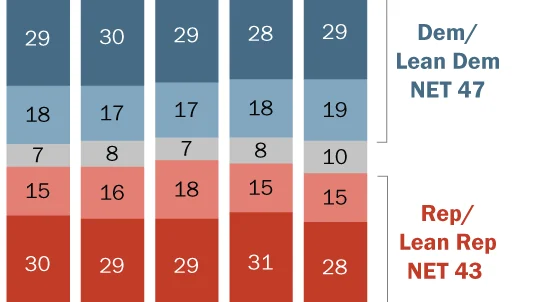
The American political landscape is a dynamic, ever-shifting entity. While the discourse often centers on the most polarized voices, the underlying currents of how Americans identify themselves politically provide a more nuanced—and often surprising—look at the nation’s health. According to the Pew Research Center’s latest National Public Opinion Reference Survey (NPORS), conducted between January and June 2026, the Democratic Party has regained a modest, but distinct, advantage in partisan affiliation among U.S. adults.
This finding serves as a critical benchmark for researchers, policymakers, and the public. With 47% of U.S. adults now identifying with or leaning toward the Democratic Party, compared to 43% for the Republican Party, the data suggests a return to the political environment observed in 2020. This shift marks a notable departure from the period between 2022 and 2025, when the American electorate appeared locked in a near-even split.
The State of the Union: Main Facts and Current Standing
The current political reality is defined by a significant reliance on "leaners"—individuals who do not explicitly identify as partisan but express a preference for one party over the other. When these leaners are included in the calculation, the partisan divide becomes clear.
Despite the prevalence of the "Independent" label, true non-partisanship is statistically rare. Research consistently shows that leaners behave in ways remarkably similar to self-identified partisans. Currently, 29% of adults identify as Democrats, while 28% identify as Republicans. The remaining 44% identify as Independents or "something else." However, when the leaners are distributed—19% of the total adult population leaning Democratic versus 15% leaning Republican—the Democratic edge emerges.
This lean-heavy structure suggests that while the base of both parties remains stable, the "swing" capacity of the electorate is largely concentrated in the ideological preferences of those who technically sit outside the formal party structures.
A Chronology of Partisan Shifts (2020–2026)
To understand where we are, one must look at the trajectory of the last six years. The 2026 data serves as the latest chapter in a volatile period of American history.
- 2020: The Baseline. In the final year of Donald Trump’s first term, the political split was characterized by a 33% to 29% lead for Democrats in core identification, with a total reach (including leaners) of 49% Democratic to 43% Republican.
- 2021: The Post-Election Shift. Following the 2020 election, the landscape saw a slight tightening, with the Democratic lead narrowing as the total Democratic reach dropped to 52% and Republicans held steady.
- 2022–2025: The Era of Parity. For three years, the nation experienced a period of remarkable equilibrium. Through mid-term elections and shifting legislative priorities, the gap between the two major parties remained within the margin of error, with the public essentially split down the middle.
- 2026: The Resurgence. The most recent NPORS data indicates a pivot back to the 2020 configuration. The Democratic Party’s modest lead has re-emerged, driven by a slight uptick in those who lean Democratic, while Republican core identification has softened compared to the 2025 peak.
Deep Dive: Supporting Demographic Data
The aggregate numbers, while telling, mask profound demographic fissures that continue to redefine the American electorate.
The Gender Gap
The gender divide in American politics remains one of the most consistent indicators of partisan behavior. Today, men are 11 percentage points more likely than women to align with the Republican Party. Conversely, women exhibit a 9-point preference for the Democratic Party. While the Republican lead among men has narrowed slightly compared to the 2022–2025 period, it remains more pronounced than it was in 2020.

The Education Factor
Education has become a primary fault line in modern partisanship. The data confirms a widening "diploma divide." Adults holding a four-year college degree or higher are significantly more likely to identify with or lean toward the Democratic Party. In contrast, the segment of the population without a college degree is now almost perfectly divided between the two parties, representing a major strategic battleground for both political organizations.
Racial and Ethnic Realignment
Historically, the Democratic Party has held a strong advantage among Black, Asian, and Hispanic voters. While these groups continue to lean Democratic, the 2026 data shows a nuanced trend: after the Republican Party made measurable inroads with these demographics between 2022 and 2025, there has been a slight "correction" or shift back toward the Democratic column in the most recent survey. White Americans, meanwhile, continue to maintain a clear preference for the Republican Party.
Age and Generational Cohorts
Age remains a significant predictor of political orientation. Adults under 50 currently tilt Democratic, while those aged 50 to 64 lean Republican. The 65-and-older cohort remains the most evenly split.
When tracking by generational cohorts—looking at the same group of people over time—the results are revealing. Those born in the 1980s and 1990s have shown a renewed shift toward the Democratic Party in the last year. This suggests that as these cohorts age, their political leanings are not merely hardening but are responding to the broader political and economic climate of the mid-2020s.
Official Methodological Considerations
The findings presented here are derived from the National Public Opinion Reference Survey (NPORS), which utilized a robust sample size of 5,511 U.S. adults. The survey, conducted by the Pew Research Center, employs a multi-mode approach—web, mail, and telephone—to ensure that all segments of the adult population are represented.
The research team, led by Senior Researcher Baxter Oliphant and Research Analyst Andy Cerda, emphasizes that these findings should be interpreted with an eye toward the inherent complexities of self-reported data. The Center notes that while margins of error are generally low, smaller sub-groups (such as men under 30) require careful analysis, as fluctuations in their reported affiliation may reflect statistical noise as much as genuine political movement.
Implications for the Future
What do these shifts mean for the American project? The return to a 2020-style partisan split suggests that the nation’s political architecture is remarkably resilient, even in the face of significant societal upheaval.
- The "Leaner" Power: The fact that nearly 44% of the population identifies as Independent, yet ultimately aligns with a party, suggests that the "Independent" label is increasingly a performative or aspirational identity rather than a reflection of true centrism.
- The Persistence of Polarization: Despite the shifting percentages, the underlying reality remains that the American electorate is profoundly divided. The "modest edge" held by the Democratic Party does not translate to a landslide in influence, as the Republican Party remains highly competitive and deeply entrenched across large swaths of the geography and demographics.
- The 2026 Context: The return to a Democratic advantage in 2026 will undoubtedly serve as a catalyst for political strategy in upcoming cycles. Parties will be forced to analyze whether this shift is a reaction to specific policy outcomes of the last two years or a broader rejection of the political status quo that dominated the mid-2020s.
Ultimately, the data from the 2026 NPORS confirms that while the American public is rarely static, it often circles back to familiar patterns of division. Understanding these trends is not merely an academic exercise; it is essential for anyone attempting to navigate the complex, often unpredictable waters of the American political system. As we look toward the remainder of the decade, the interplay between education, gender, and age will likely continue to be the primary drivers of our national political identity.
 rifanmuazin
  Sagoh
Sagoh 