
 By Jia Lissa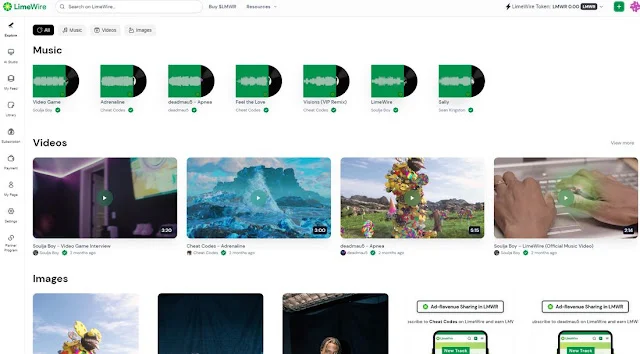
By Tech & Innovation Desk
Published: October 2023
Main Facts
The digital landscape is undergoing a paradigm shift, and once-familiar digital ghosts are finding new life in the era of artificial intelligence. LimeWire—a brand universally recognized as the pioneering peer-to-peer (P2P) file-sharing titan of the early 2000s—has successfully reinvented itself as a cutting-edge generative AI content publishing studio and decentralized marketplace.
Far removed from its legal controversies of the past, the modern iteration of LimeWire operates as a robust multi-model AI platform. It allows everyday users, professional digital artists, and mainstream musicians to conceptualize, generate, edit, and monetize AI-generated imagery. More than just a prompt-and-render tool, LimeWire functions as an end-to-end publishing ecosystem. Every piece of content created on the platform can be automatically minted as a Non-Fungible Token (NFT) on scalable blockchains like Polygon and Algorand. Furthermore, the platform introduces a unique Web3-integrated revenue-sharing model. Through its native cryptocurrency token, LMWR, creators earn up to 70% of ad revenue generated by views on their content, alongside ongoing royalties from secondary NFT trades.
Chronology
To understand how LimeWire transitioned from a dismantled music-sharing protocol to a Web3-backed AI powerhouse, it is essential to trace its timeline:
- 2000–2010 (The P2P Era): Mark Gorton founded LimeWire, which quickly became the world’s most popular file-sharing client. Driven by the Java-based Gnutella network, it defined early-millennium internet culture before a landmark 2010 federal court ruling shut down operations due to massive copyright infringement liabilities.
- 2022 (The Crypto Pivot): Entrepreneurs Paul and Julian Zehetmayr acquired the dormant LimeWire brand. Initially intended as a digital collectible marketplace for music and art, the platform aimed to leverage the burgeoning NFT market.
- Early 2023 (Entering the Generative AI Space): Recognizing the explosive growth of generative AI, LimeWire pivoted its core strategy. It integrated powerful open-source and proprietary text-to-image models—such as Stable Diffusion and DALL-E—transforming its marketplace into an active creation studio.
- Mid-to-Late 2023 (Token Launch and Ecosystem Expansion): LimeWire launched its native utility token, $LMWR, on major cryptocurrency exchanges (including Kraken, ByBit, and Uniswap). The platform rolled out tiered subscription plans, automated NFT minting features, and ad-revenue sharing. Prominent mainstream artists such as Deadmau5, Soulja Boy, and Sean Kingston adopted the platform to drop AI-infused digital collectibles and music.
- The Future Horizon: LimeWire has announced aggressive roadmaps to expand its generative suite beyond still images, promising upcoming audio and video AI generation tools to capture the entire spectrum of digital media creation.
Supporting Data
The operational mechanics of LimeWire AI Studio rely on a structured hierarchy of free and paid tiers, balancing accessibility with high-volume enterprise creative needs. Below is a breakdown of the platform’s current subscription models, credit allocations, and monetization incentives:
| Tier Name / Price | Monthly Credits | Approximate Image Generations | Ad Revenue Share | Key Perks & Features |
|---|---|---|---|---|
| Free Tier ($0) | 10 credits | Up to 20 images/day | 50% | Basic model access, community support, standard generation speeds. |
| Basic Plan ($9.99/mo) | 1,000 credits | Up to 2,000 images | 50% | Pro profile badge, faster generation, ad-free experience, early model access. |
| Plus Plan ($29/mo) | 3,750 credits | Up to 7,500 images | 60% | Pro profile badge, full creation history, priority queue, early model access. |
| Pro Plan ($49/mo) | 5,000 credits | Up to 10,000 images | 70% | Maximum ad revenue split, priority generation, full creative suite access. |
| Advanced Plan ($99/mo) | 11,250 credits | Up to 22,500 images | 70% | Enterprise-level capacity, maximum revenue share, dedicated support. |
Financial Mechanics of $LMWR
- Payout Structure: Earnings are distributed monthly in $LMWR tokens.
- Secondary Market Royalties: Creators automatically earn a 2.5% royalty every time their minted NFT assets are traded on secondary marketplaces.
- Utility: $LMWR tokens can be cashed out via external exchanges or recycled directly into the platform to purchase additional prompt credits for AI generation.
Official Responses
The pivot from a decentralized file-sharing graveyard to a Web3 AI darling has generated significant commentary from the platform’s leadership and industry analysts alike.
In public statements regarding the relaunch, co-founder Paul Zehetmayr emphasized the company’s commitment to shifting power back to the individual creator:
"When we acquired LimeWire, our vision was to reclaim a legendary brand and align it with the most disruptive technologies of our time. Generative AI and Web3 are not just buzzwords for us; they are the foundational infrastructure of a new creator economy. By automating NFT minting and giving creators direct ownership, ad revenue, and royalty streams, we are removing the traditional gatekeepers of digital art."
Industry stakeholders have also noted the deliberate distance LimeWire has placed between its legacy software and its current architecture. By utilizing transparent, blockchain-verified protocols (Polygon and Algorand) and partnering with established figures in the music and entertainment industries, management has actively sought to build institutional trust.
Celebrity early-adopters, including electronic music producer Deadmau5, have highlighted the platform’s utility in bridging the gap between automated art and fan engagement. Through exclusive subscriber drops and tradeable digital assets, artists view LimeWire Studio not merely as an art generator, but as a direct-to-consumer digital merchandising hub.
Implications
The evolution of LimeWire carries profound implications for the broader tech, legal, and creative landscapes.
1. Democratization of Digital Art and Production
By integrating multiple sophisticated AI models—such as Stable Diffusion XL, Stable Diffusion 2.1, and DALL-E 2—under a single, user-friendly interface, LimeWire lowers the barrier to entry for digital creation. Users do not need complex local hardware setups, expensive graphic cards, or advanced prompt-engineering skills to produce cinematic, anime, pixel art, or analog-style imagery.
2. Redefining Creator Monopolies and Ad Revenue
Traditional social media and content platforms often retain the lion’s share of advertising revenue, offering creators fractions of a cent per view or relying entirely on external brand sponsorships. LimeWire’s model—paying out up to 70% of ad revenue directly in cryptocurrency—tests a radical alternative. It treats every piece of user-generated content as a micro-business.
3. The Convergence of AI and Web3
For years, generative AI and blockchain technology existed as parallel tech hypes, occasionally intersecting via speculative NFT art projects. LimeWire’s integration demonstrates a practical, native use case for blockchain: automated tokenization, verifiable ownership, and decentralized royalty enforcement. When an AI-generated image is minted instantly upon publication, questions of provenance and digital scarcity are addressed at the code level.
4. Regulatory and Copyright Horizons
Given LimeWire’s historical legal battles over copyright infringement, the platform’s current navigation of AI-generated content is closely watched by legal experts. While training foundational AI models on vast web datasets remains a contentious legal grey area globally, platforms that provide tools for users to mint and trade AI outputs must carefully monitor compliance, intellectual property complaints, and fair-use boundaries.
As LimeWire prepares to roll out its forthcoming audio and video generation suites, it stands at the vanguard of a new digital frontier. Whether it can permanently shed its historical legacy and cement itself as a permanent fixture in the modern creator economy will depend on its ability to innovate safely, sustainably, and fairly in a rapidly crowding generative AI market.
 Nila Kartika Wati