By Chloe West Published: September 14, 2026 Estimated Reading Time: 20 minutes
Introduction: The Evolving Landscape of SocialMedia Organizations
A social media team is no longer just a group of interns tasked with posting pictures on Instagram or firing off quick replies on X. In 2026, a brand’s social media department sits at the bleeding edge of marketing, public relations, customer service, and revenue generation.
As digital channels multiply and consumer expectations shift toward instant, authentic engagement, organizations are forced to rethink how they staff and structure their social departments. Whether you are a lean startup looking to make your first hire or an enterprise corporation orchestrating multi-region campaigns, building an effective social media team requires a delicate balance of strategy, creative execution, data literacy, and technological adaptation.
In this comprehensive guide, we examine the core pillars of social media team construction: defining responsibilities, choosing the right organizational structure, budgeting for salaries, integrating artificial intelligence, and measuring success.
1. Main Facts: What Does a Social Media Team Actually Do?
At its core, a social media team is responsible for planning, creating, publishing, and managing a brand’s entire public-facing social media presence. However, looking at the daily calendar of a modern social team reveals a scope of work that touches nearly every facet of a business.
Daily Execution and Long-Term Strategy
A robust social media operation manages a wide array of responsibilities, bridging creative output with analytical rigor:
Content Planning & Scheduling: Designing content calendars that align with overarching product launches, seasonal campaigns, and cultural moments.
Asset Production: Creating high-performing short-form videos, static graphics, carousels, and written copy optimized for specific platform algorithms.
Community Management: Actively monitoring inboxes, addressing customer service inquiries, engaging in proactive community building, and managing brand sentiment.
Performance Tracking: Analyzing daily engagement metrics, tracking click-through rates, and reporting on return on investment (ROI) to leadership.
Beyond tactical publishing, enterprise-grade social teams act as a critical intelligence hub for the wider business. They provide early risk signals, surface emerging consumer trends, monitor competitor movements, and capture voice-of-customer insights that feed directly into product development and executive decision-making.
2. Chronology: The Maturation of Social Media Staffing
The role of social media within corporate structures has undergone a massive evolution over the past decade and a half:
The Early Era (Pre-2015): Social media was largely treated as an afterthought. Companies often delegated the task to junior marketing coordinators or interns. Strategy consisted of broadcasting company press releases across a couple of platforms with little focus on engagement or community building.
The Generalist Boom (2015–2020): As platforms monetized and algorithms grew sophisticated, the "Social Media Manager" emerged as a dedicated generalist role. One person was typically expected to write copy, design graphics, shoot video, answer customer service complaints, and run basic paid ad campaigns.
The Era of Specialization (2020–2024): The explosive growth of video-first platforms (like TikTok and Reels) and paid social channels shattered the "unicorn generalist" model. Organizations began carving out dedicated roles for content creators, community managers, and paid media specialists.
The AI-Augmented Era (2025–Present): With artificial intelligence drastically accelerating drafting, tagging, data parsing, and reporting workflows, the focus has shifted away from raw headcount toward high-value strategy, governance, and creative direction. Lean teams can now accomplish what once required large departments, provided they possess the right specialized skill sets in-house.
3. Organizational Models: How to Structure Your Team
Before making your first hire, leadership must decide how the social media apparatus will be structured. Your organizational model dictates who owns strategy, how quickly content is published, and how consistently your brand voice is maintained.
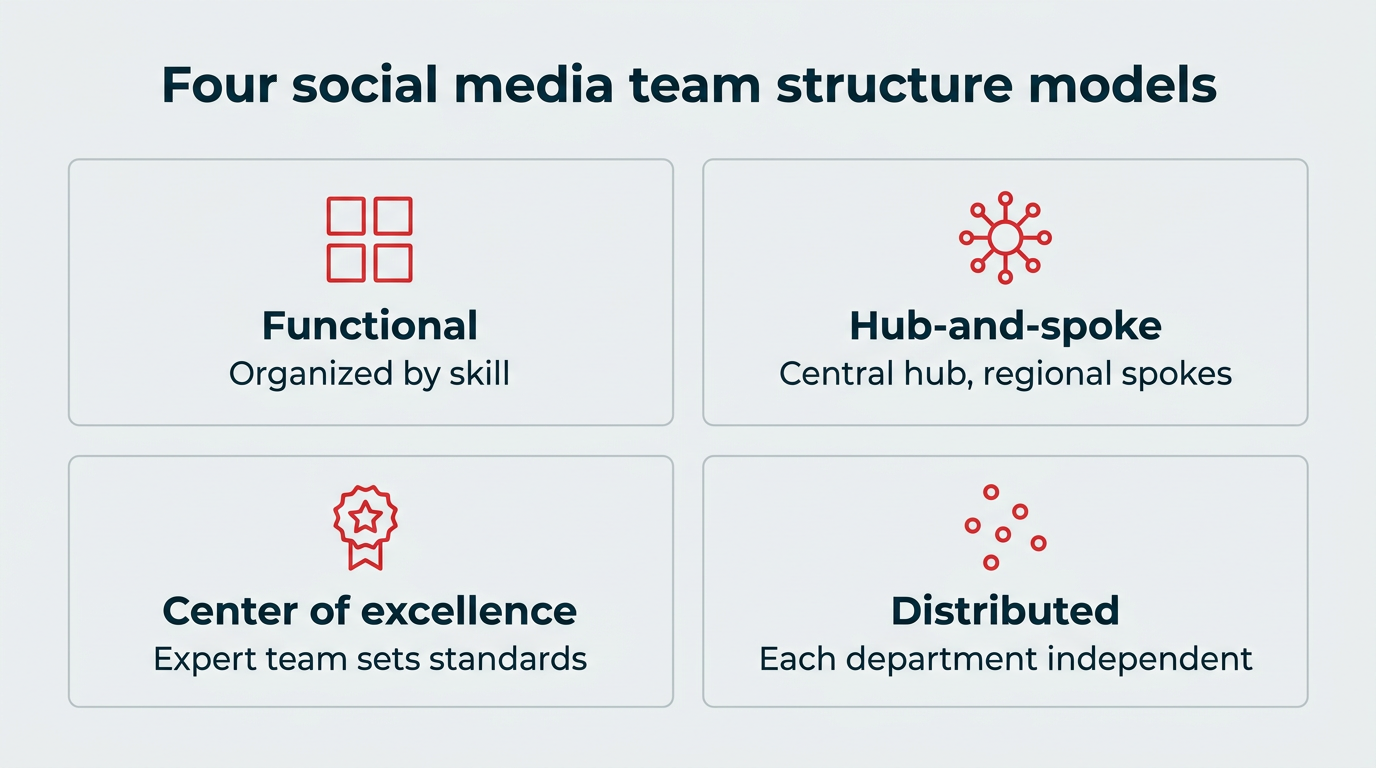
Four Common Social Media Team Structures
The Functional Structure: Organized by specific skill sets—content, community, analytics, and paid social each have dedicated owners. This model works exceptionally well for mid-size organizations with a single core brand. It offers deep expertise and clear ownership, though it requires intentional cross-functional collaboration to prevent teams from working in isolated silos.
The Hub-and-Spoke Model: A central "hub" team sets the overarching strategy, brand voice, and governance standards, while regional or business-unit "spokes" handle localized execution. This model is ideal for multi-brand or global enterprises that must balance international brand consistency with local cultural relevance.
The Center of Excellence (CoE): A small elite team establishes best-practice playbooks, toolkits, and compliance guardrails, while actual social execution is embedded within other departments (such as HR, PR, and customer care). This model scales effortlessly in highly decentralized organizations where social touchpoints are distributed across the enterprise.
The Distributed Model: Departments manage their own social presences entirely independently without a central governing body. While this allows for maximum speed and agility, it represents the highest risk profile for brand consistency, compliance issues, and fragmented messaging. Most scaling organizations eventually transition away from this model.
4. Key Roles, Responsibilities, and US Salaries
A high-performing social media team comprises distinct roles tailored to business objectives. Below is an exhaustive breakdown of core positions, expected compensation, and daily tools.
1. Social Media Strategist
Primary Focus: Defines the overarching direction of the social program, aligns channels with business objectives, establishes KPIs, and reports to executive leadership.
Key Skills: High-level strategic planning, competitive research, executive communication, and data interpretation.
Tools: Enterprise analytics suites, business intelligence tools, project management platforms.
Reports To: Marketing Director or Chief Marketing Officer (CMO).
2. Social Media Manager
Primary Focus: The backbone of day-to-day execution. Translates high-level strategy into actionable operational plans and ensures content ships smoothly.
Primary Focus: Produces native visual and written assets, specializing in high-engagement formats such as short-form video (TikTok, Reels, YouTube Shorts) and design graphics.
Key Skills: Visual storytelling, basic video editing, lighting/audio capture, and deep familiarity with internet culture.
Tools: CapCut, Adobe Creative Cloud, smartphone production setups.
Reports To: Social Media Manager.
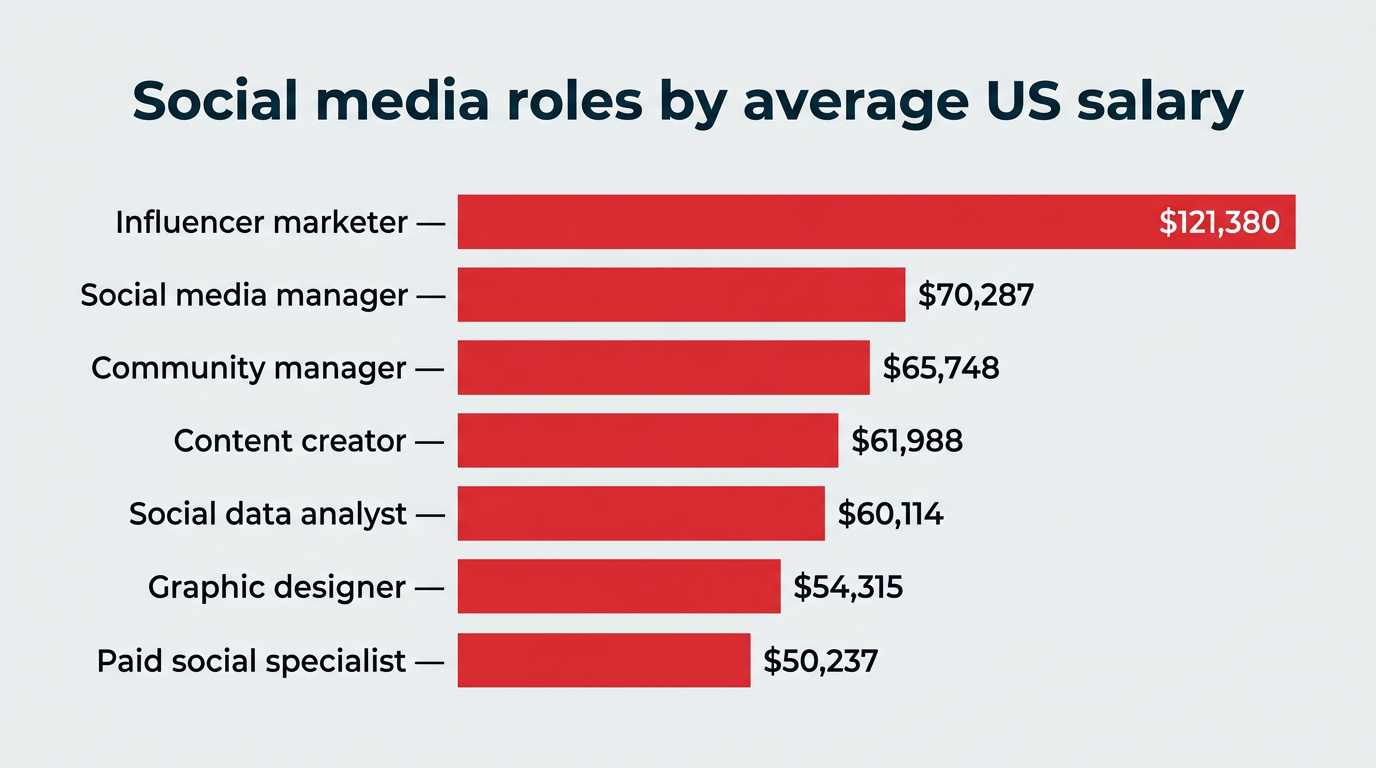
Average US Salary: $61,988
4. Community Manager
Primary Focus: Acts as the primary human voice of the brand, managing direct messages, public comments, and dedicated community spaces (e.g., Facebook Groups, Slack channels).
Key Skills: Empathetic customer service, crisis de-escalation, active listening, and brand tone adherence.
Tools: Unified social inboxes, customer relationship management (CRM) software.
Reports To: Social Media Manager.
Average US Salary: $65,748
5. Paid Social Media Specialist
Primary Focus: Manages paid advertising campaigns across social networks. Optimizes budgets, tests audience segments, and scales high-performing ad creatives.
Tools: Meta Ads Manager, LinkedIn Campaign Manager, TikTok Ads Manager, Google Analytics.
Reports To: Social Media Manager or CMO.
Average US Salary: $50,237
6. Social Data Analyst
Primary Focus: Transforms raw social metrics into actionable intelligence, building dashboards, tracking KPIs, and presenting performance trends to stakeholders.
Key Skills: Data visualization, SQL, quantitative analysis, and trend forecasting.
Tools: Tableau, Looker Studio, advanced social listening tools.
Reports To: Social Media Manager.
Average US Salary: $60,114
7. Graphic Designer
Primary Focus: Crafts polished visual branding assets, campaign banners, infographics, and typography systems tailored for social distribution.
Key Skills: Graphic design principles, typography, digital asset management, and brand alignment.
Tools: Adobe Illustrator, Photoshop, Figma.
Reports To: Social Media Manager or Paid Ads Specialist.
Average US Salary: $54,315
8. Influencer Marketer
Primary Focus: Manages end-to-end creator partnerships, ranging from contract negotiation and outreach to campaign execution and performance auditing.
Industry experts emphasize that companies must avoid falling into the trap of looking for a "one-size-fits-all unicorn" employee.
Eileen Kwok, Hootsuite’s former Social & Influencer Marketing Strategist, notes that while social media management can be overwhelming, the professionals who succeed are those driven by natural curiosity, tenacity, and a commitment to creativity.
"Being a Social Media Manager can be an overwhelming job," says Kwok. "That’s why the ones that are naturally curious about all things social, have the desire to always learn and improve, and, most importantly, place creativity at the forefront of their work, are the ones that truly succeed."
Kwok advises hiring managers to work backward from clear organizational goals rather than piling an unmanageable array of tasks onto a single generalist.
"Set your expectations and get really clear on what you are looking for… Jot down your list of priorities and be mindful of what’s achievable from one person or a small team."
Furthermore, Kwok advocates for practical assessments during the interview process: "Don’t be afraid to ask for examples of their work or to have them complete a small task as part of the interview process. This will give you a better sense of what they’re capable of and what they can bring to the table."
6. Implications: The Impact of Artificial Intelligence on Team Roles
The integration of artificial intelligence into daily workflows has fundamentally transformed what social media professionals do. Rather than replacing human creativity, AI has automated the "work about work"—such as routine copywriting drafts, initial content tagging, automated sentiment sorting, and baseline report generation.
Content Creators now use generative AI to brainstorm hooks, storyboard concepts, and rapidly iterate ad variations.
Community Managers leverage AI-assisted categorization to prioritize urgent customer service inquiries within unified social inboxes.
Analysts use automated reporting templates to pull cross-platform data instantly, freeing up hours for strategic interpretation.
However, this technological shift increases the importance of governance and oversight. Because AI can accelerate publishing speed, brands require clear human guardrails to protect brand voice, ensure factual accuracy, and prevent compliance violations. Prompt engineering, data interpretation, and AI governance have thus become essential competencies across all levels of the modern social team.
Conclusion: Steps to Build Your Social Media Team
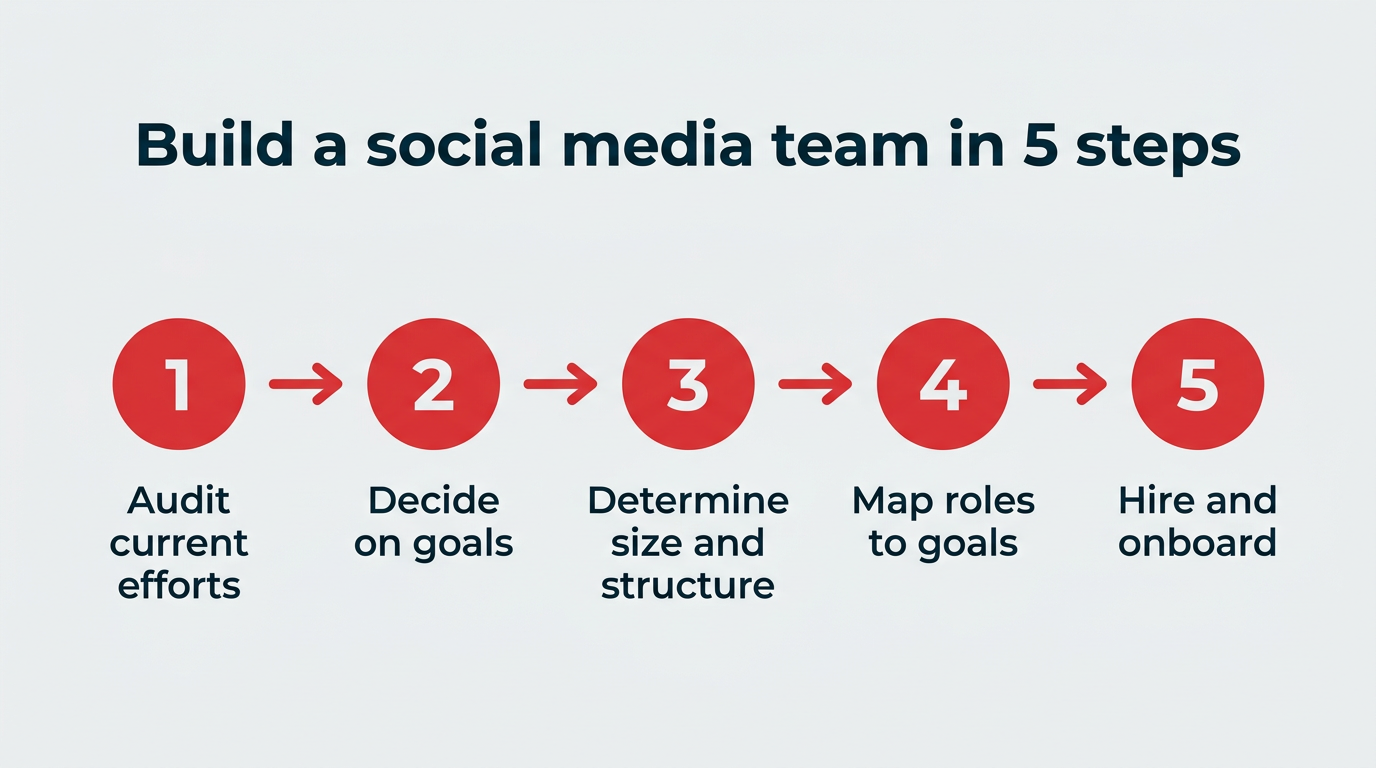
Building a high-performing social media team requires a structured, multi-step approach:
Audit Current Efforts: Review existing performance, resource allocation, and budget limitations to identify operational gaps.
Define Clear Goals: Connect social objectives directly to business outcomes—whether that is brand awareness, customer retention, or direct revenue.
Determine Team Size and Structure: Select the organizational model that minimizes friction and size your team according to your operational scope (e.g., lean 1–3 person squads vs. 7+ person enterprise units).
Map Roles to Objectives: Assign dedicated responsibilities to the roles that directly drive your primary goals.
Hire, Test, and Onboard: Implement practical skill assessments during interviews, and arm new hires with essential brand guidelines, approval workflows, and collaborative tools.
By anchoring your hiring strategy in clear business outcomes and arming your personnel with modern tooling, your organization can build a resilient social media operation capable of thriving in a competitive digital ecosystem.

 By Pevita Pearce



 Neng Nana
  Nila Kartika Wati
  Ammar Sabilarrohman