
 By Azzam Bilal Chamdy
WASHINGTON — As the polling and market research industry rapidly incorporates generative artificial intelligence into its methodologies, a major new methodological study from the Pew Research Center puts the trend to the ultimate test. The conclusion? When it comes to accurately capturing public sentiment, artificial intelligence cannot reliably stand in for real human respondents.
The comprehensive research project examined whether AI-generated survey data—frequently referred to in the industry as "synthetic samples" or "digital twins"—could accurately mirror the results of high-quality public opinion polls. Utilizing Anthropic’s advanced Claude Opus 4.6 model, researchers fed the AI detailed demographic profiles, regional data, and past political typology survey responses belonging to actual members of the Center’s American Trends Panel (ATP). The AI was then tasked with answering fresh survey questions in the exact sequence and phrasing experienced by human participants.
The results provide a cautionary tale for researchers eager to leverage AI for instant, cost-effective polling. While synthetic panels offer unmatched speed and scale by bypassing the need to recruit and interview real people, they struggle significantly to capture real-world shifts in public opinion, breaking news reactions, and nuanced local issues.
Main Facts: The Methodology and Core Findings
The Pew Research Center’s experiment was designed to rigorously evaluate an emerging technique in survey methodology. While AI-based polling is increasingly adopted by commercial firms seeking rapid insights, Pew’s leadership emphasized that the organization has no current or future plans to substitute real human engagement with AI-generated data.
To conduct the experiment, researchers adopted a "digital twins" framework:
- The Persona Pool: The AI model was assigned the personas of real human panelists from the American Trends Panel. Each digital twin was loaded with self-reported demographic data and historical views from the Center’s 2025 political typology survey.
- The Test Waves: The model was given questions from three separate ATP survey waves conducted during the first half of 2026 (Waves 185, 190, and 192). These surveys covered diverse formats and addressed wide-ranging topics, attitudes, and behaviors.
- The Benchmark: Direct comparisons were drawn between the AI-generated responses and the actual answers provided by human panelists.
Across all evaluated questions, the synthetic surveys yielded an average margin of error of roughly 12 percentage points. More critically, the AI models frequently flatlined on ongoing trends, misjudged political polarization on fast-moving news, and hallucinated extreme consensus on niche regional topics like data centers.
Chronology of the Experiment
The methodological evaluation unfolded through a carefully staged series of replications and testing phases throughout early 2026:
- January 2026: Pew researchers established baseline human data on critical public issues, including economic worries, presidential approval, and emerging technological debates like local data center expansion.
- March 9–12 and April 7–10, 2026: Researchers fielded the first synthetic replications using Claude Opus 4.6, testing the model’s ability to mirror human sentiment on early-year trends and the unfolding fallout of specific regional immigration enforcement measures (such as "Operation Metro Surge").
- Late March to Early May 2026: Following military escalations involving the United States, Israel, and Iran starting in late February 2026, researchers tested the AI’s capacity to track public opinion on active international conflicts. Synthetic replications were conducted from March 30–April 2 and April 27–May 1.
- September 30, 2026: Pew Research Center officially published its comprehensive findings, data tables, and methodology papers under the title "Can AI Stand In for Human Survey-Takers? Not Really."
Supporting Data: Where the AI Model Missed the Mark
The analysis revealed three distinct areas where synthetic samples severely deviated from reality: presidential approval trends, topical and fast-moving political crises, and local infrastructure concerns.
1. Stagnant Presidential Approval
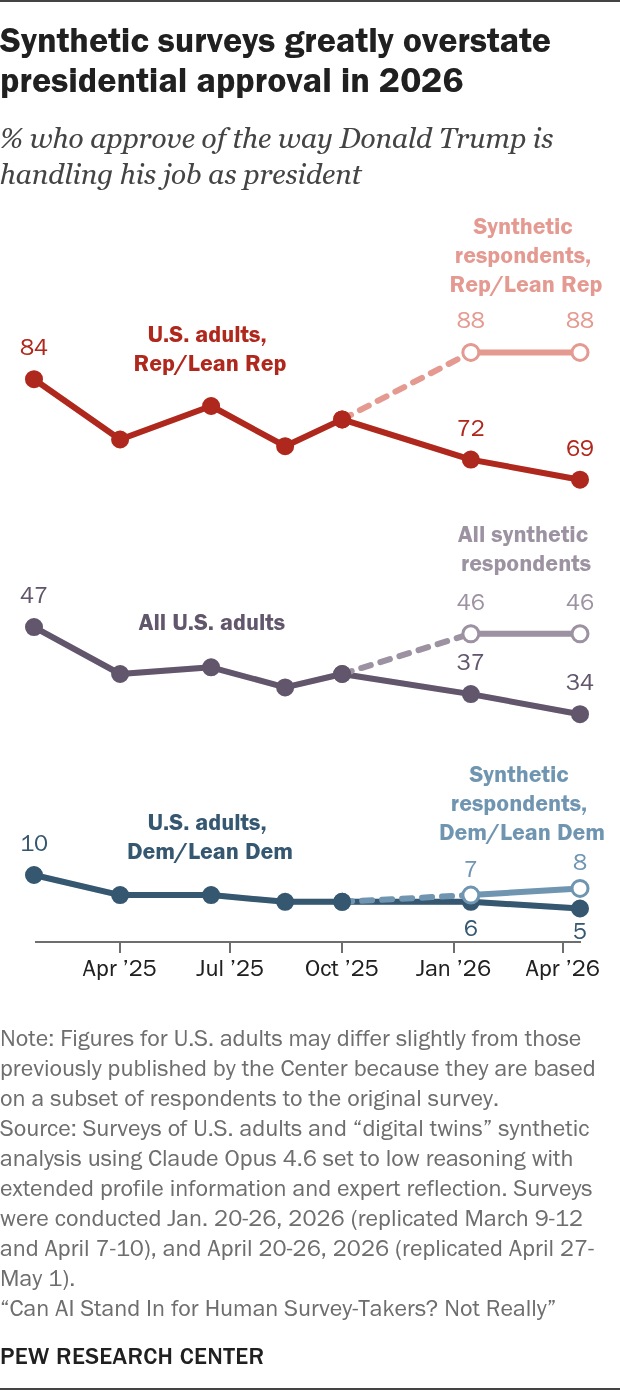
Presidential approval metrics serve as a gold standard for tracking long-term shifts in political climate. Between January and April 2026, Pew’s human panels tracked a notable decline in public approval of President Donald Trump’s job performance, falling from 37% in January to 34% by April.
The synthetic panels, however, proved entirely oblivious to this downward trajectory. The AI models estimated Trump’s approval rating at a stubborn 46% across both waves. While the synthetic model successfully tracked overall Democratic sentiment, it dramatically overestimated approval among Republicans and Republican leaners, missing actual human sentiment by up to 19 percentage points.
2. Fast-Moving International and Domestic Crises
When confronted with "timely and topical" events that occurred after the model’s baseline training data or involved unprecedented real-world dynamics, the AI failed to capture nuanced public division:
- Immigration Enforcement: Following controversies surrounding immigration enforcement actions—such as ICE agents wearing face coverings—the synthetic sample drastically underestimated the share of Americans who found masks acceptable. While 67% of human Republican respondents found the practice acceptable, only 35% of synthetic "Republicans" agreed.
- Conflict in Iran: Following the outbreak of military conflict involving the U.S., Israel, and Iran on February 28, 2026, the AI poll consistently overstated public support for the strikes. Around 93% of synthetic Republicans expressed strong confidence in Trump’s Iran policy and approved of the military actions, whereas actual human polling revealed that only about two-thirds (66%) of Republicans shared those views—a substantial gap between a solid majority and unanimous artificial consensus.
3. The Data Center Disconnect
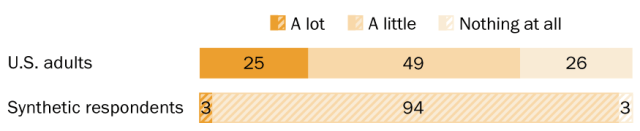
Perhaps the starkest illustration of synthetic polling failure occurred regarding regional infrastructure. When asked about local data centers, human respondents displayed a natural bell curve of awareness: 25% had heard a lot, 26% had heard nothing at all, and roughly half (49%) had heard a little.
The AI model, conversely, hallucinatory claimed that 94% of Americans had heard a little, while virtually collapsing the extremes to 3% each. Furthermore, nearly every synthetic respondent claimed ignorance about whether data centers were planned in their local area, and an overwhelming 97% to 99% falsely concluded that data centers were universally harmful to local quality of life, the environment, and home energy costs—views far more extreme than actual human sentiment.
Official Responses and Institutional Policy
The release of the Pew Research Center report has ignited intense debate within the data science and polling communities. As commercial enterprises look toward generative AI to slash the high costs and logistical friction of traditional human sampling, academic and non-partisan institutions are drawing a hard line.
In its official policy statement, the Pew Research Center affirmed its foundational commitment to direct human engagement:
"The Center believes that speaking to the public is essential to measuring public opinion and has no current or future plans to use AI models to generate survey results."
Methodologists argue that while Large Language Models (LLMs) are exceptionally proficient at mimicking human language, syntax, and average demographic persona traits, they fundamentally lack the lived experiences, emotional volatility, and authentic psychological shifting that define real public opinion during crises. An LLM acts as an echo chamber of internet text rather than an active, responsive citizen.
Implications for the Future of Public Opinion Research
The implications of the Pew study ripple across multiple industries, from political forecasting and market research to media polling and public policy design:
- The Illusion of Consensus: AI models are heavily biased toward consensus and predictability. When asked sensitive or polarized questions, "digital twins" frequently exaggerate partisan extremes or smooth over healthy societal debate, creating artificial unanimity that does not exist in the electorate.
- The Recency Trap: Even with advanced prompt engineering and extended profile conditioning, AI models struggle to process rapid shocks to the sociopolitical ecosystem. Events that break from historical precedent expose the dangerous lag and blind spots inherent in synthetic data generation.
- The Cost-Speed Trade-Off: While traditional polling is expensive, time-consuming, and dependent on declining response rates, the alternative—cheap, instantaneous AI polling—carries an unacceptable risk of profound inaccuracy.
As generative AI continues its rapid evolution, Pew’s rigorous experiment serves as a vital anchor for the research community. For now, the "digital twins" of silicon cannot replace the complex, unpredictable, and irreplaceable voice of the American public.
 Asep Darmawan
  Jia Lissa
  Neng Nana