
 By Dwi Wanna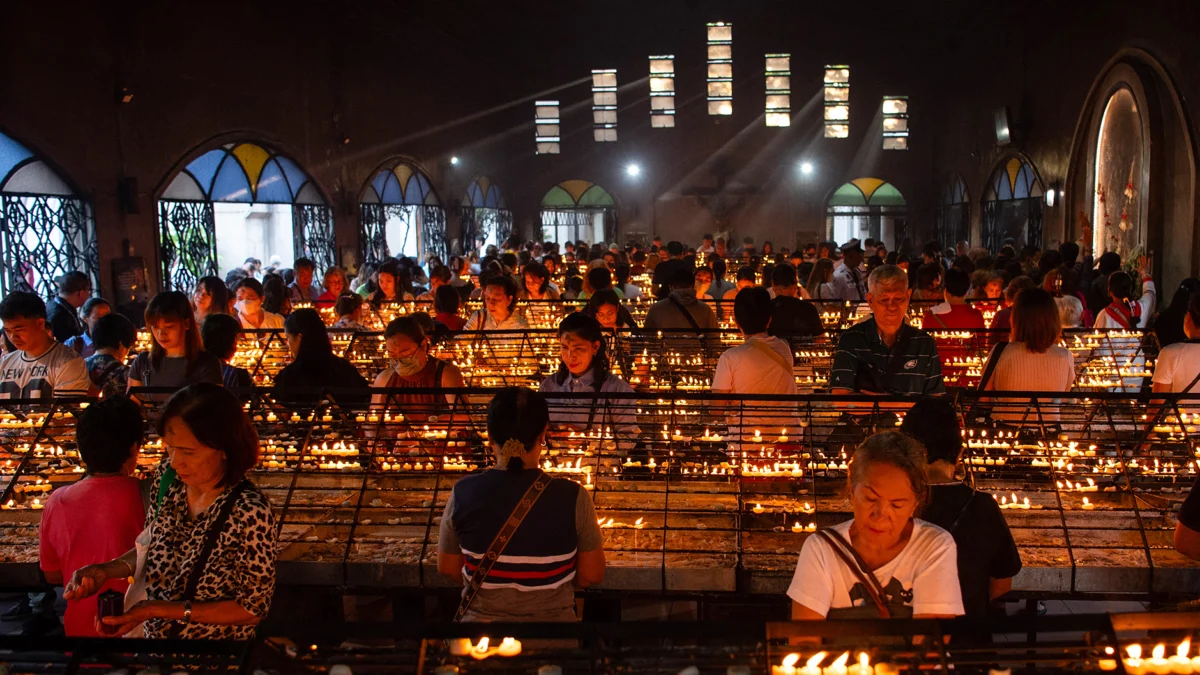
The Philippines stands as a unique bastion of faith in Southeast Asia. With a geographic spread of over 7,600 islands and a population defined by its fervent devotion, the nation offers a compelling case study for sociologists and theologians alike. According to recent data from the Pew Research Center, the Philippines remains one of the most religious nations on the planet, where spiritual identity is not merely a cultural artifact but a central pillar of daily existence.
Nearly every Filipino adult identifies with a religious tradition, and for nine-in-ten, religion is categorized as "very important" in their lives. These figures are among the highest recorded in global survey work, underscoring a societal framework where the divine is integrated into everything from personal decision-making to the formation of public policy.
1. A Nation of Faith: The Core Facts
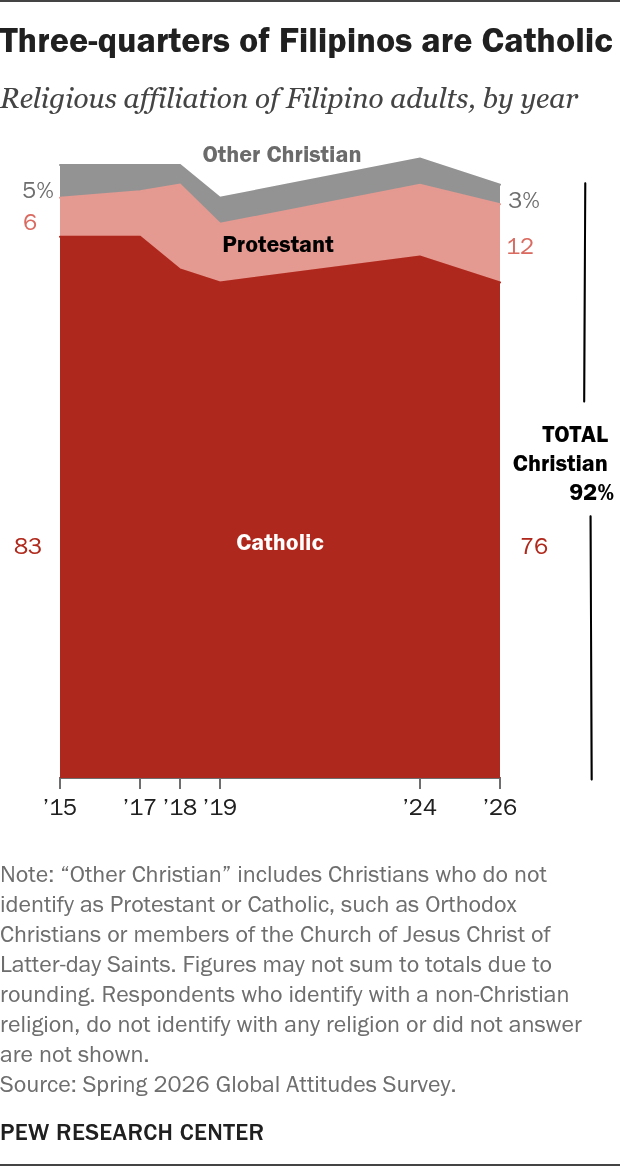
To understand the Philippines is to understand its religious demography. As of 2026, roughly 92% of Filipino adults identify as Christian. Within this majority, Catholicism remains the dominant force, claiming 76% of the population. This makes the Philippines home to the world’s third-largest Catholic population, trailing only Brazil and Mexico.
However, the religious landscape is not monolithic. Protestantism has seen a consistent presence, accounting for 12% of the population as of the most recent surveys. The remaining segments are comprised of a variety of other Christian denominations, as well as a significant Muslim minority, primarily in the southern regions of the archipelago. While this analysis focuses heavily on the Christian majority—largely due to sample size limitations in current polling regarding Muslim communities—it is essential to recognize that the Philippines is a pluralistic society where religious identity informs the national character.

2. Chronology: The Evolution of Belief
Religious affiliation in the Philippines has remained relatively stable, though not without minor fluctuations. Data tracking between 2015 and 2026 reveals a consistent trend. In 2015, 83% of the population identified as Catholic; by 2026, that figure stands at 76%. During the same period, Protestant affiliation saw a rise from 6% to 12%.
- 2015-2017: The Catholic majority remained steady at 83%.
- 2018: A notable shift occurred, with Catholic identification dipping to 78% as Protestantism climbed to 13%.
- 2019-2024: The numbers stabilized, with Catholicism hovering around 80% before adjusting to the 2026 levels.
- 2026: Current data indicates a slight diversification, with Catholicism at 76% and Protestantism at 12%.
These shifts reflect broader global patterns of religious switching. While the vast majority of Filipino Catholics remain "lifelong" adherents—raised in the faith and remaining within the fold into adulthood—the slight growth in Protestant denominations suggests an evolving spiritual marketplace.
3. Supporting Data: Practice and Belief
Beyond mere affiliation, the intensity of practice in the Philippines is striking. When asked about belief in God, 99% of Filipino adults respond in the affirmative. This near-unanimous consensus crosses denominational lines, uniting Catholics and Protestants alike.
The Power of Prayer
The Philippines consistently ranks at the top of international indices regarding the frequency of prayer. Approximately 79% of adults report praying on a daily basis. This is not restricted to the elderly; across age demographics, the practice remains a consistent feature of life. Catholics report a 77% daily prayer rate, while Protestants show an even higher intensity at 88%.
Ancestral Spirits and Rituals
A fascinating divergence between the two major Christian groups lies in their relationship with traditional spiritual beliefs. Over half of Filipino Catholics (56%) hold the belief that the spirits of ancestors can exert influence—either positive or negative—over the living. In contrast, only 26% of Protestants share this view. This suggests that for many Filipino Catholics, indigenous cultural beliefs and institutional faith exist in a syncretic harmony that is less prevalent among the Protestant population.
Furthermore, the physical manifestation of faith varies. Filipinos are three times more likely to light candles or incense for spiritual reasons if they are Catholic (76%) compared to their Protestant counterparts (27%). These practices highlight the tactile, sensory nature of Filipino Catholicism, which frequently incorporates devotional objects into personal piety.
4. Official Perspectives and Leadership
The relationship between the Filipino faithful and the Vatican remains strong, as evidenced by the high approval ratings for Pope Leo XIV. As of 2026, 79% of Filipino Catholics view the Pope with favor.
Age plays a significant role in these perceptions. Younger Catholics (ages 18–34) are more likely to express a positive opinion (86%) compared to those aged 50 and older (67%). This gap is partly attributed to awareness; 19% of older Catholics reported that they had never heard of the Pope or declined to answer, compared to only 7% of the youngest cohort. This indicates that while the Church hierarchy remains relevant, the digital and global connectivity of younger generations may play a role in their familiarity with modern Church leadership.

5. Implications: Religion and the State
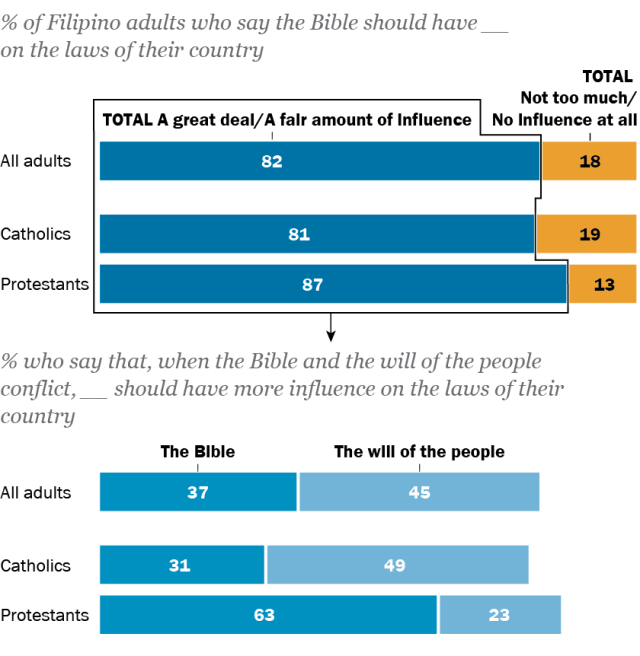
One of the most complex areas of inquiry is the role of the Bible in public life. A vast majority of Filipinos (82%) agree that the Bible should exert either "a great deal" or "a fair amount" of influence on national laws. This sentiment is shared across the religious spectrum, with 81% of Catholics and 87% of Protestants in agreement.
However, a fundamental tension arises when respondents are asked how to navigate conflicts between religious texts and the "will of the people." When presented with this hypothetical conflict:
- Protestant View: 63% believe the Bible should hold more influence than the will of the people.
- Catholic View: Only 31% share this view, with 49% favoring the will of the people as the primary arbiter of law.
This divide highlights a significant difference in the application of faith to governance. The Protestant population in the Philippines appears to lean toward a more "biblically centric" approach to statecraft, whereas the Catholic majority leans toward a democratic, populist interpretation of legal legitimacy.
Future Outlook and Scholarly Context
The research provided by the Pew-Templeton Global Religious Futures project suggests that the Philippines will continue to serve as a bellwether for the role of religion in a modern, developing nation. The integration of high-frequency religious practice with democratic participation is a defining characteristic of the Filipino experience.
As the nation navigates the 21st century, the interaction between these deeply held beliefs and the evolving needs of a globalized economy will be critical. Whether through the lens of legislative debates or the changing demographics of belief, religion in the Philippines is not a static relic of the past, but a vibrant, living force that continues to shape the trajectory of the nation.
Methodology and Acknowledgments
The findings detailed in this report are primarily drawn from the Pew Research Center’s 2024 surveys of 36 countries and a 2026 study on religious affiliation in the Philippines. The methodology involved extensive opinion polling and demographic analysis designed to capture the nuance of faith in diverse cultural contexts.
This work was produced as part of the Pew-Templeton Global Religious Futures project, which receives funding from The Pew Charitable Trusts and the John Templeton Foundation. By documenting these trends, researchers aim to foster a better understanding of how religious change impacts global societies, ensuring that policymakers and the public alike have access to data-driven insights into the forces that move the human spirit.
Citation: Evans, Jonathan and Kirsten Lesage. 2026. "5 facts about religion in the Philippines." Pew Research Center. doi: 10.58094/kp5g-vp74.
 Muslim
  Nana Muazin
  Siti Muinah