
 By Siti Muinah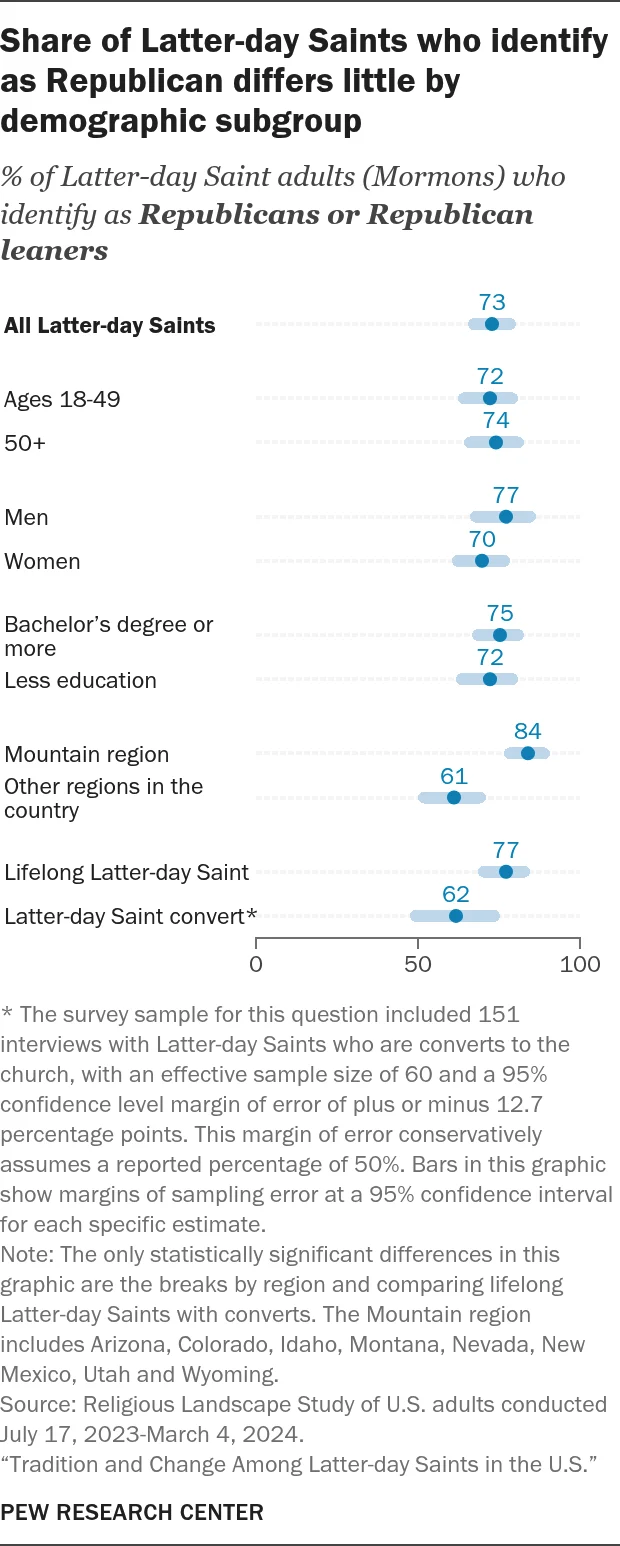
By Global News Desk
Published: September 2026
Main Facts
A comprehensive new research project released by the Pew Research Center sheds light on the complex intersection of religious devotion, social philosophy, and political alignment among members of the Church of Jesus Christ of Latter-day Saints—widely known as Mormons—in the United States.
The data reveals that while Latter-day Saints remain a heavily conservative voting bloc with deep ties to the Republican Party, they occupy a fascinating paradox in modern American politics. On traditional moral issues such as abortion and the societal acceptance of homosexuality, Latter-day Saint Republicans lean significantly more conservative than the average national Republican. However, when the conversation shifts to questions of racial diversity, ethnic pluralism, and religious variation, these same voters are notably more progressive and optimistic than their partisan peers nationwide.
Key takeaways from the report include:
- Overwhelming Republican Alignment: Approximately 73% of U.S. Latter-day Saints identify as Republicans or lean toward the GOP, compared with just 23% who align with the Democratic Party.
- The Mountain Region Concentration: Political affiliation is strongest in the Mountain region (Arizona, Colorado, Idaho, Montana, Nevada, New Mexico, Utah, and Wyoming), where 84% of church members identify as Republican. All nine Latter-day Saints currently serving in the U.S. Congress represent this region and belong to the GOP.
- Divergence on Diversity: Roughly 75% of Latter-day Saint Republicans say that a U.S. population made of many different races and ethnicities strengthens American society—outpacing the 60% average among all U.S. Republicans. Furthermore, 60% say religious diversity strengthens the country, compared to a 39% national Republican average.
- Shifting Internal Views: Although traditional orthodoxy remains robust, certain social views are experiencing internal evolution. For instance, 46% of all Latter-day Saints now believe that homosexuality should be accepted by society—a dramatic climb from just 24% when measured by Pew Research in 2007.
Chronology: Tracing Pew’s Study of Latter-day Saints
To fully understand the current snapshot of Latter-day Saint culture in America, researchers and sociologists look at a historical continuum of demographic shifts, major milestones, and progressive data collection over the last two decades.
- 2007 (Shifting Baselines): Long-term religious tracking by organizations like the Pew Research Center began recording baseline metrics on social attitudes within the Latter-day Saint community, capturing a period when the church’s social views were largely homogenous and deeply traditional.
- January 2012 (The Landmark Survey): The Pew Research Center published "Mormons in America," an extensive executive summary and survey that served as a cornerstone for understanding the community’s unique civic engagement, high retention rates, and solidifying political identity.
- October 2018 (A Linguistic Shift): President Russell M. Nelson of the Church of Jesus Christ of Latter-day Saints delivered a historic address emphasizing the correct name of the church. He explicitly discouraged the use of the moniker "Mormon" or "Mormon Church," directing members and global media outlets toward the full name of the faith or the term "Latter-day Saints."
- July 2023 – March 4, 2024 (The Religious Landscape Study): Field researchers conducted the extensive Religious Landscape Study (RLS). Funded by major philanthropic entities including The Pew Charitable Trusts, Lilly Endowment Inc., and the Templeton Religion Trust, the survey sampled 36,908 randomly selected U.S. adults—including dedicated subsets of 565 current Latter-day Saints (414 lifelong members and 151 converts) and 316 former members. This massive data collection window concluded months ahead of the 2024 U.S. presidential election.
- September 2026 (Public Release): Pew officially published its granular findings under the title "Tradition and Change Among Latter-day Saints in the U.S.," giving researchers, theologians, and political scientists their first comprehensive look at post-pandemic religious trends within the faith.
Supporting Data and Demographic Analysis
The quantitative findings of the 2023–24 Religious Landscape Study offer a granular look at the demographic underpinnings of the Latter-day Saint population. While the political cohesion of the church is striking, subtle differences emerge when examining geography, conversion status, and education.

Partisan Breakdown Across Subgroups
When researchers cross-referenced Republican identification and leanings across various demographic vectors, the numbers showed remarkable stability:
- All Latter-day Saints: 73% (Lower bound: 67.3%, Upper bound: 78.4%)
- Ages 18–49: 72%
- Ages 50+: 74%
- Men: 77%
- Women: 70%
- Bachelor’s Degree or More: 75%
- Less Education: 72%
- Mountain Region vs. Other Regions: Members residing in the Mountain states registered an 84% Republican affiliation, while those living in all other regions dropped significantly to 61%.
- Lifelong Members vs. Converts: Lifelong members of the church register a 77% GOP alignment, whereas converts show a softer, though still solid, 62% partisan alignment.
Contrasting Latter-day Saint Republicans with National Republicans
On specific hot-button cultural and social topics, the survey highlights stark divergences between Latter-day Saint Republicans and the broader national base of the Republican Party:
- Abortion Policy: Only 21% of Latter-day Saints believe abortion should be legal in all or most cases, compared to 42% of Republicans overall—a striking 21-percentage-point conservative divergence.
- Acceptance of Homosexuality: Only 37% of Latter-day Saint Republicans say homosexuality should be accepted by society, trailing the broader Republican average of 50%.
- Racial and Ethnic Diversity: Compensating for their conservative reputation on moral issues, 75% of Latter-day Saint Republicans view a multiracial and multiethnic U.S. population as a strength, outperforming the national Republican benchmark of 60% by 15 points.
- Religious Pluralism: A commanding 60% of Latter-day Saint Republicans agree that a nation composed of people from many different religions strengthens American society, dwarfing the 39% figure found among Republicans nationwide.
- Immigration Views: While 46% of Latter-day Saint Republicans view a growing immigrant population as a change for the worse, 31% view it as a change for the better—higher than the 18% recorded among all Republicans nationally.
Official Responses and Contextual Frameworks
Sociologists and institutional representatives have been quick to contextualize the numbers, pointing out that the unique cultural position of Latter-day Saints flows naturally from their history as a historically persecuted religious minority that eventually built a cohesive, community-oriented society in the American West.
Researchers note that because Latter-day Saints make up roughly 2% of the total U.S. population, their lived experience as a distinct religious minority likely influences their broader appreciation for religious and cultural pluralism. Even as they maintain strict doctrinal standards regarding personal morality, family structure, and lifestyle choices, their theological emphasis on global missionary work exposes many members to diverse cultures and international populations at an early age—potentially fostering an openness to multicultural dynamics that transcends standard political polarization.
Furthermore, church leadership has consistently maintained a strict political neutrality as an institution, encouraging individual members to participate thoughtfully in civic life while refraining from endorsing specific candidates or political parties. Despite this official stance, the shared conservative moral framework preached from the pulpit has historically fostered a strong alignment with conservative political platforms.
Implications for the Future of American Politics and Religion
The publication of the Pew Research Center’s data carries profound implications for political analysts, religious leaders, and cultural observers alike.

1. The Myth of the Monolith
For decades, political strategists have treated religious conservative groups as ideological monoliths. However, the data demonstrates that even within a highly organized and disciplined faith tradition like the Church of Jesus Christ of Latter-day Saints, internal nuances exist. The divide between lifelong members and converts, as well as the geographical split between the Mountain West core and diaspora communities elsewhere in the United States, proves that religious subcultures are dynamic.
2. A Bridge in the Culture Wars?
The willingness of Latter-day Saint Republicans to embrace racial and religious diversity—while simultaneously holding firm lines on traditional religious doctrines—suggests a complex voter profile. In an era defined by hyper-partisanship and binary thinking, this demographic refuses easy categorization. Their strong support for multiculturalism combined with deep-seated social conservatism points to a distinct worldview rooted in communitarian values rather than secular political tribalism.
3. The Secularization Narrative
While many mainstream Christian denominations in the United States have faced precipitous membership declines and rapid secularization over the past two decades, the data indicates that Latter-day Saints retain exceptionally high levels of religious commitment, institutional loyalty, and lifestyle adherence. Nevertheless, the subtle liberalizing trends regarding specific social attitudes—such as the rising acceptance of homosexuality among younger members—demonstrate that even the most resilient faith traditions are not entirely immune to broader cultural currents.
As the United States moves further into the 21st century, the community of Latter-day Saints will undoubtedly remain a fascinating case study in how ancient religious traditions negotiate modern political identity, community preservation, and engagement with a pluralistic society.
 Asro
Asro  Laily UPN
  Lina Hope