
 By Ali Ikhwan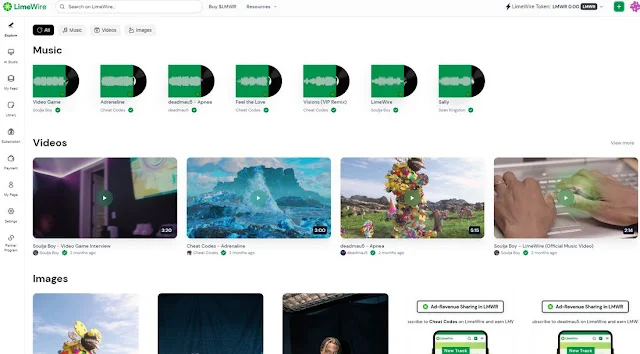
Main Facts
LimeWire—a brand historically synonymous with the decentralized peer-to-peer (P2P) file-sharing networks of the early 2000s—has officially redefined itself as a cutting-edge generative artificial intelligence (AI) platform and content-publishing studio. Today, the platform operates as a multifaceted digital ecosystem designed to democratize AI content creation, automate blockchain-based asset minting, and provide robust monetization channels for digital artists, musicians, and creators.
Operating primarily through its core interface, the LimeWire AI Studio, the platform merges advanced generative algorithms with Web3 infrastructure. Users can generate high-fidelity images using industry-standard models such as Stable Diffusion (versions 2.1 and XL) and OpenAI’s DALL-E 2. Once a piece of content is produced, creators can effortlessly publish their work, which automatically mints the creation as a Non-Fungible Token (NFT) on scalable blockchains like Polygon or Algorand.
The platform’s economic engine is driven by its native utility cryptocurrency, LMWR. Through LMWR, creators receive monthly payouts derived from platform ad revenue and secondary-market royalties. Moreover, high-profile mainstream entertainers—including Deadmau5, Soulja Boy, and Sean Kingston—have leveraged the environment to distribute proprietary digital collectibles, music, and video assets, signaling mainstream validation for the platform’s Web3-integrated content model.
Chronology of Transformation
To understand how LimeWire transitioned from a legal battleground in the music piracy era to a regulated Web3 and AI ecosystem, it is essential to trace its timeline:
- 2000–2010 (The P2P Era): Founded by Mark Gorton, LimeWire reigned as one of the world’s most popular Java-based file-sharing applications. The platform eventually faced severe copyright infringement lawsuits led by the Recording Industry Association of America (RIAA), culminating in a 2010 federal court injunction that forced the original software offline and shuttered operations.
- 2022 (The Acquisition and Rebrand): Austrian entrepreneurs Julian and Paul Zehetmayr acquired the dormant LimeWire brand rights with a vision to pivot the nostalgic moniker toward the burgeoning creator economy and blockchain technology.
- 2022–2023 (Crypto Launch and NFT Pivot): LimeWire launched its native utility token, LMWR, through private and public sales. The platform initially re-emerged as a curated digital marketplace for music NFTs and digital art collectibles, partnering with prominent independent and mainstream music acts.
- Late 2023–Present (The Generative AI Integration): Recognizing the explosive growth of generative AI, LimeWire integrated state-of-the-art text-to-image models. The platform transitioned into an all-in-one "AI Studio," allowing users to generate, publish, mint, and monetize artificial intelligence art within a single interface. Roadmap announcements further signaled impending expansions into AI-driven music and video synthesis tools.
Supporting Data & Platform Economics
LimeWire’s business architecture rests on a tiered subscription framework coupled with an aggressive creator-first revenue-sharing model. Understanding the math behind the platform requires examining its credit systems, subscription tiers, and tokenized payouts.
Subscription Tiers and Credit Allocation
LimeWire operates on a freemium model designed to capture casual users while supplying heavy creators with high-volume computational resources:
- Free Tier: Users receive 10 complimentary daily credits (yielding approximately 20 image generations per day) along with a 50% ad revenue share.
- Basic Tier ($9.99/month): Delivers 1,000 monthly credits (up to 2,000 image generations), early access to new AI models, a 50% ad revenue share, a Pro profile badge, faster processing speeds, and an ad-free interface.
- Plus Tier ($29.00/month): Scales up to 3,750 credits (up to 7,500 generations), early access features, and a 60% ad revenue share.
- Pro Tier ($49.00/month): Provides 5,000 credits (up to 10,000 generations), full creation history, and an elevated 70% ad revenue share.
- Advanced/Enterprise Tier ($99.00/month): Grants 11,250 credits per month (up to 22,500 image generations), priority processing, and a maximum 70% ad revenue share.
The LMWR Token and Revenue Distribution
Monetization on LimeWire deviates from traditional fiat-only web monetization by anchoring earnings to its native cryptocurrency, LMWR:
- Ad Revenue Split: Creators earn up to 70% of all advertising revenue generated when other platform users view their published images, music, or videos. Payouts are distributed monthly in LMWR tokens.
- Secondary Market Royalties: Whenever a fan or collector trades a creator’s minted NFT on the LimeWire marketplace, the original creator automatically captures a 2.5% royalty on the transaction.
- Token Utility: Beyond cash-out options on major cryptocurrency exchanges such as Kraken, ByBit, and Uniswap, users can spend LMWR tokens directly on the platform to purchase additional prompt credits for generative AI tools.
Official Responses and Strategic Vision
Leadership behind the resurrected LimeWire brand has consistently emphasized that the platform is engineered to solve the economic precarity traditionally faced by digital artists in the web era.
Julian Zehetmayr, co-CEO and co-founder of the revitalized LimeWire, stated in corporate briefings that the objective was never merely to build another image generator, but to construct a self-sustaining economy where creators retain absolute ownership of their digital output. According to executive statements, the integration of generative AI serves as a catalyst to lower the barrier to entry for visual arts, while blockchain infrastructure ensures transparent, immutable attribution and monetization.
Industry observers note that securing endorsements from legacy artists like Deadmau5 and Soulja Boy was a deliberate strategic maneuver to bridge the gap between Web3 skepticism and mainstream cultural adoption. By positioning LimeWire Studio as a legitimate publishing house rather than a speculative crypto-project, management has sought to insulate the brand from regulatory headwinds that plagued earlier iterations of NFT-centric platforms.
Implications for the Creative Industry and Generative AI Landscape
The emergence of modern LimeWire carries profound implications for multiple overlapping sectors, including the creator economy, intellectual property law, and the software-as-a-service (SaaS) generative AI market.
1. Democratization of Artistry vs. Copyright Concerns
By granting free access to advanced models like Stable Diffusion XL and DALL-E 2 alongside user-friendly style modifiers (such as cinematic, anime, pixel art, and analog film presets), LimeWire lowers the technical threshold for artistic creation. However, like all platforms relying on open-source diffusion models, it inherits industry-wide debates regarding training data provenance, copyright ethics, and the displacement of human graphic designers.
2. The Normalization of Web3 Integration
Many consumer-facing applications have struggled to introduce blockchain mechanics without alienating non-technical users. LimeWire’s approach—which automates the minting of content as an NFT on Polygon or Algorand entirely in the background upon publication—serves as a case study in frictionless Web3 integration. Users do not need to understand smart contracts to tokenize their output; the platform handles decentralization seamlessly.
3. Redefining Platform Loyalty Through Revenue Sharing
Traditional social media and content-hosting platforms historically retained the vast majority of monetization upside derived from user engagement and ad impressions. By committing up to a 70% ad revenue share and programmatic royalty structures, LimeWire challenges the legacy Web2 business model. If sustainable at scale, this framework could force larger technology conglomerates to reevaluate how they compensate independent content creators.
Conclusion
LimeWire’s evolution from an infamous peer-to-peer file-sharing software to a sophisticated generative AI studio and Web3 publishing network stands as one of the most unexpected corporate pivots in technology history. By combining accessible, multi-model AI image generation with automated blockchain minting and lucrative token-based revenue sharing, the platform has carved out a distinct niche. As LimeWire prepares to roll out its proprietary AI models alongside upcoming music and video generation tools, it remains positioned as a dynamic testing ground for the future intersection of artificial intelligence, digital ownership, and the global creator economy.
 Evan Lee Salim
  Nana Wu
  Siti Muinah