
 By Azzam Bilal Chamdy
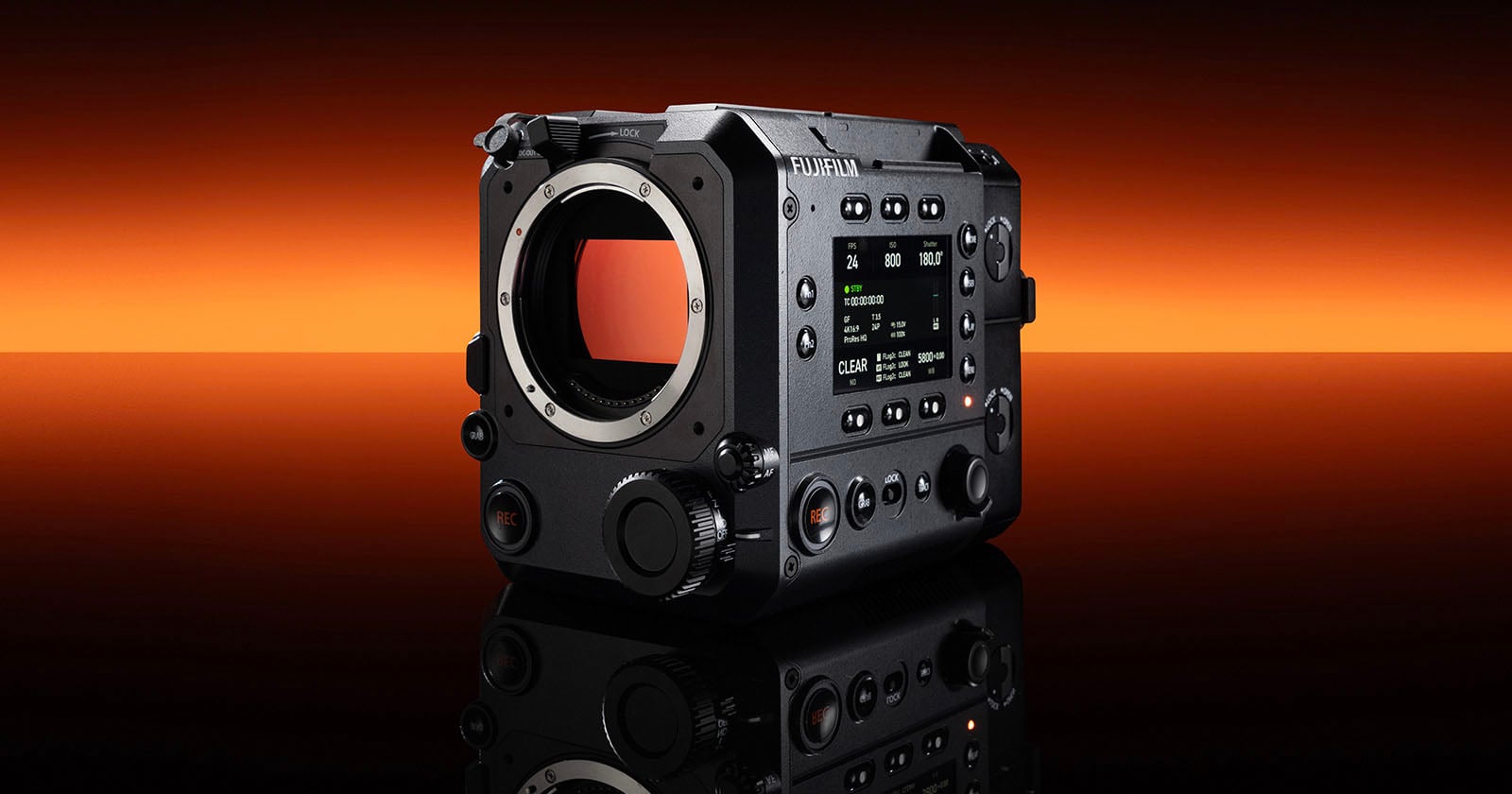
Fujifilm has officially unveiled an ambitious, multi-phase firmware roadmap for the GFX Eterna 55, its flagship IMAX-certified cinema camera. Since its high-profile launch in September 2025, the Eterna 55 has established itself as a formidable player in the professional filmmaking landscape. By outlining a series of strategic updates that stretch from the present day into early 2027, Fujifilm is signaling a long-term commitment to evolving the camera’s utility, workflow efficiency, and creative potential for cinematographers working in demanding production environments.
The Core Transformation: What the Roadmap Means for Filmmakers
The Eterna 55, known for its massive GFX-series sensor and the ability to capture open-gate footage, has already made waves for its unique marriage of high-resolution medium format aesthetics and dedicated cinema features. However, the newly announced firmware path—beginning with version 1.10 and culminating in the highly anticipated version 1.30—suggests that Fujifilm is listening closely to the needs of working professionals.
The update strategy is bifurcated: immediate stability improvements followed by deep-feature integration. By focusing on both the backend "quality of life" improvements—such as playback formats and settings management—and advanced technical capabilities like automatic neutral density (ND) adjustments, Fujifilm is attempting to bridge the gap between a high-end production tool and an intuitive, field-ready workhorse.
Chronology of the Firmware Deployment
Fujifilm has structured the rollout to minimize disruption to active productions while ensuring that power users have a clear trajectory for when specific features will become available.
Phase 1: Stability and Refinement (Version 1.10)
Available immediately, Firmware Version 1.10 serves as the foundational update. While it does not introduce flashy new creative tools, it addresses the essential requirements of any professional-grade cinema camera: stability and reliability. Fujifilm describes this update as a necessary step to refine the overall shooting experience, ironing out minor software bugs and optimizing performance to ensure the sensor and processor are working in perfect harmony.
Phase 2: Workflow and Playback Enhancements (Version 1.20)
Scheduled for release before the conclusion of 2026, Version 1.20 is designed to integrate the Eterna 55 more seamlessly into professional post-production pipelines. Key additions include:
- Native MXF Playback: The ability to review Material eXchange Format (MXF) files directly on the camera. This is a critical feature for DPs (Directors of Photography) who need to verify exposure and color on-set without offloading to a secondary monitor.
- Settings Management App: A new, dedicated mobile application will allow users to back up and restore camera settings. This is a massive boon for rental houses and multi-camera productions, where matching configurations across several bodies is a time-consuming necessity.
- Anamorphic Expansion: The update introduces new desqueeze options, specifically targeting Open Gate 4K 4:3 workflows, allowing for greater flexibility when using vintage or modern anamorphic glass.
- I/O Latency Optimization: Building on the foundations laid in version 1.04, this update further refines the latency performance of SDI and HDMI outputs, which is vital for live monitoring and wireless video transmission.
Phase 3: The "Auto-ND" Revolution (Version 1.30)
Slated for January 2027, Version 1.30 is arguably the most significant update in the camera’s history. It targets the electronic variable neutral density (VND) system, transforming it from a static tool into an automated, responsive creative engine.
Supporting Data: The Impact of Electronic Variable ND
The crown jewel of the upcoming 1.30 update is the introduction of automatic in-camera adjustment of the ND filter density. Traditionally, managing exposure in variable lighting conditions requires a constant dance between the aperture (iris), shutter speed, and ISO. Changing the iris to adjust exposure inherently alters the depth of field—often an undesirable side effect in narrative filmmaking.
By allowing the Eterna 55 to automatically adjust its internal ND filter while maintaining a constant iris, shutter angle, and ISO, Fujifilm is granting operators the ability to maintain a consistent "look" regardless of lighting shifts. This is particularly valuable for documentary filmmakers moving between indoor and outdoor settings, or for operators tracking subjects through complex lighting environments.
This capability, often referred to as "iris-pulling without the exposure shift," has become a gold standard in the industry, previously dominated by select high-end cinema lines. The inclusion of this feature in the GFX Eterna 55 places it in direct competition with cameras costing significantly more, further validating its position as a serious cinema camera.
Professional Integration: LANC and Duvo Lens Support
Beyond exposure management, the version 1.30 update emphasizes hardware interoperability. The addition of Local Application Control Bus System (LANC) support allows for the use of standard remote control grips, focus controllers, and zoom demands.
Furthermore, the integration of remote control features for the Fujifilm Duvo series of lenses—specifically through the multi-function dial located on the camera body and top handle—is a strategic move. The Duvo series, known for its broadcast-ready zoom capabilities, will now feel like a native extension of the Eterna 55. This unification of control reduces the need for external accessories and simplifies the operator’s interface, allowing for faster adjustments during high-stakes shoots.
Implications for the Industry
The decision to provide such comprehensive updates for the GFX Eterna 55 highlights several key trends in the modern digital cinema market:
1. The Rise of the "Living Camera"
Modern cinema cameras are increasingly being defined by their software as much as their hardware. Fujifilm’s decision to publish a multi-year roadmap demonstrates a shift toward the "living camera" model, where the value of a hardware investment continues to grow long after the initial purchase. For a $16,500 investment, this level of ongoing support is not just a perk—it is an expectation that Fujifilm is actively meeting.
2. Democratization of High-End Features
Features that were once the exclusive domain of top-tier Arri or Panavision systems—such as advanced internal ND management and robust open-gate metadata handling—are rapidly becoming standard on high-end mirrorless and compact cinema bodies. By incorporating these into the Eterna 55, Fujifilm is effectively lowering the barrier to entry for independent filmmakers looking for IMAX-quality output.
3. Workflow as a Differentiator
The focus on MXF playback and settings management via an app underscores that camera manufacturers are no longer just selling sensors; they are selling workflows. The time saved by being able to sync settings across a production via a mobile app can equate to significant cost savings on a professional set.
Official Response and Availability
Fujifilm has been clear that these updates are a direct result of user feedback collected since the camera’s launch. By engaging with the community and observing how the Eterna 55 is being utilized in the wild—whether for narrative, commercial, or documentary work—the company has identified the specific pain points that this roadmap aims to alleviate.
For current and prospective owners of the Fujifilm GFX Eterna 55, the roadmap provides a sense of security. Knowing that the camera will gain advanced ND automation and deeper lens integration by early 2027 justifies the current price point and encourages those sitting on the fence to commit to the system.
All firmware updates will be made available through the official Fujifilm Eterna 55 firmware support page. Users are encouraged to bookmark this resource and subscribe to firmware notifications to ensure they are the first to implement these critical performance enhancements.
Conclusion
The GFX Eterna 55 was already a landmark device for Fujifilm, representing its boldest foray into the cinema market to date. With the announcement of this comprehensive firmware roadmap, the company is proving that it is not merely interested in the initial sale, but in the long-term viability of the camera as a professional tool.
As we look toward 2027, the Eterna 55 is set to become an increasingly sophisticated and capable instrument. Whether through the refined stability of version 1.10, the workflow efficiencies of version 1.20, or the game-changing automation of version 1.30, Fujifilm is clearly positioning this camera to remain relevant, competitive, and essential for the next generation of cinematographers. The message to the industry is clear: the Eterna 55 is not finished evolving, and its best days are still on the horizon.
 Raul Delapena Setiawan
  rifanmuazin
  Ammar Sabilarrohman