
 By Lina Irawan
TOKYO — For the better part of two decades, the dedicated digital camera industry operated under a stubborn, aging paradigm. As smartphone manufacturers steadily cannibalized the point-and-shoot market, legacy camera giants doubled down on traditional demographics: middle-aged men, seasoned photojournalists, and high-end commercial professionals. Marketing campaigns routinely emphasized raw technical specifications, megapixels, shutter speeds, and rugged weather-sealing—metrics that rarely captured the imagination of the everyday content creator.
Today, that archaic playbook is being systematically dismantled.
Recent data and industry insights published by Nikkei Asia and corroborated by internal corporate disclosures reveal a profound demographic shift quietly sweeping through the photography sector. Fujifilm, a brand historically celebrated for its deep roots in photographic film, is experiencing a staggering renaissance. Propelled by an aggressive strategy to capture younger demographics—most notably female consumers and Gen Z creators—Fujifilm has fundamentally rewritten what it means to be a modern camera manufacturer.
According to data confirmed by Fujifilm’s Corporate Vice President, Kouji Matsumoto, roughly 40% of the user base for the company’s celebrated X Series consists of women, while an overwhelming 70% of total users are individuals in their 30s or younger. These figures stand in stark contrast to the historical norms of the industry, offering a rare, transparent glimpse into a business model that is not merely surviving the smartphone era, but actively thriving within it.
Main Facts: The Demographic Shift Driving Fujifilm’s Ascent
The numbers speak for themselves. In an industry where demographic data is traditionally guarded like state secrets, Fujifilm’s recent admissions illuminate a demographic goldmine.

- Youthful Adopters: Over 70% of Fujifilm’s X Series camera users are under the age of 40, capturing a vibrant cohort of Millennials and Generation Z photographers who grew up entirely in the digital and smartphone age.
- The Female Demographic: Approximately 40% of the X Series consumer base is female. This represents a massive departure from legacy camera demographics, which historically skewed heavily male.
- Explosive Shipment Growth: Fujifilm’s total global digital camera shipments have surged dramatically over a three-year period, climbing from 430,000 units in 2023 to 740,000 units, before breaking past the 1.16 million mark.
- Production Scaling: Mirrorless and X Series production ramped up from 380,000 units in 2023 to an estimated 750,000 units last year, marking the steepest percentage growth of any major Japanese legacy camera brand.
These statistics underscore a vital reality: Fujifilm is not just selling more cameras; it is selling them to an entirely new audience that views photography not merely as a technical hobby, but as a lifestyle, an extension of personal style, and a medium for artistic self-expression.
Chronology: How Fujifilm Built Its Modern Momentum
To understand how Fujifilm arrived at this pivotal moment, it is necessary to examine the chronological evolution of its product strategy and marketing initiatives over the past several years.
Phase One: The Heritage Aesthetic (Pre-2023)
Long before the current boom, Fujifilm made a conscious design choice that would ultimately pay massive dividends. Rather than chasing the utilitarian, futuristic aesthetic favored by some competitors, Fujifilm leaned heavily into nostalgia. By modeling its digital cameras—particularly the iconic X100 and X-T series—after classic mid-century film cameras, the company created objects of desire. These cameras featured physical shutter speed dials, aperture rings, and a tactile, analog shooting experience that stood in direct opposition to the smooth, screen-dominated interface of smartphones.
Phase Two: The Post-Pandemic Creator Boom (2023)
As the world emerged from pandemic restrictions in 2023, a cultural craving for tangible, real-world experiences took hold. Fujifilm’s digital camera shipments stood at a modest 430,000 units. However, the company recognized a burgeoning appetite among younger consumers who were suffering from digital fatigue. Instead of treating smartphones as an enemy to be fought, Fujifilm positioned its compact, high-styling cameras as the ultimate antidote to sterile smartphone photography.
Phase Three: Experiential Marketing and Direct Engagement (2024–2025)
Realizing that younger, information-literate consumers do not buy products based on traditional print advertisements or spec sheets, Fujifilm pivoted heavily toward experiential marketing. The company expanded its global footprint of hands-on events, ranging from massive international "Fujikina" showcases to hyper-localized community meetups.

A prime example of this strategy occurred recently in Tokyo, where Fujifilm hosted a four-day experiential event. The gathering drew approximately 1,400 attendees, the vast majority of whom fell into the 20-to-30 age bracket. Crucially, 70% of the attendees were women, and an astonishing 90% of the participants admitted they had never previously used a Fujifilm camera. By placing cameras directly into the hands of curious content creators, influencers, and casual enthusiasts, Fujifilm transformed skeptics into brand loyalists.
Phase Four: Hitting the Top Three Milestone (2026)
By 2026, the cumulative effect of these initiatives pushed Fujifilm into the upper echelons of the global digital imaging market. While industry analysts frequently debate the exact nuances of market share rankings—particularly regarding the fine lines between mirrorless shipments and total digital camera output—the undeniable truth is that Fujifilm’s factories are running at a historic pace, driven by a demographic that legacy brands spent decades ignoring.
Supporting Data: Analyzing the Market Landscape
For industry watchers, tracking the health of the digital camera market has historically been an exercise in frustration. Camera manufacturers rarely disclose regional breakdowns, demographic profiles, or model-specific sales figures. Market analysts are typically left to extrapolate data from industry maps, financial reports, and customs filings.
However, publications like the Nikkei Industry Map and the Japan Company Handbook (Shikiho) provide critical windows into production realities. Data compiled across these reports shows a stark contrast between Fujifilm’s trajectory and the rest of the market. While industry titan Canon continues to lead the global market share in terms of sheer volume, Fujifilm has achieved the most aggressive upward momentum.
Fujifilm Digital Camera Shipments (Global Totals)
==================================================
2023: ■■■■■ 430,000 units
2024: ■■■■■■■■ 740,000 units
2025: ■■■■■■■■■■■■ 1,160,000 units
This trajectory highlights a fundamental truth about modern consumer electronics: growth is no longer captured by preaching to the converted. While older, traditional photographers continue to upgrade their gear incrementally, the explosive growth in shipments is being fueled entirely by new market entrants—specifically young women and Gen Z creators who value portability, aesthetic design, and out-of-camera color science over raw processing power.

Official Responses: The Philosophy Behind the Success
The philosophy guiding Fujifilm’s market dominance was succinctly captured by Corporate Vice President Kouji Matsumoto in statements provided to Nikkei Asia.
"Our main target is the discerning segment with a high level of information literacy," Matsumoto explained, detailing the company’s deliberate pivot toward modern, connected consumers. "We need to deliver a quality that resonates with that segment."
This focus on "information literacy" is crucial. Today’s younger consumers do not rely on traditional media reviews to make purchasing decisions. They inhabit an ecosystem of TikTok reviews, YouTube vlogs, Instagram aesthetics, and community-driven Discord servers. They research film simulations, color profiles, and ergonomic handling with microscopic scrutiny. Fujifilm’s response has been to ensure that its cameras—such as the viral X100VI—function not just as imaging tools, but as cultural artifacts that fit seamlessly into a curated lifestyle.
Furthermore, Matsumoto’s acknowledgment that 40% of X Series users are women validates what many industry observers have noticed on social media platforms: female photographers, street shooters, and lifestyle content creators have enthusiastically adopted Fujifilm systems. Features like built-in film simulations (such as Classic Chrome and Nostalgic Neg) allow users to achieve professional, nostalgic color grades straight out of the camera without spending hours hunched over editing software on a desktop computer—a massive selling point for creators on the go.
Implications: What This Means for the Future of Photography
Fujifilm’s success carries profound implications for the broader imaging industry. For years, competing camera manufacturers watched their user bases age gracefully—and dangerously. As legacy demographics grew older, the pipeline of new, young photographers threateningly ran dry.
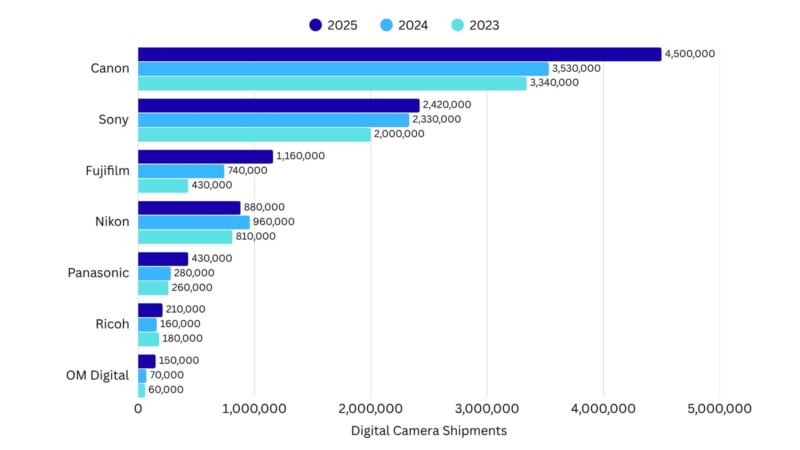
Fujifilm’s playbook demonstrates that the market for dedicated cameras is not shrinking; rather, it was simply being underserved by outdated marketing philosophies. By prioritizing industrial design, simplifying the creation process through in-camera color science, and investing heavily in face-to-face experiential marketing that resonates with women and younger demographics, Fujifilm has future-proofed its business.
Other legacy brands are already taking notice. Competitors are beginning to re-evaluate their own product lines, attempting to introduce more compact bodies, retro styling, and lifestyle-oriented marketing campaigns. However, replicating Fujifilm’s cultural cachet—built over decades of film heritage and carefully nurtured digital evolution—cannot be accomplished overnight.
As the camera industry marches forward, Fujifilm stands as a case study in modern market adaptation. By opening its arms to a diverse, youthful, and digitally native audience, the company has proven that the future of photography belongs to those willing to look beyond the spec sheet and capture the imagination of a brand-new generation.
 Suro Senen