
 By Suro Senen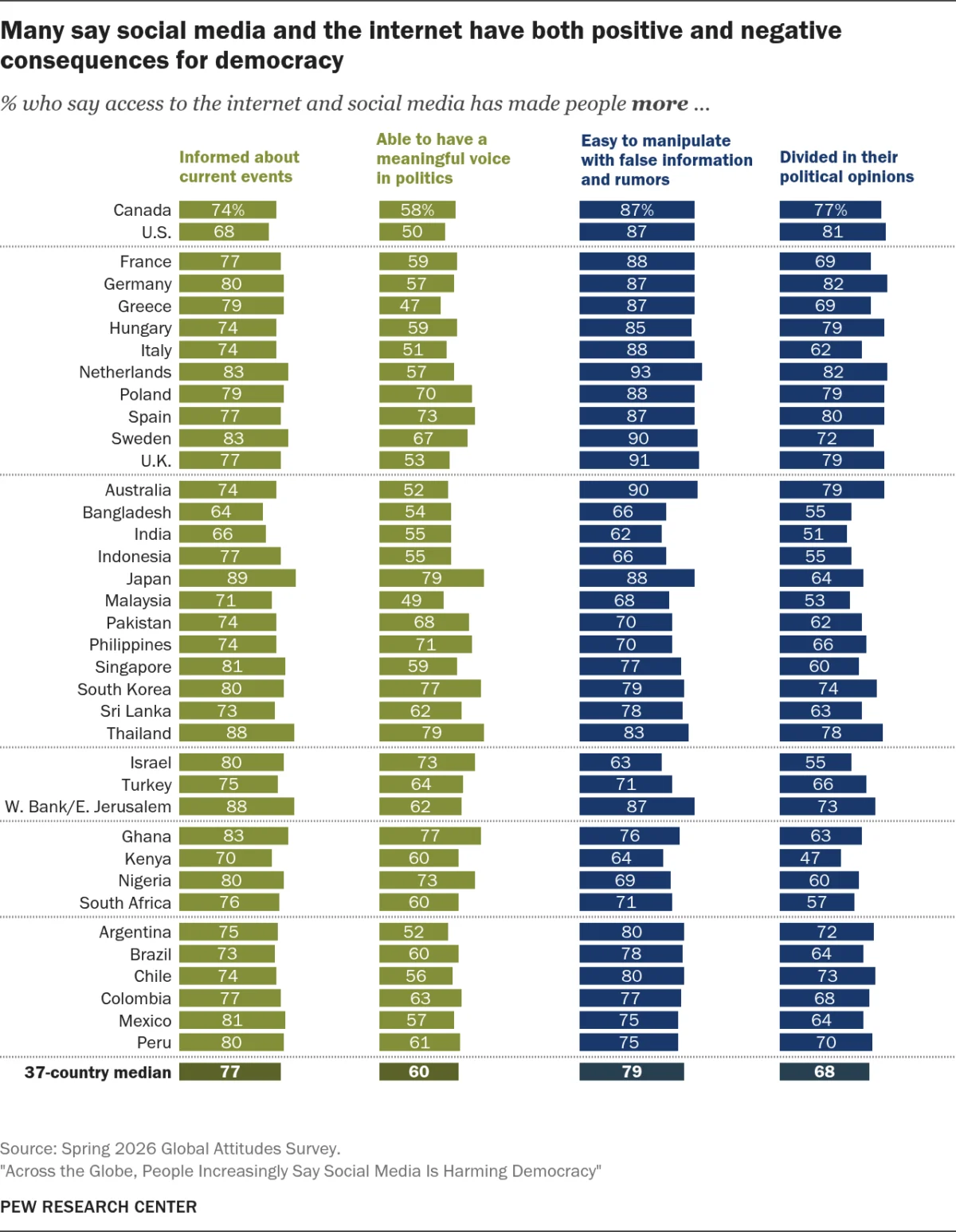
WASHINGTON — As digital platforms continue to embed themselves into the core infrastructure of the global information ecosystem, public sentiment regarding their societal footprint has taken a sharp downturn. A comprehensive, multi-nation study released by the Pew Research Center reveals that citizens worldwide are increasingly viewing social media as a corrosive force against democratic governance.
Covering over 45,000 respondents across 37 countries, the extensive global attitudes study highlights a striking paradox: while digital platforms are routinely praised for expanding political discourse and keeping populations informed, they are simultaneously blamed for driving unprecedented political polarization and easing the spread of misinformation.
Main Facts: The Growing Democratic Deficit
The findings, compiled from surveys conducted between February and June 2026, illustrate a clear macro-trend: in nearly every surveyed nation where historical trend data is available, public perception has soured significantly compared to figures recorded in 2022 and 2023.
- The United States Leads in Skepticism: American adults remain among the most critical of social media’s political impact, with 64% stating that platforms like Facebook, Instagram, and TikTok are detrimental to democracy. However, while U.S. sentiment has plateaued at this high level of distrust since 2022, other high-income nations are rapidly catching up.
- The Wealth Divide: Skepticism regarding social media is heavily concentrated in wealthier nations. Majorities in high-income economies—including the Netherlands (70%), France (65%), Germany (61%), the United Kingdom (56%), Canada (55%), and Australia (52%)—view social media as a net negative for democratic stability.
- The Developing World Perspective: Conversely, public sentiment trends in the opposite direction in lower-income and emerging economies. In nations such as Nigeria (80%), Thailand (77%), Kenya (75%), and the Philippines (74%), roughly three-quarters or more of the population view social media as a positive force for democracy.
- The Global Baseline: Despite rising anxieties, the cross-national median across all 37 countries still leans cautiously optimistic regarding overall impact, with a median of 55% viewing social media as a "good thing" for democracy, compared to 35% who view it as a "bad thing."
Chronological Context: The Escalation of Digital Skepticism
The trajectory of public opinion regarding digital platforms has undergone a profound transformation over the past decade.

- The Optimistic Era (Early 2010s): Following the Arab Spring and the initial widespread adoption of mobile internet, social networks were widely hailed by international observers, civil rights advocates, and technologists as tools for democratization—empowering grassroots movements and breaking state-controlled media monopolies.
- The Turning Point (2016–2018): Global confidence began to fracture in the wake of high-profile electoral interference scandals, the weaponization of personal data, and the rapid proliferation of coordinated disinformation campaigns across major western democracies.
- The Post-Pandemic Reality Check (2022–2023): As tracked by previous Pew Research iterations, public faith eroded rapidly during the global health crises and subsequent polarized elections. By 2022, substantial pluralities in countries like Germany, South Korea, and the U.S. began registering deep-seated concerns over echo chambers and institutional distrust.
- The 2026 Benchmark: The current 2026 data marks a tipping point. In key European and Asia-Pacific markets—including Poland, Germany, France, and Japan—the share of the population labeling social media a "bad thing" for democracy has expanded by double-digit margins over a mere four-year window.
Supporting Data: A Double-Edged Sword for Society
To unpack why citizens hold such contradictory views, the Pew Research survey queried respondents on specific democratic mechanisms. The data reveals that public anxiety is not irrational; rather, it stems from a dual recognition of digital capabilities.
The Empowering Side: Information and Access
- Informed Publics: A staggering 37-country median of 77% of respondents agree that internet and social media access has made people more informed about current events. Majorities in every single surveyed nation share this sentiment.
- Political Voice: A median of 60% report that digital platforms have successfully granted ordinary citizens a more meaningful voice in the political arena, cutting through traditional institutional gatekeeping.
The Destructive Side: Manipulation and Polarization
- Vulnerability to False Information: An overwhelming median of 79% of global respondents believe that social media has made populations significantly easier to manipulate through false information and rumors.
- Political Polarization: A median of 68% state that platforms have deepened political divisions within their societies. In advanced democracies such as Germany (82%), the U.S. (81%), Spain (80%), Poland (79%), and the U.K. (79%), roughly eight-in-ten citizens believe digital networks are tearing the political fabric apart. Notably, partisan alignment in the U.S. has little bearing on this view: 83% of Republicans/leaners and 82% of Democrats/leaners agree that social media fuels division.
Demographic Divides: Age, Education, and Platform Usage
Public attitudes are far from monolithic within individual countries. Significant demographic fractures define who trusts and who distrusts the digital landscape.

The Age Gap
In almost every market where generational differences are statistically significant, younger adults (ages 18–34) are substantially more optimistic about social media’s democratic utility than their older counterparts (ages 50 and older).
- In the United Kingdom, 60% of young adults view social media positively, compared to only 31% of those over 50—a massive 29-point gap.
- Similar generational divides appear in India (+24 points), Ghana (+23 points), Thailand (+21 points), and the United States (+16 points).
However, researchers note a nuanced reality: younger demographics are simultaneously hyper-aware of the risks, frequently reporting high rates of exposure to political polarization and manipulative content, yet they continue to value the connective and informational utility of the tools.

Education and Platform Diversity
Education correlates with nuanced views: highly educated respondents often see both the profound benefits (information access) and extreme detriments (polarization) more acutely. Furthermore, individuals who actively utilize a wider array of platforms (engaging across three or more apps) tend to maintain a more favorable view of the overall ecosystem compared to light users or non-users, who are frequently more cynical—or simply lack strong opinions.
Regarding platform dominance, Facebook remains the most ubiquitous social network globally across the 37 nations surveyed (with a median usage rate of 69%), followed by Instagram (51%) and TikTok (40%), with the latter skewing heavily toward younger demographics.

Implications for Global Governance and Policy
The implications of the 2026 Pew Research findings present a profound challenge for policymakers, civil society, and platform architects alike.
- Regulatory Pressure on Big Tech: With majorities in the wealthiest and most influential democracies concluding that social media is actively harming democratic governance, regulatory bodies will likely face intensified domestic pressure to enact stringent oversight, transparency mandates, and content moderation rules. Recent legislative debates—such as proposals in Australia regarding social media restrictions for minors—reflect a growing political appetite for state intervention.
- The Global South as a Battleground: While high-income nations grapple with severe institutional cynicism, emerging markets in Africa, Latin America, and Southeast Asia continue to view digital platforms as engines of civic empowerment. Tech companies navigating these regions face a delicate balance: preserving the democratizing, connective tissue of their networks while insulating vulnerable information ecosystems from imported polarization and localized disinformation campaigns.
- The Crisis of Epistemic Trust: Perhaps the most alarming takeaway for democratic theorists is the near-universal consensus regarding the weaponization of falsehoods. When 79% of the global public believes platforms make societies easier to manipulate, the foundational shared reality required for democratic debate fractures. Rebuilding public trust will require structural shifts in algorithmic design, enhanced media literacy initiatives, and a reimagining of how digital public squares incentivize civic discourse over outrage economics.
 Evan Lee Salim
  Pevita Pearce
  Raul Delapena Setiawan