
 By Laily UPN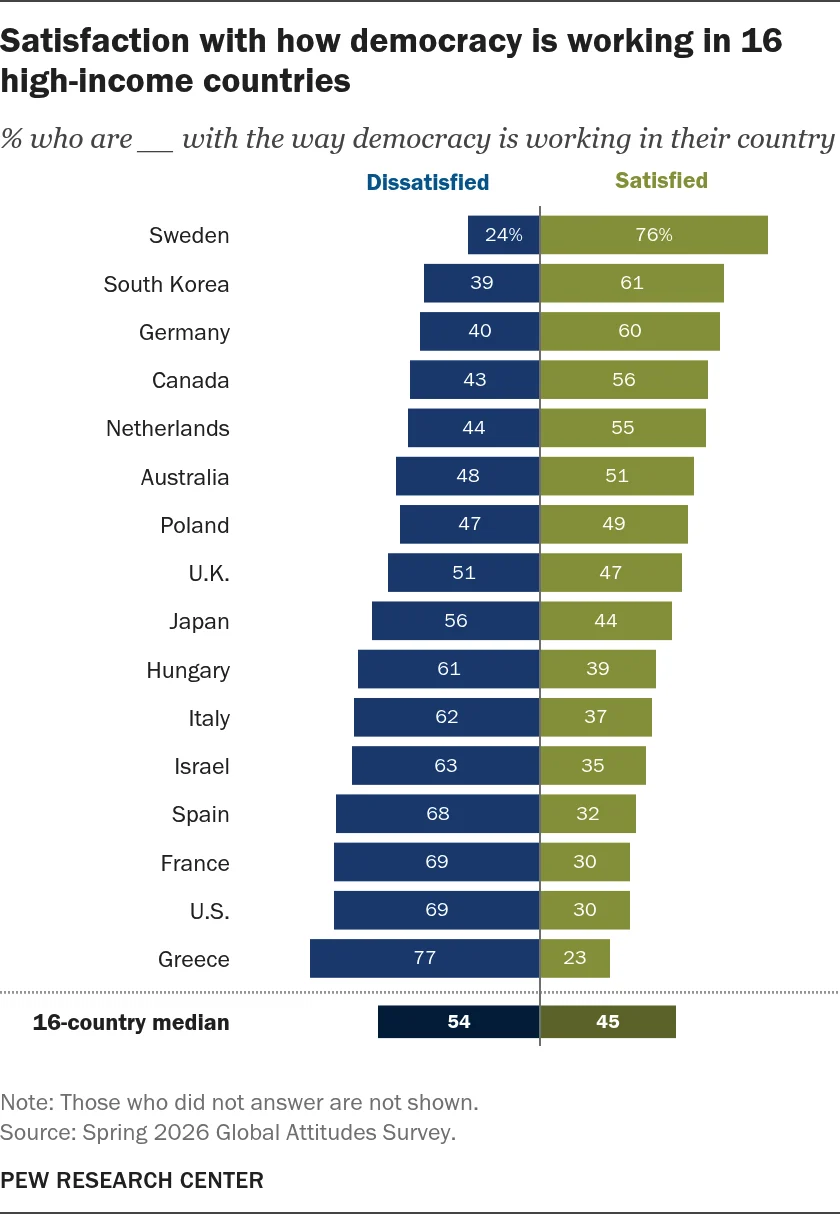
By Jonathan Schulman and Richard Wike
Pew Research Center
As the global political landscape navigates a period of profound volatility, a new report from the Pew Research Center reveals a startling trend: faith in the democratic process is fracturing across the world’s most prosperous nations. According to the 2026 Global Attitudes Survey, which captured the sentiments of nearly 20,000 individuals across 16 high-income countries, democratic malaise has become the dominant sentiment.
Around seven-in-ten U.S. adults (69%) now express explicit dissatisfaction with the way democracy is functioning in their country. This sentiment is not isolated to the United States; it is a pervasive, cross-continental phenomenon that poses significant questions about the resilience of modern political systems.
The State of Democratic Satisfaction
The 2026 data paints a bleak picture of the public’s relationship with their governments. Across the 16 nations surveyed, a median of 54% of adults report being dissatisfied with the status quo of their democracy, while only 45% remain satisfied.
The United States finds itself at the lower end of the satisfaction spectrum, tied with France for the highest level of dissatisfaction (69%) among the nations polled. In stark contrast, Sweden stands as an outlier, with 76% of its population expressing satisfaction with their democratic institutions. This wide variance underscores that while the "crisis of democracy" is a shared narrative, the degree of institutional failure—or at least the perception of it—varies wildly depending on national context and recent political history.
A Chronology of Volatility: 2021–2026
To understand why so many citizens are turning away from their political systems, one must look at the recent historical arc. The data from the past five years suggests that democratic satisfaction is highly sensitive to electoral outcomes, leadership changes, and economic stability.

The Rise and Fall of Political Hope
In countries like South Korea and Japan, recent years have been defined by intense electoral upheaval. In 2025, South Korea faced a constitutional crisis following the impeachment of President Yoon Suk Yeol. This period of instability saw satisfaction with democracy crater to 28%. However, the subsequent early election of Lee Jae Myung acted as a "reset" button for the electorate. By 2026, satisfaction had more than doubled to 61%, representing the most significant positive swing recorded in the survey.
Japan underwent a similarly dramatic, albeit different, transition. Following the resignation of Prime Minister Shigeru Ishiba and the rise of Sanae Takaichi, Japan’s political landscape saw a consolidation of power. After the landslide victory of Takaichi’s party in early 2026, satisfaction levels jumped from 24% in 2025 to 44% in 2026. Notably, this shift was accompanied by the closing of a long-standing gender gap in political sentiment, as Takaichi assumed the role of the nation’s first female prime minister.
The Erosion of Stability in the West
While Asian democracies saw a rebound, the narrative in the West has been one of slow, steady erosion. In Australia, satisfaction plummeted from 61% in 2025 to 51% in 2026. Researchers attribute this not just to political infighting, but to the harsh economic reality facing the average Australian. As the percentage of those who view their country’s economic situation as "good" dropped by nearly half (from 37% to 20%), the spillover effect onto their view of democratic health was immediate and measurable.
The United States, meanwhile, remains trapped in a cycle of deepening polarization. The decline in satisfaction from 37% to 30% over the last year is not a universal trend but a partisan one. The drop is primarily driven by the Republican electorate, which has grown increasingly skeptical of the current system.
Supporting Data: The Partisan Divide
The U.S. results reveal a nation deeply divided. While 86% of Democrats and those who lean Democratic express dissatisfaction with the current functioning of American democracy, the figure among Republicans is 51%.
However, looking beneath the surface, the two parties share a common, albeit cynical, consensus: a significant majority of Americans (68%) believe that the U.S. system once served as a model for the world, but has failed to do so in recent years. This shared sense of "lost glory" suggests that while the reasons for dissatisfaction differ between the left and the right, the outcome—a profound loss of faith in the integrity and efficacy of the democratic apparatus—is the same.

Official Responses and Political Implications
Political analysts and observers have long argued that democracy is not a static state, but a process that requires constant validation through economic performance and social cohesion. The data provided by the 2026 Global Attitudes Survey suggests that when governments fail to deliver on basic economic promises, or when they appear trapped in cycles of perpetual crisis, the public does not merely blame the current leadership—they blame the system itself.
The implications for international relations are severe. When a country’s own citizens view their democracy as "broken" or "ineffective," that nation loses its soft power on the global stage. For the United States, which has long marketed itself as the "City on a Hill," the finding that nearly seven-in-ten citizens are dissatisfied suggests a potential withdrawal from international democratic advocacy.
Moreover, the sharp increase in satisfaction in South Korea and Japan following major political transitions serves as both a warning and a glimmer of hope. It indicates that the public is not necessarily anti-democratic; rather, they are frustrated with specific manifestations of it. When a change in leadership provides a perceived path forward, the public is willing to recalibrate their trust. Conversely, in nations where political systems appear stagnant or gridlocked, the downward trend in satisfaction shows no signs of reversing.
The Future of Democratic Engagement
As we look toward the remainder of the decade, the challenge for leaders in the 16 nations surveyed is clear: the legitimacy of the democratic project is currently under review by the very people who sustain it.
The "dissatisfaction gap"—the distance between what citizens expect from their democracy and what they feel they are receiving—has become the defining political metric of our time. In countries like Greece, where 77% of adults report dissatisfaction, the risk is not just a change in government, but a wholesale rejection of the democratic model in favor of more populist or authoritarian alternatives.
The Pew Research Center’s findings for 2026 serve as a stark reminder that democracy is fragile. It relies on the consent of the governed, and currently, that consent is being withdrawn at an alarming rate. Whether these nations can restore faith in their institutions will depend on their ability to address the economic anxieties, partisan toxicity, and institutional stagnation that have characterized the last five years.

For now, the world remains in a state of democratic wait-and-see. If 2025 was a year of warning, 2026 is a year of reckoning. The data clearly shows that for millions of people, the status quo is no longer enough. To restore faith, the democratic system must do more than simply survive; it must perform.
Methodology and Further Research
The 2026 Global Attitudes Survey was conducted between February 9 and May 6, 2026. Researchers interviewed 19,715 adults across 16 countries, including Australia, Canada, France, Germany, Greece, Hungary, Israel, Italy, Japan, the Netherlands, Poland, South Korea, Spain, Sweden, the United Kingdom, and the United States.
The survey methodology was designed to ensure that the sample represents the views of the adult population in each respective country. For more granular details on the survey questions and the comprehensive statistical methodology used to derive these figures, please refer to the official Pew Research Center documentation.
Jonathan Schulman is a research associate focusing on global attitudes research at Pew Research Center. Richard Wike is the director of global attitudes research at Pew Research Center.
 Muslim
  Nana Muazin
  Siti Muinah