
 By Muslim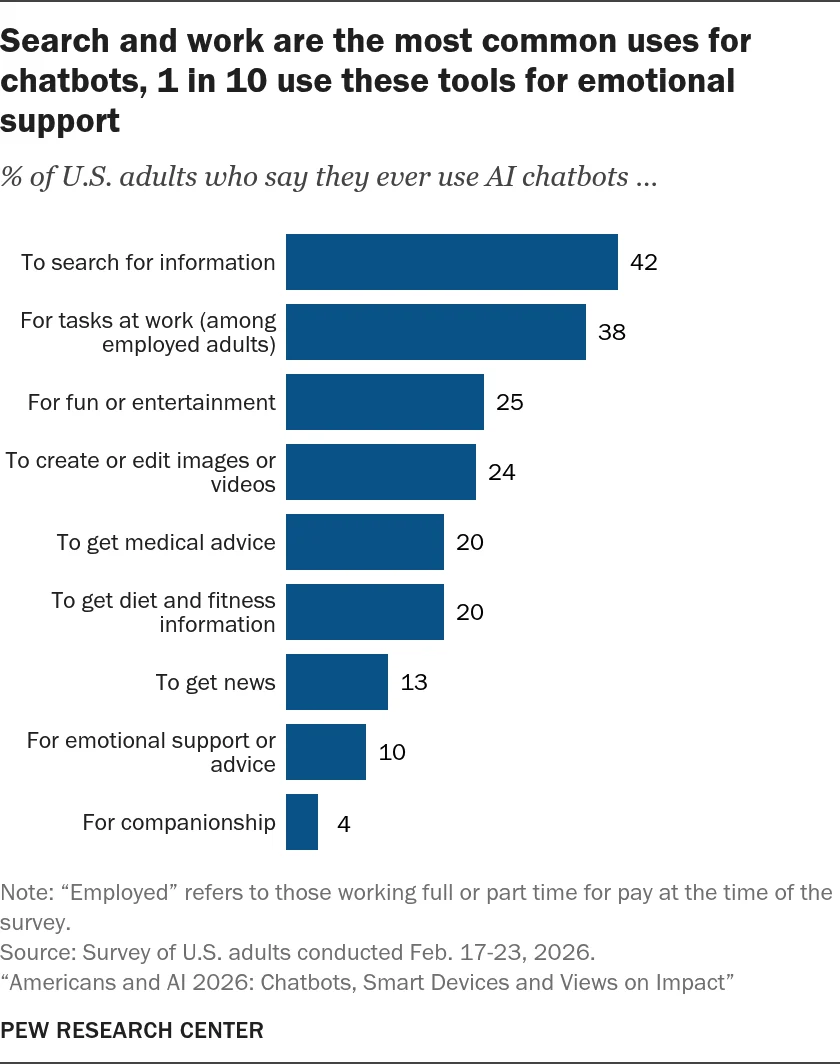
Artificial intelligence (AI) has rapidly transitioned from the realm of science fiction into the fabric of daily American life. From the sophisticated algorithms powering medical diagnostics and the generative tools reshaping the entertainment industry to the mundane efficiency of workplace automation, the presence of AI is no longer a futuristic promise—it is a present-day reality.
A comprehensive new survey conducted by the Pew Research Center, surveying 5,119 U.S. adults between February 17 and February 23, 2026, reveals the depth of this integration. The data paints a picture of a nation simultaneously embracing AI tools for productivity while harboring profound, systemic anxieties regarding data security, the pace of technological development, and the efficacy of governance in the digital age.
Main Facts: The Surge in Chatbot Adoption
The most immediate indicator of AI’s cultural penetration is the rapid adoption of chatbots. As of early 2026, approximately 49% of U.S. adults report using AI chatbots—such as ChatGPT, Gemini, or Copilot. This represents a significant jump from 2024, when only about a third of the population reported engaging with these platforms.
The dominance of OpenAI’s ChatGPT remains unchallenged in the public consciousness. Nearly 44% of U.S. adults state they have used ChatGPT, a figure that has more than doubled since 2023. While competitors like Gemini (24%), Copilot (17%), and Meta AI (14%) have carved out their own user bases, they trail significantly behind the market leader.

This adoption is not uniform. Age acts as a primary divider, with adults under the age of 50 being nearly twice as likely as their older counterparts to leverage these tools. Younger users are, in effect, the primary drivers of the "AI-first" movement in personal productivity and information retrieval.
Chronology: From Novelty to Necessity
To understand the current state of AI in America, one must look at the trajectory of the technology’s deployment over the last three years:

- 2023: The "Breakthrough Year." ChatGPT became a household name. Initial surveys showed 18% of Americans had experimented with it, largely driven by curiosity.
- 2024: The "Integration Year." Chatbot usage climbed to 33%. The conversation shifted from "what is this?" to "how can I use this at work or school?"
- 2025: The "Expansion Year." The market diversified. New entrants like Claude and Grok began to appear, and AI features were baked into common household appliances, from smart speakers to home security systems.
- 2026: The "Ubiquity Year." With nearly half of all adults using chatbots, AI is no longer an optional utility. It is now a default component of search engines—60% of Americans report reading AI-generated summaries at the top of their search results—and a standard feature in modern smart homes.
Supporting Data: Utility vs. Anxiety
The Pew study highlights a fascinating tension: while Americans are increasingly relying on AI, they are not necessarily "optimistic" about its trajectory.
Usage Patterns
When asked why they use chatbots, the primary motivations are pragmatic:

- Information Retrieval: 42% of users turn to AI for searching information.
- Professional Productivity: 38% of employed adults use these tools for work-related tasks.
- Creative and Personal Tasks: Roughly a quarter of users employ AI for entertainment, media creation (images/video), or health-related advice (diet/fitness).
- Emotional Support: 10% of users report using chatbots for emotional support, with a smaller 4% using them for companionship—a trend that signals a nascent shift in how humans define social interaction.
Perceived Impact
Despite the high adoption rates, the public is cautious. Americans are more likely to report that AI helps their productivity (30%) and knowledge base (28%) than hurts them. However, when the focus shifts to societal and long-term personal impact, the mood darkens.
Only 16% of Americans believe AI will have a positive impact on society over the next 20 years, while 40% anticipate a negative outcome. Regarding their personal lives, 31% expect a negative impact, while only 23% foresee a net positive.

The Smart Home and Data Security
Beyond the screen, AI has physically entered the American household. Roughly 35% of U.S. adults own a smart speaker, while 18% utilize smart doorbells and 13% rely on robot vacuums. These devices offer a veneer of convenience, but they serve as constant data collection points.
This creates a significant point of friction. When asked about the impact of AI on their personal information, 71% of Americans explicitly state they believe AI will make their data less secure. This overwhelming lack of trust suggests that while consumers enjoy the convenience of "smart" living, they are acutely aware of the surveillance and privacy trade-offs involved.

Official Responses and Governance
The survey data highlights a growing crisis of confidence in both the public and private sectors. Americans appear to feel that the technology is outstripping the guardrails.
- The Pace of Advancement: 63% of Americans believe AI is advancing "too quickly." Only 2% feel it is moving too slowly. This sentiment underscores a widespread feeling of helplessness in the face of rapid, algorithm-driven societal changes.
- The Trust Gap: The data shows a significant partisan shift in confidence regarding governance. In 2024, Republicans were the more skeptical group regarding the government’s ability to regulate AI. By 2026, that skepticism has flipped. Currently, 74% of Democrats report having "not too much or no confidence" in the government’s ability to regulate AI effectively, compared to 61% of Republicans.
- Corporate Accountability: There is similarly low faith in the private sector. 65% of Democrats and 53% of Republicans do not believe that U.S. companies will develop and use AI responsibly.
Implications: A Society in Transition
The implications of these findings are profound. We are witnessing the birth of a "dual-use" society. On one hand, the American public is becoming increasingly proficient with AI tools, recognizing their value in streamlining work and gathering information. The fact that usage has grown from a third to nearly half of the population in just two years demonstrates that the "AI train" has left the station.

On the other hand, the foundational trust required for this technology to thrive is fracturing. When the vast majority of a population believes a technology is advancing too quickly and that it poses a threat to their personal data, the stage is set for a period of political and regulatory turbulence.
The shift in partisan skepticism is particularly telling. It suggests that AI regulation is no longer a niche tech-policy concern; it is becoming a central political issue. As we move into the latter half of the 2020s, the challenge for lawmakers will be to bridge the gap between the rapid pace of corporate innovation and the public’s clear demand for security, safety, and accountability.

For the individual user, the "AI experience" is now a permanent fixture of daily life. Whether it is a quick question posed to a chatbot, a, "Hello, Alexa," or a glance at an AI-generated search summary, these tools are now essential. Yet, the data from the 2026 Pew Research Center survey serves as a stark reminder: adoption does not equate to endorsement. Americans are using AI, but they are doing so with their eyes wide open to the risks, waiting for a framework that protects their privacy and their future in an increasingly automated world.
 Nana Muazin
  Siti Muinah