
 By Nila Kartika Wati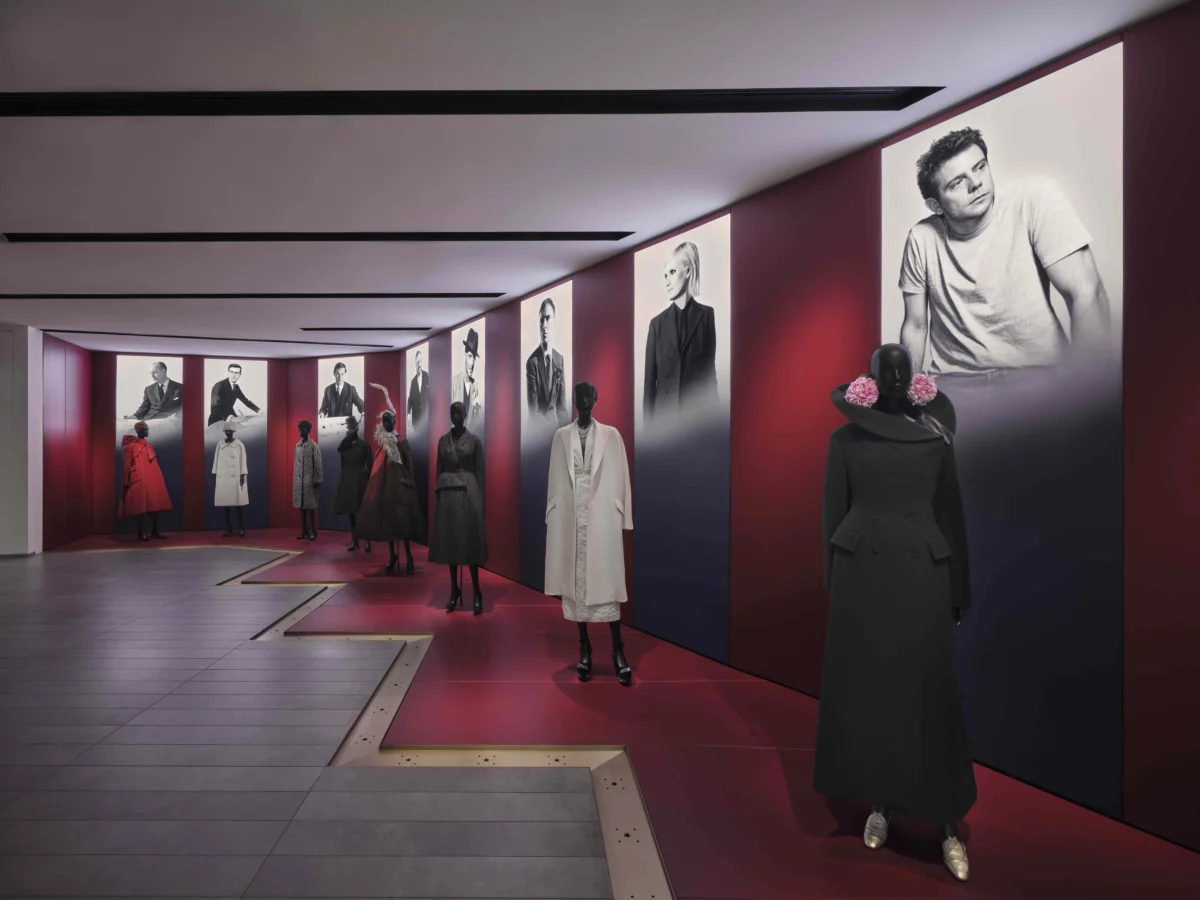
PARIS — In the storied halls of 30 Avenue Montaigne, where the ghost of Christian Dior still lingers amidst the scent of J’adore and the rustle of silk, a new chapter has been etched into the firmament. Jonathan Anderson, the visionary Irish designer who has spent the last year navigating the delicate balance between archival reverence and avant-garde disruption, has officially taken his place in the pantheon of the house’s creative directors at La Galerie Dior.
A commanding portrait of Anderson, captured in a moment of understated modernity—dressed in a simple gray marl T-shirt—now greets visitors in room three of the permanent exhibition. It is a striking visual anchor that places him in direct dialogue with the seven legendary couturiers who preceded him, forming a seamless, if evolving, narrative of French luxury that stretches back to the house’s 1947 inception.
A Chronology of Artistic Evolution
The inclusion of Jonathan Anderson is not merely a bureaucratic update to the gallery’s display; it is a profound recognition of his role in steering the brand toward a new epoch. The exhibit juxtaposes his contemporary vision with the heritage of his predecessors, illustrating the cyclical nature of high fashion.
Since assuming the mantle as creative director for women’s, men’s, and haute couture collections, Anderson has been tasked with the "impossible" brief: maintaining the house’s rigid identity while injecting the radicality that has defined his own career. The gallery now features approximately 15 designs from his inaugural year, strategically placed to demonstrate how he has dissected and reconstructed the "Dior DNA."

The chronological journey begins with the foundational silhouettes of Christian Dior and moves through the eras of Yves Saint Laurent’s youthful rebellion, Marc Bohan’s geometric precision, and the theatrical romanticism of John Galliano. By inserting his own work—specifically the "Rêve" coat with its gravity-defying, swooping collar—into this timeline, the house emphasizes that Anderson is not just a custodian of the past, but an active participant in its future.
The Architecture of Style: Analyzing the Anderson Aesthetic
The curatorial team at La Galerie Dior has meticulously "tweaked" the themed rooms to emphasize the specific brand codes that Anderson has identified as his north stars. Chief among these is the bow—a recurring motif that the founder famously lauded in his 1954 Little Dictionary of Fashion.
"I love bows to close a décolleté, trim a hat or to fasten a belt. I like them big, small or enormous, in any way and in any material," Dior once wrote.
Anderson has taken this sentiment and applied a modern, almost architectural lens. In the room christened "The Art of the Bow," visitors can see his cream Noeud pantsuit displayed alongside historical pieces. The juxtaposition is jarring yet harmonious; where Dior’s bows were often an expression of soft, mid-century femininity, Anderson’s interpretations feel structural, sharp, and occasionally rebellious.

Furthermore, Anderson has tapped into the house’s 18th-century roots, bringing back signature medallions adorned by the "fontange" bow—a nod to the mistress of Louis XIV. These elements are displayed in a newly curated cabinet of curiosities, which also features an exquisite couture evening clutch fashioned from fabrics dating back to the reign of Marie Antoinette. This fusion of the regal past with modern couture techniques serves as a cornerstone of Anderson’s tenure.
Expert Perspectives: The Tension of Modernity
Olivier Flaviano, the head of La Galerie Dior, views this new exhibition as a masterclass in creative tension. Speaking on the integration of Anderson’s work, he notes that the exhibition design was directly inspired by the vocabulary established in Anderson’s debut couture show.
"There’s a real radicality in the form, which is super interesting, yet it’s infused with a sense of refinement and femininity, which is equally compelling," Flaviano stated. "Jonathan Anderson’s pieces help us see more clearly this tension that is at the root of the Dior style. It is not about looking back; it is about looking at the tension between the heritage and the now."
This "tension" is best exemplified by the pieces chosen for the "Enchanted Gardens" and "Le Bal Dior" rooms. The off-the-shoulder draped Ombré dress, which gained international acclaim after being featured on the cover of EE72 magazine, highlights Anderson’s mastery of fabric manipulation. Meanwhile, the bulbous, pleated Clémentine dress—inspired by the organic, sculptural ceramic work of Magdalene Odundo—dominates the "Le Bal Dior" room. The space, now drenched in intense, saturated shades of orange and red, serves as a testament to Anderson’s willingness to push the boundaries of color theory within the house.

Historical Depth: The Discovery of Diorling
Beyond the focus on Anderson, the gallery is currently unveiling a previously under-represented aspect of the brand’s history: the Diorling ready-to-wear line. For the first time, visitors can view a selection of pieces from this line, which was launched in the United Kingdom in 1968 under the guidance of Jorn Langberg, then the artistic director of the Christian Dior London subsidiary.
The Diorling collection is a time capsule of the Swinging Sixties, characterized by bold geometric prints and floral patterns that capture the electric atmosphere of Carnaby Street. By displaying these alongside Anderson’s contemporary work, the house is making a bold statement: Dior has always been a brand that thrives on "renewal."
Olivier Bialobos, Dior’s deputy managing director in charge of global communication and image, emphasized the significance of this inclusion. "The essence of the Dior spirit is unveiled through the 150 models on display: from the modernity of the Diorling ready-to-wear… to the tradition of balls featuring haute couture gowns that will make visitors dream more than ever," he said.
Implications for the Future of the House
The integration of Jonathan Anderson into La Galerie Dior signals a transition from "the house of a legend" to "the house of evolving legends." By placing his work in the permanent collection, Dior is validating the shift in creative direction as a permanent evolution rather than a temporary trend.

The implications for the wider fashion industry are significant. In an era where creative directors are often discarded after only a few seasons, Dior’s decision to elevate Anderson to a "historical peer" within the museum suggests a long-term commitment to his vision. It also reinforces the idea that the "Dior style" is not a static list of tropes, but a living, breathing entity that requires constant interrogation.
As the exhibition makes clear, the Parisian tradition of couture is, and always has been, about renewal. By inviting Anderson to reinterpret the bow, the silhouette, and the historical archives of the 18th century, the house is ensuring that it remains relevant to a new generation of consumers who demand both the weight of history and the shock of the new.
Conclusion: A Living Legacy
As visitors walk through the halls of La Galerie Dior, they are not just looking at dresses on mannequins; they are witnessing a conversation across time. The portrait of Jonathan Anderson in his gray T-shirt is a reminder that behind the velvet, the silk, and the intricate needlework, there is a human mind at work—a mind that respects the foundations laid by Monsieur Dior but is unafraid to dismantle them to build something entirely new.
The exhibition is a triumph of narrative design, proving that the house remains at the pinnacle of luxury not by standing still, but by daring to redefine itself with every passing season. Whether it is through the structural audacity of a pleated dress or the subtle nod to 18th-century aristocracy, the current iteration of Dior is a bold, beautiful, and deeply considered step into the future of high fashion.
 Nana Muazin
  Nana
Nana  Ali Ikhwan