
 By Muslim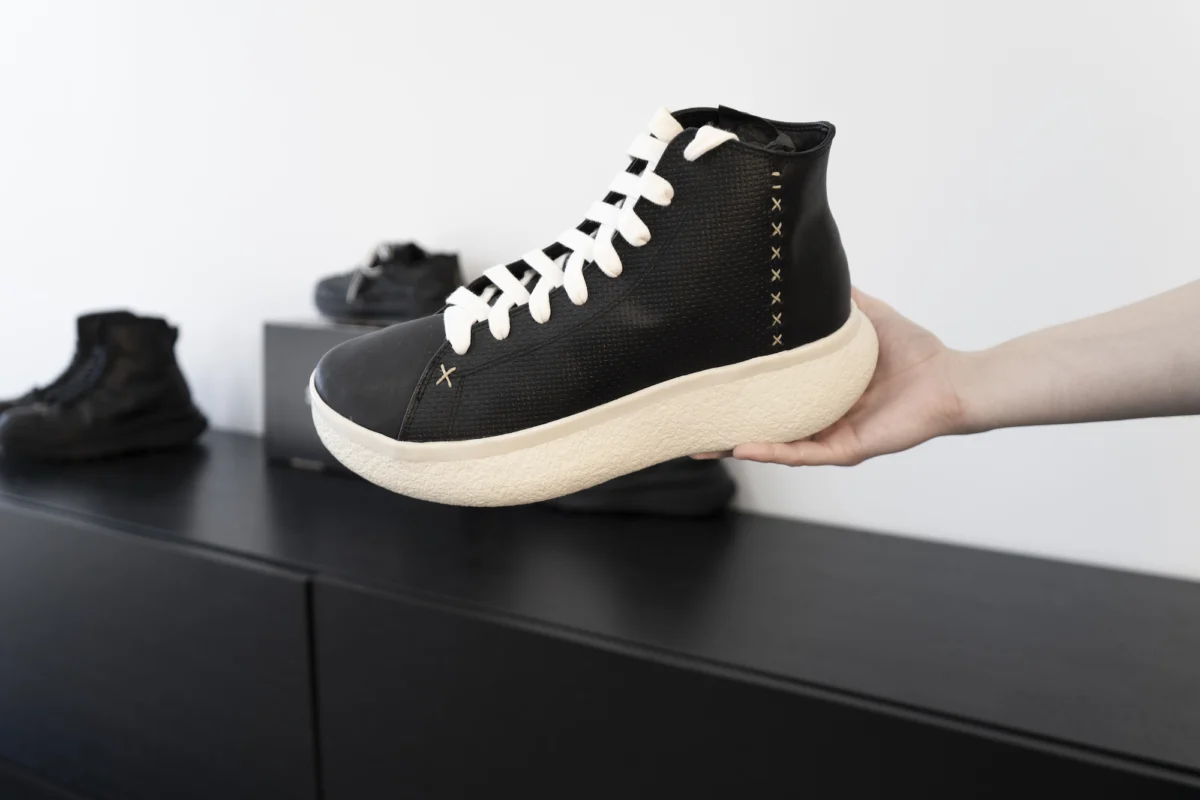
The global apparel and soft-goods industry, a behemoth valued at approximately $2 trillion, has operated on a foundational logic that has remained largely unchanged for centuries: take raw fiber, spin it into yarn, weave or knit it into flat fabric, cut that fabric into patterns, and finally, sew it together. This labor-intensive, multi-stage, and waste-heavy process is the bedrock of how we dress, travel, and inhabit our spaces.
However, a North Carolina-based materials innovation start-up, Simplifyber, is challenging this paradigm. Founded by Phil Cohen and Maria Intscher-Owrang, the company is positioning itself not merely as a material supplier, but as a next-generation manufacturing platform. By leveraging a proprietary liquid-based, FSC-certified cellulose process that allows manufacturers to inject fiber directly into molds, Simplifyber is effectively bypassing the traditional cut-and-sew cycle.
The Genesis of a New Manufacturing Era
The origins of Simplifyber lie in a fundamental reimagining of product architecture. Founded in 2020, the company emerged from a desire to address the inefficiencies that plague modern supply chains. While traditional manufacturing is often defined by geographic fragmentation—where raw materials are harvested in one country, processed in another, and assembled in a third—Simplifyber’s "one step, one location" philosophy aims to localize and shorten the production lifecycle.
The process is deceptively simple: instead of building a product from a flat sheet, the platform forms fibers into a finished, three-dimensional shape in approximately 100 seconds. This technological leap allows for the creation of complex geometries—such as shoe uppers, structural components for automotive interiors, and intricate consumer goods—without the need for traditional weaving, knitting, or the extensive, wasteful cutting processes that have defined the status quo for generations.
Technical Versatility and Material Agnostic Philosophy
One of the most critical aspects of Simplifyber’s platform is its lack of reliance on a single fiber source. In an era where supply chain volatility is the norm, this versatility is a strategic advantage. The platform is engineered to be "material-agnostic," capable of processing a wide range of natural and regenerated fibers.
Current compatible inputs include FSC-certified wood pulp, recycled paper, Tencel, and various recycled textile streams such as Circulose. Moreover, the system can handle blended fiber systems, allowing for the fine-tuning of performance characteristics—such as durability, breathability, or structural rigidity—depending on the specific requirements of the application. The system can even incorporate ground-up particles, effectively turning what would be considered industrial or post-consumer waste into a high-value feedstock.
Impact Data: Quantifying the Sustainability Shift
Simplifyber’s value proposition is backed by preliminary life-cycle assessment (LCA) data conducted in collaboration with North Carolina State University. The results, while preliminary and pending peer review, offer a compelling argument for the platform’s environmental potential.
According to the study, a fully bio-based molded material produced using renewable electricity results in a carbon footprint of just 1.41 kg CO2e/kg. To contextualize this:

- Polypropylene: 1.8–2.5 kg CO2e/kg
- ABS Plastic: 3.6–3.9 kg CO2e/kg
- Polyester Fabric: Up to 9.6 kg CO2e/kg
- Leather: 12–15 kg CO2e/kg
These figures suggest that Simplifyber’s impact extends far beyond the material itself. By eliminating the need for cutting, trimming, and complex assembly, the company is effectively stripping away the "process waste" that often goes uncounted in traditional sustainability reports.
Strategic Collaborations and Market Entry
While much of the company’s work since its 2020 inception has been kept under wraps, Simplifyber has begun to surface in high-profile applications. The fashion industry, historically resistant to radical manufacturing shifts, has shown early interest. Notable "cool-girl" brand Ganni has already tapped the platform for experimental footwear designs, signaling a shift toward material innovation as a core pillar of high-end design.
Beyond fashion, the company is working with automotive giant Kia. This cross-industry adoption underscores the platform’s potential to disrupt disparate sectors. Whether it is a door panel in a vehicle or the upper of a luxury sneaker, the core demand remains the same: a reduction in complexity, a reduction in waste, and the ability to create products that feel premium while remaining inherently circular.
Official Perspectives: The Philosophy of "Making Differently"
In discussions with the industry, Maria Intscher-Owrang, co-founder of Simplifyber, emphasizes that the most successful partnerships are not built on direct, one-to-one material replacements.
"The most successful partnerships don’t start with the question, ‘What material can replace the one I’m using today?’" Intscher-Owrang explains. "They start with the question, ‘What becomes possible if products can be made differently?’"
This shift in inquiry is essential. If a brand treats a new technology as a drop-in replacement, they miss the opportunity for design innovation. By moving from 2D, cut-and-sew logic to 3D, molded-fiber logic, designers are suddenly empowered to integrate textural elements, structural reinforcements, and complex shapes that were previously impossible or cost-prohibitive to manufacture.
Addressing the question of end-of-life, Intscher-Owrang is pragmatic. While the platform is capable of producing 100 percent bio-based, compostable goods, she avoids broad, misleading claims. "End-of-life characteristics depend on the specific formulation and intended use of the product," she notes. "For car interior panels, we need to add conventional coatings for longevity. For footwear, it is much easier to maintain 100 percent bio-based integrity."
The Economic and Labor Implications
Critics of automated manufacturing often point to the potential displacement of labor. However, Intscher-Owrang argues that Simplifyber represents a transformation of the labor profile rather than its eradication.

"If you reduce cutting, sewing, trimming, bonding, and multi-part assembly, you reduce the amount of manual labor required for certain tasks," she acknowledges. "But the labor profile changes. More value shifts into material preparation, machine operation, quality control, and process expertise."
Furthermore, the technology promises to reshape the economics of global manufacturing. By reducing the labor-intensive assembly steps that have historically driven production to regions with low-cost labor, Simplifyber opens the door to more localized, "near-shoring" production models. This not only reduces the carbon footprint associated with global shipping but also increases the resilience of supply chains, insulating companies from the geopolitical shocks that have rattled the industry in recent years.
Future Outlook: Scaling the Ecosystem
As Simplifyber moves into its next phase, the company is pivoting from technology development to industrial scale. With its first full-scale production line now operational, the company’s focus has shifted to scaling, partnership expansion, and market entry.
The ambition is not to become a monolithic manufacturer, but to serve as a foundational technology provider. By making this platform accessible to global manufacturers, Simplifyber hopes to usher in a future where products are made closer to the point of consumption, using locally available fibers, and constructed with a drastically lower environmental footprint.
"For decades, we’ve been surrounded by products made from plastic, polyester, and increasingly complex multi-material assemblies," Intscher-Owrang says. "Paper has already replaced plastic in packaging. I believe we are seeing the beginning of a similar transition in durable, high-value goods."
The transition will not happen overnight. The inertia of the $2 trillion apparel industry is significant. Yet, as brands face mounting pressure from regulators and consumers to address waste, the appeal of a "one-step" manufacturing solution is becoming increasingly difficult to ignore. Simplifyber is not just selling a new material; it is selling a new way of thinking about the very structure of the products we use every day. In a world defined by its waste, a shift toward efficient, bio-based, and modular manufacturing is not just a commercial opportunity—it is a necessity.
 Neng Nana
  Ali Ikhwan
  Lina Hope