
 By Siti Muinah
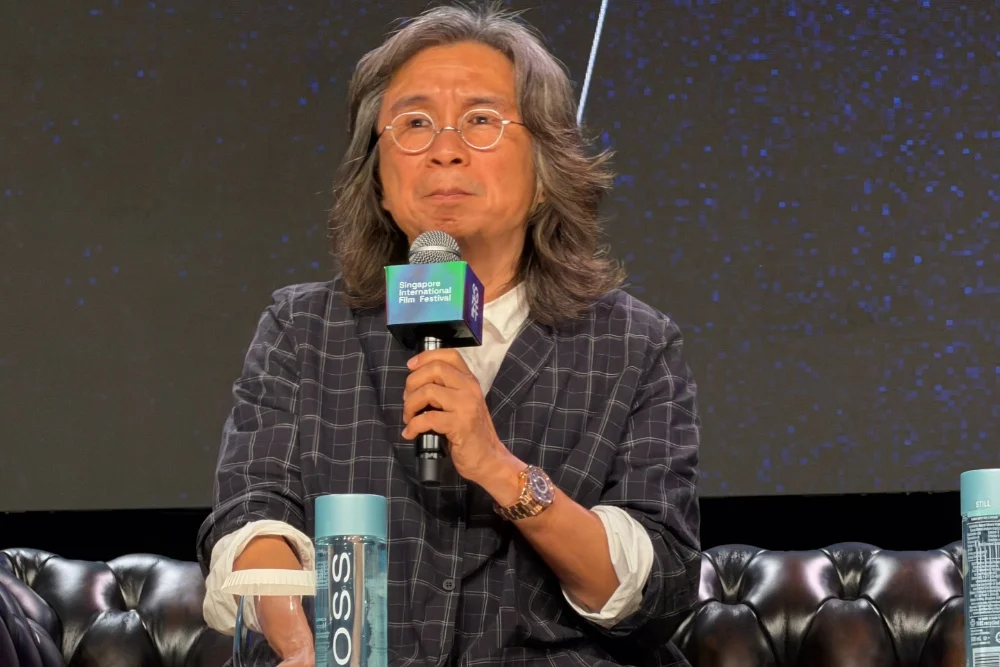
In an era defined by the fragmentation of attention and the rapid encroachment of artificial intelligence into the creative arts, few figures in global cinema command as much authority as Peter Chan Ho-sun. The Hong Kong auteur, known for masterworks like Comrades: Almost a Love Story and the sprawling historical epic The Warlords, recently took to the stage at the Singapore International Film Festival (SGIFF) to offer a candid, unvarnished look at his career and the future of the medium he has served for nearly four decades.
Speaking to a rapt audience at the Grand Ballroom of the Marina Bay Sands, Chan navigated the complexities of modern filmmaking with the poise of a veteran who has survived the shifting tides of the industry, from the analog golden age of Hong Kong cinema to the digital, algorithm-driven landscape of modern Hollywood and beyond.
The AI Dilemma: Tools vs. Truth
Perhaps the most pressing question facing creators today is the role of artificial intelligence. Chan’s stance is nuanced: while he is open to technological evolution, he draws a firm line in the sand regarding the nature of storytelling.
"I will probably use AI as a technique, the way the industry already uses CGI and special effects," Chan explained, noting that the cinematic world has been quietly integrating AI into post-production workflows for years. However, he was emphatic in his rejection of "AIGC"—AI-generated content. For Chan, the distinction is fundamental. "Anything that helps me make movies, I welcome. But they won’t know art. Movies are still made by people."
Chan views the current technological shift as a continuation of the industry’s historical reliance on tools to enhance human vision. He suggests that just as the introduction of digital cameras and sophisticated visual effects did not replace the director’s intent, AI should be viewed as a sophisticated brush rather than an artist. His optimism remains tethered to the belief that the human experience—the "soul" of a narrative—is an element that machine-learning models cannot replicate.
A Career Defined by "The Flow"
To understand Chan’s perspective on the industry, one must understand his journey. His career is a study in adaptability. Reflecting on his early days in the 1990s with the United Filmmakers Organization (UFO), Chan described a landscape dominated by rigid genre tropes. "We were not exactly going with the flow, but we did make the flow, somehow," he recalled.
This philosophy of "going with the flow and knowing when to stop" was crystallized during his research for his latest film, The Road Not Taken. While visiting an Alzheimer’s care institution in Chengdu, China, he encountered a local wisdom that resonated with his own professional trajectory. It was a lesson he learned the hard way during his mid-career transition into the Hollywood studio system.
His foray into American filmmaking with the DreamWorks production The Love Letter proved to be a pivotal, albeit difficult, chapter. Working within a corporate structure that relied heavily on test screenings—an early precursor to the data-driven, algorithmic decision-making seen in modern streaming platforms—was a stark departure from his experience in Hong Kong. "Had I gone to America with the knowledge that I have of film, marketing, and dealing with corporate [systems], I probably would have fared better," he admitted. "I was too young then, too naive."
Chronology of an Auteur: From ‘Comrades’ to ‘The Road Not Taken’
The year 2024 marks the 30th anniversary of Comrades: Almost a Love Story, a film that serves as a cornerstone of Chan’s legacy. Released when he was just 34 years old, the film captures a specific, melancholic zeitgeist of Hong Kong between 1985 and 1995.
"That movie gave me a lease of movie life for the next 30 years," Chan noted. Despite the film’s lasting impact on audiences across East and Southeast Asia, Chan remains humble about its commercial performance at the time, noting that it barely recouped its investment. He expressed a desire to "break the spell" of being remembered for only that one film, even as he acknowledged the blessing of having created a work that resonates so deeply with multiple generations.
His latest project, The Road Not Taken, represents a return to the intimate, character-driven narratives that define his best work. The film, which premiered at the Toronto International Film Festival, explores the complexities of a family dealing with early-onset Alzheimer’s. The story is deeply personal, mirroring the generational dynamics of his own life; the character of the daughter in the film is 20, the same age as his own daughter, who is currently training as an actor.
The Resilience of the Two-Hour Feature
Despite the rise of short-form, vertical dramas designed for shrinking attention spans, Chan remains bullish on the future of the traditional two-hour feature film. He rejects the notion that the medium is dying, pointing to the paradoxical coexistence of rapid-fire social media content and the resurgence of long-form media, such as the multi-hour podcast.
"There are two completely opposite ends of the spectrum that are surviving and thriving simultaneously," Chan observed. He cited Christopher Nolan’s Oppenheimer as a prime example of how audiences still crave the "purist" theatrical experience. For Chan, cinema is not about the medium of delivery, but about the commitment of the audience to a sustained narrative.
He offered a stern word of advice for aspiring filmmakers: "This is probably the toughest time for film, but do I believe this medium is going to be lost and gone to short-form entertainment? No."
The "Hard" Path of the Creative
Chan is well-known in the industry for his rigorous, almost punishing approach to script development. He is not a director who accepts the first draft. When asked by an aspiring screenwriter how to handle a scene that isn’t working, his answer was characteristically blunt: "I don’t usually fix it for them. I make them fix it over and over and over again."
His reputation for intensity is well-earned. He famously employed nine writers for The Warlords, leading to industry jokes that his writing staff would not fit inside a standard minibus. "I milk the writer to death, and then I milk another writer," he said. "The writers’ community really doesn’t like me very much. But making movies is not about being well-liked."
This uncompromising commitment to the script is what allows Chan to tackle diverse genres—from horror anthologies like The Eye and Three to historical epics and romantic dramas—while maintaining a consistent thematic thread. He views his entire body of work, from Alan & Eric: Between Hello and Goodbye to The Warlords, as a single, ongoing conversation.
"Making every movie is answering some sort of life question that I have at that stage," he remarked. "So in a way, I’ve been making the same movie in my mind for the last 36 years."
Implications for Future Filmmakers
As Chan looks toward the future, his message is one of endurance and creative autonomy. When asked about navigating the volatile landscape of censorship in mainland China, he drew a parallel to his time in the corporate studio system. "Dealing with a corporate is very, very difficult. And if I can survive that, I can survive anything."
He posits that the limitations imposed by budgets, studio executives, or censorship are not merely obstacles—they are catalysts for innovation. "Limitations push filmmakers to be more creative," he suggested.
For those entering the industry today, Chan’s career offers a blueprint for survival. It is a career built on the rejection of complacency. Whether it was his decision to pivot from the Hong Kong romantic comedies of the 90s to the pan-Asian horror experiments of Applause Pictures, or his move into large-scale historical epics, Chan has consistently sought to challenge his own boundaries.
As he concluded his talk at SGIFF, he summarized his philosophy with a nod to the Robert Frost poem that gave his latest film its English "There’s really no right path. Whether it’s right or wrong, it’s all about how you walk it. You make it right."
In a rapidly changing world, Peter Chan Ho-sun remains a stalwart believer in the power of the human perspective. As long as there are filmmakers willing to "milk the script to death" and engage with the difficult questions of existence, he believes the two-hour feature film will continue to hold its ground, thriving alongside—and perhaps in spite of—the digital noise of the 21st century.
 Raul Delapena Setiawan
 Ali Ikhwan
 Neng Nana
