
 By Nana Wu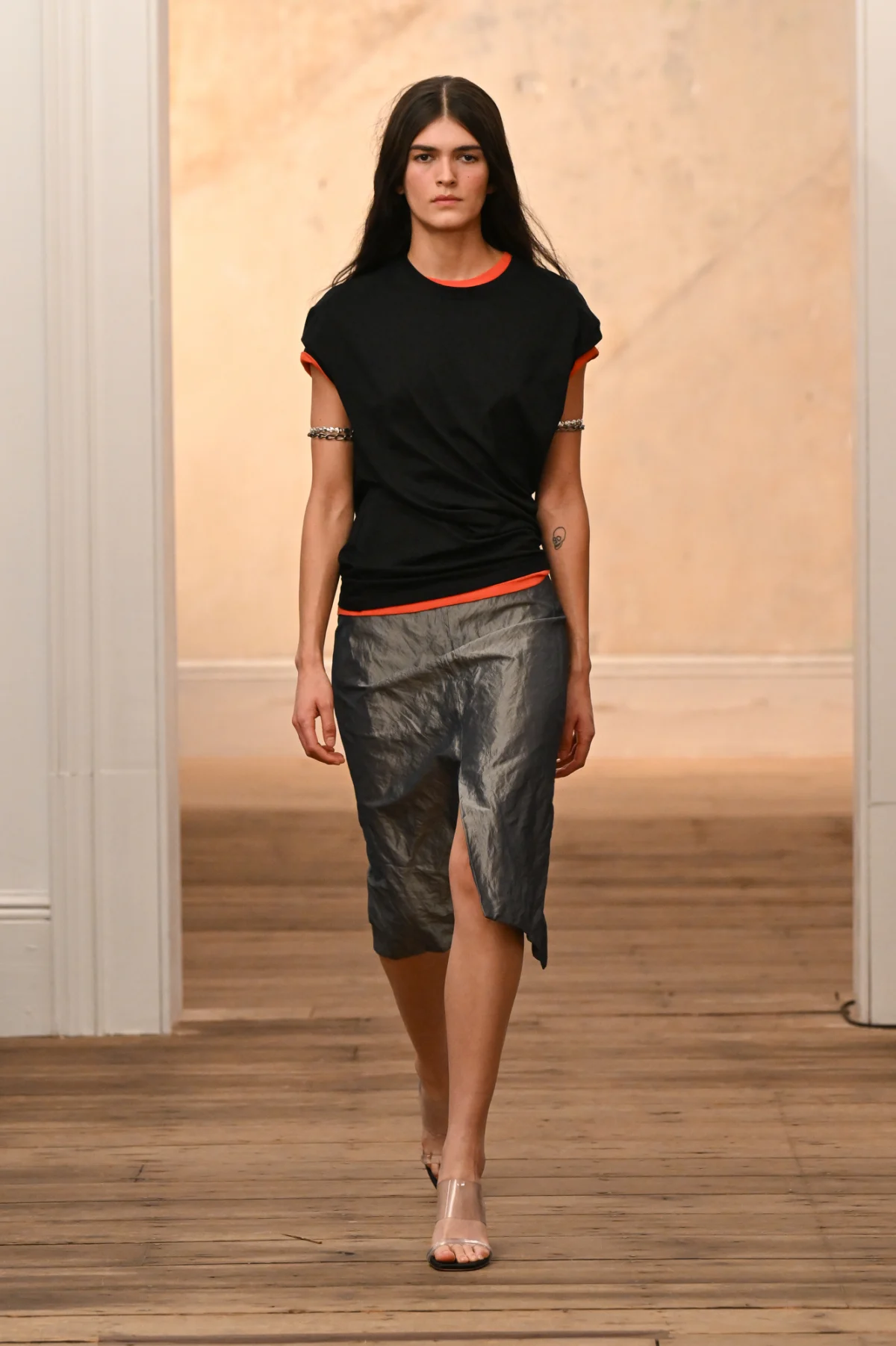
In an industry perpetually obsessed with the "next big thing," the term "downtown style" has become something of a fashion industry shorthand—a ghostly echo of 1970s SoHo, 1990s grunge, and the perpetually elusive, effortless cool that supposedly lives in the streets of lower Manhattan. Yet, in the hands of design duo Mike Eckhaus and Zoe Latta, the term is being interrogated, dismantled, and rebuilt into something far more fluid.
For fifteen years, the label Eckhaus Latta has occupied a unique space in the global fashion ecosystem. With a bi-coastal existence—Eckhaus based in New York City, Latta in Los Angeles—the pair has cultivated a brand identity that transcends the tired geography of its origins. Their latest collection serves as a testament to this evolution: a sophisticated exploration of movement, texture, and the art of "dressing up the casual."
The Core Philosophy: Fashion as a Social Circle
The primary hallmark of the Eckhaus Latta ethos is a refusal to rely on the traditional, rigid structure of seasonal "inspirations." Where many luxury houses spend months tethered to an archival reference or a specific historical period, Eckhaus and Latta prefer a process of organic growth.
"It’s about making more friends," Latta explains when asked about the evolution of their silhouettes. It is a metaphorical approach to design that treats a garment’s lifecycle like a social gathering.
Eckhaus elaborates on this party-centric philosophy: "Some concepts are like people that stay there longer. And then when someone enters in every season, there’s new energy, and there’s some people who evolve and you’re working through ideas creatively. Then there’s things where you’re like, ‘OK, we’re over that,’ and we’re moving on."
This iterative process—what the designers call "sinking into certain things"—allows for a depth of design that is rarely seen in the fast-paced, high-burnout environment of contemporary fashion. Instead of reinventing the wheel every six months, they refine it, shifting the weight and texture of their core pieces until they resonate with the lived-in reality of their clientele.
A Chronology of Influence: From Niche to Necessity
To understand the current collection, one must look at the fifteen-year trajectory of the brand. Eckhaus Latta began as a disruptive force, known for casting non-models, utilizing unconventional runways, and prioritizing a raw, visceral aesthetic that felt distinctly "New York."
The Early Years (2011–2016)
The label established its reputation through experimentation. Their shows were often surreal, blurring the lines between art performance and runway presentation. They were among the first to bridge the gap between "gallery fashion" and wearable, everyday clothing, earning them a cult following that prized intellectual rigor over traditional prestige.
The Expansion Phase (2017–2022)
As the brand matured, the garments became more refined. The focus shifted from pure provocation to the construction of a modular wardrobe. This was a period of material innovation—the introduction of signature knits, raw-edged denim, and experimental fabric treatments that became the brand’s calling card.
The Institutional Pivot (2023–Present)
The most recent chapter marks a transition into a more established, albeit still subversive, role within the industry. The successful J.Crew collaborations, which were showcased on the runway alongside their primary line, signal a shift in how the brand views its audience. By successfully navigating the mass-market collaboration space without losing their subversive edge, Eckhaus and Latta have proven that their vision is not just an aesthetic—it is a viable, scalable way of dressing.
Technical Innovations: The Mechanics of Movement
If there is a defining characteristic of the most recent collection, it is the manipulation of physics. Movement is not merely a byproduct of the design; it is the intent.
Texture and Light
The standout piece of the current collection was a metallic plum skirt. Rendered in a cross-woven polyester, the fabric possessed a chameleon-like quality, shifting its luster as light hit the fibers. This piece encapsulated the designers’ focus on "washes and fabrications"—taking an accessible material and elevating it through experimental treatment.
Structural Geometry
The garments were largely cut on the curve, a technique that allows clothing to hug the body in non-linear ways. A jersey organza tee, for instance, was designed to gather and scrunch in response to the wearer’s natural stride. These pieces are not static; they are meant to be molded, twisted, and lived in.
Functional Complexity
Despite the focus on fluid motion, the collection was anchored by sharp, functional details. Detachable zippered flaps on the back of trousers served as a nod to utility, providing a structural counterpoint to the softer, draped layers. These details never felt "overly conceptual"—a trap many avant-garde designers fall into—but rather served to make the clothing more responsive to the wearer’s environment.
Official Responses and Creative Direction
In discussions regarding their process, both Eckhaus and Latta emphasize the importance of "sinking" into ideas. The pressure to provide a radical departure every season is, according to the designers, a recipe for creative bankruptcy.
"It’s nice to just kind of really sink into certain things and work around it for a season or two," Eckhaus noted during a post-show discussion. "Let it evolve in practice and then those ideas will shift down."
This approach represents a significant departure from the traditional fashion calendar. By allowing their designs to percolate, the duo ensures that every piece in the collection feels like a natural extension of its predecessor. It is a slow-fashion methodology applied to a luxury framework, creating a sense of continuity that their base has come to rely on.
Implications: The Future of "Downtown"
The success of Eckhaus Latta raises a fundamental question about the future of fashion: Is the concept of "downtown style" becoming obsolete?
As the internet homogenizes global aesthetic trends, the idea of a specific neighborhood defining a "look" feels increasingly antiquated. Eckhaus Latta succeeds precisely because they recognize this shift. They aren’t trying to capture a moment in a specific zip code; they are trying to capture a specific type of consciousness—one that values innovation, wearability, and an absence of pretense.
The Wearability-Innovation Paradox
Perhaps the most significant implication of their fifteen-year run is the masterclass they have provided on the balance between innovation and wearability. Many "directional" designers create clothing that is essentially costume—unwearable in the real world. Eckhaus and Latta have managed to create clothes that are intellectually interesting while remaining firmly grounded in how people actually move through their days.
They have effectively debunked the myth that to be "fashion-forward," one must look as though they are trying too hard. Their aesthetic is one of ease, yet it is backed by complex, rigorous construction.
Conclusion: A New Standard for Authenticity
As Eckhaus Latta looks toward the future, they do so from a position of profound stability. They have survived the transition from "indie darlings" to "industry heavyweights" without compromising the integrity of their creative process.
By treating their collections like a long-running conversation—a party where new guests arrive and old ones evolve—they have created a brand that feels alive. They have proven that "downtown" is not a place you go, but a way you see. In a landscape of transient trends and fleeting viral moments, Eckhaus and Latta offer something far more durable: a wardrobe that is as dynamic, messy, and evolving as the people who wear it. Their work remains a vital reminder that the best design doesn’t shout—it simply persists, shifting in the light, moving with the body, and waiting for the next season to evolve.
 Iffa Jayyana
  Suro Senen
  Lina Hope