
 By Pevita Pearce
In a dramatic pivot for American foreign policy, U.S. assistance to foreign nations has cratered to its lowest level in over twenty years. New data from the Pew Research Center, analyzing federal disbursements, paints a picture of a nation rapidly withdrawing from its traditional role as a global benefactor. As the Trump administration continues to dismantle the bureaucratic infrastructure of international aid, the fiscal reality is one of austerity, with the United States recalibrating its financial footprint on the global stage to a degree not seen since 2004.
The Shrinking Ledger: An Overview of the Decline
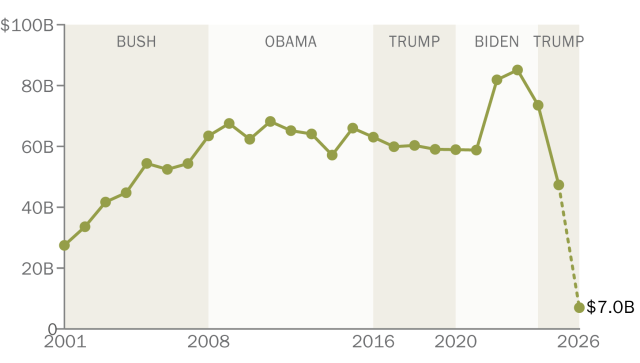
For the fiscal year ending September 30, 2025, federal agencies disbursed a total of $47.3 billion in foreign aid. When adjusted for inflation, this figure represents a staggering $26 billion drop from the previous fiscal year, 2024. This precipitous decline is not merely a temporary budgetary fluctuation; it is a structural shift. The current fiscal year, 2026, is already signaling an even steeper downward trajectory. As of July 1, 2026—covering three-quarters of the current fiscal year—the U.S. government had dispersed a mere $7 billion in foreign assistance.
To put this in historical perspective, between 2008 and 2021, annual U.S. aid spending consistently hovered between $57 billion and $68 billion (in constant 2025 dollars), with foreign assistance accounting for roughly 1% of total federal expenditures. By contrast, in fiscal 2025, that share slipped to 0.67%. In the current fiscal year, that number has plummeted to a negligible 0.09% of total federal spending.
Chronology of a Shift: From Ukraine-Era Peaks to Current Austerity
The narrative of U.S. foreign aid over the last five years is a tale of two distinct eras. The first period, spanning 2022 to 2024, saw a significant surge in foreign assistance, largely driven by the massive mobilization of support for Ukraine following the Russian invasion in February 2022. During this window, inflation-adjusted assistance hit a historical zenith, peaking at $85.1 billion in fiscal 2023.
However, the current administration’s shift in priorities has effectively dissolved the momentum of that era. The dismantling of key USAID infrastructure and the broader "America First" directive have curtailed the mechanisms through which this aid was historically delivered.

The decline has been swift:
- Fiscal 2023: The peak of modern U.S. aid, reaching $85.1 billion.
- Fiscal 2024: A cooling period, with spending dropping to $73.5 billion.
- Fiscal 2025: A sharp contraction, with spending falling to $47.3 billion.
- Fiscal 2026 (Year-to-date): A continued collapse, with just $6.9 billion disbursed as of mid-year.
Data Analysis: Who Receives the Funding?
The geography of U.S. aid has also undergone a radical reconfiguration. Ukraine, which for four consecutive years stood as the primary recipient of American generosity, has seen its funding vanish. In fiscal 2025, Ukraine received $6.7 billion—a 34.1% decrease from 2024. In the first nine months of fiscal 2026, that figure has dropped to a nominal $214.4 million, almost entirely restricted to humanitarian and economic aid.
Israel and Jordan, traditionally top-tier recipients of U.S. support, have also seen their allocations adjusted. While Israel received $3.3 billion in 2025—a 51.4% reduction from the previous year—the nature of this aid remains heavily skewed toward military and security assistance, which accounted for 99.8% of the total. Jordan, meanwhile, received $1.7 billion in 2025, with its aid more broadly distributed across economic, security, and social sectors.
As of July 2026, Jordan currently stands as the leading recipient of U.S. funds, having received $965.7 million. The West Bank, Gaza, and Ethiopia follow, though the absolute dollar amounts are substantially lower than in previous years, reflecting a broader strategy of targeted, rather than expansive, international investment.
The Changing Composition of Aid
Beyond the who, the what of U.S. aid has fundamentally changed. Historically, military and security assistance—encompassing anti-terrorism efforts, drug trafficking prevention, and police training—represented the largest share of the foreign aid budget. In 2024, more than a quarter of all foreign assistance was dedicated to these goals.
In 2025, however, the administration slashed military and security aid by nearly $11 billion, dropping it from $18.2 billion to $7.3 billion. This category now accounts for only 15.5% of total foreign aid, the lowest level since records began in 2001.
Public health initiatives—covering HIV/AIDS relief, malaria control, and maternal health—now occupy the largest share of the budget, at 23.1%. Despite this, the total funding for health programs has still fallen from $15.2 billion in 2024 to $10.9 billion in 2025. Economic development aid, while still representing 17.3% of the total pie, also saw an absolute decline of $1.4 billion.
Official Stance and Administrative Implications
The current administration has been vocal about its desire to reduce what it characterizes as "unnecessary entanglements" in foreign nations. The reduction in aid is not merely a result of budget cuts; it is the result of a deliberate, systematic dismantling of the institutional apparatus at agencies like the U.S. Agency for International Development (USAID).
By focusing on disbursements—the actual cash leaving the Treasury—rather than abstract obligations or budget requests, researchers have identified a clear policy goal: the actual cessation of long-term funding cycles. This move has sparked intense debate in Washington. Proponents of the cuts argue that the U.S. has reached a point of "aid fatigue" and must prioritize domestic fiscal health. Critics, however, warn that the withdrawal creates a power vacuum, allowing global competitors to step into regions where the U.S. has traditionally held significant influence.
Global Implications: A World Without the "American Safety Net"
The withdrawal of $26 billion in annual aid carries profound implications for global stability. Many developing nations in sub-Saharan Africa and Southeast Asia have long relied on U.S. funds for infrastructure, health, and democratic governance. As these flows dry up, international observers are monitoring the potential for a spike in instability.
In middle-income countries, public sentiment toward this reduction is increasingly negative. Many communities that previously viewed the U.S. as a reliable partner in humanitarian crises are now facing a reality where basic social services—water, sanitation, and disease control—are underfunded.
Moreover, by excluding "Foreign Military Sales" (the commercial transfer of weapons) from these aid statistics, the data suggests that while the charitable aspect of U.S. foreign policy is shrinking, the transactional aspect—where nations must purchase their own security—is likely to grow. This marks a transition from a post-WWII model of "generous donor" to a more hard-nosed, transactional model of international relations.
Conclusion
The data from the first half of 2026 serves as a definitive marker: the era of robust U.S. international assistance has reached a significant inflection point. Whether this represents a permanent retreat from global leadership or a temporary pause in the exercise of American soft power remains the central question of the current administration. However, the numbers on ForeignAssistance.gov leave little room for ambiguity—the U.S. footprint abroad is becoming smaller, more targeted, and significantly more expensive for those nations that were once the beneficiaries of American aid.
As the fiscal year 2026 concludes, the world will be watching to see if this trend continues or if the U.S. will find a new equilibrium in its global obligations. For now, the "Great Retrenchment" is the defining reality of American foreign policy.
 Neng Nana