
 By rifanmuazin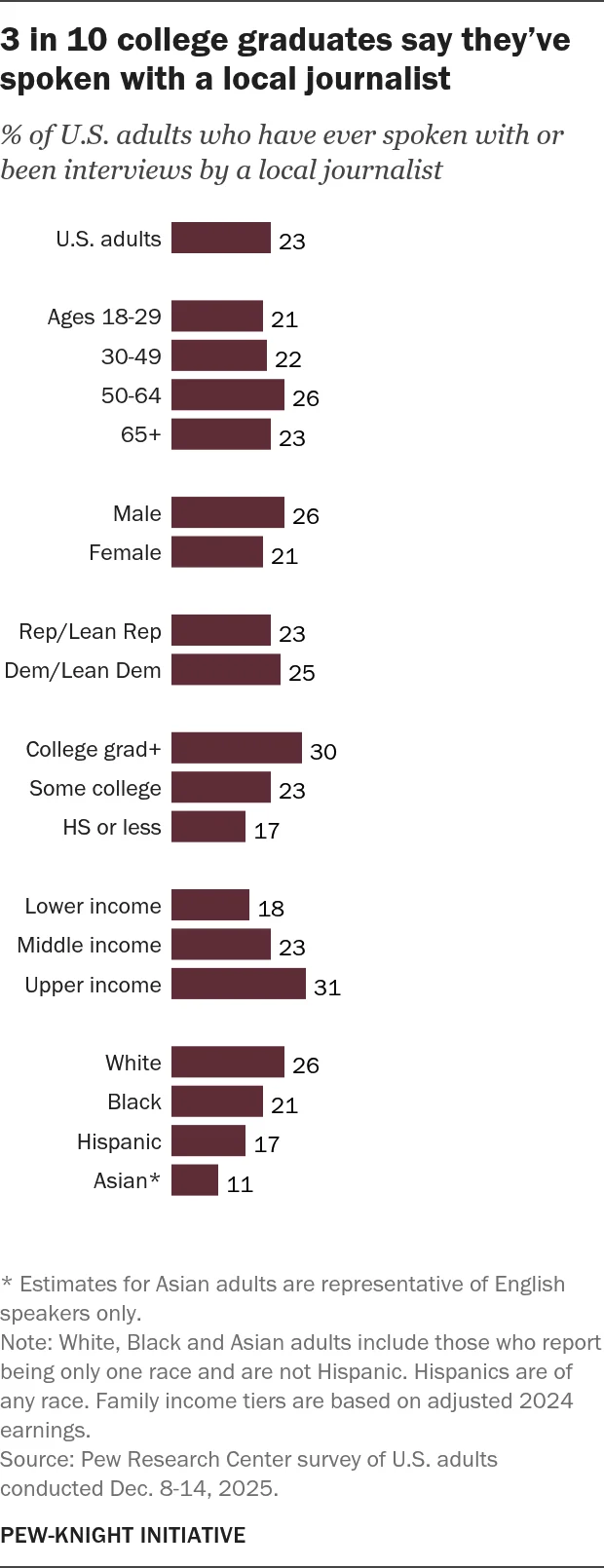
In the vast ecosystem of American civic life, the local journalist often acts as a chronicler of community milestones, a watchdog of municipal governance, and a storyteller of the neighborhood experience. Yet, for the vast majority of the American public, this relationship remains strictly observational. According to a new comprehensive analysis from the Pew Research Center, conducted under the auspices of the Pew-Knight Initiative, roughly 23% of U.S. adults report having ever spoken with or been interviewed by a local journalist.
This statistic, derived from a survey of 3,560 U.S. adults conducted in December 2025, underscores a profound distance between the news media and the citizenry they serve. Despite the essential role local news plays in fostering an informed electorate, the actual point of contact—the direct interview or the casual conversation—is a rare occurrence for the average person.
The State of Public Engagement: Main Facts
The findings suggest a remarkable stability in the relationship between the public and the local press. When the Pew Research Center first posed this question in 2016, 26% of respondents indicated they had interacted with a local reporter. Nearly a decade later, that figure has remained largely static, fluctuating only within the low-to-mid-twenties.
This stability indicates that the barrier to entry for media-public interaction is not merely a product of the current digital climate or the rise of social media, but rather a structural reality of how local newsrooms operate. The data clarifies that for the overwhelming majority of Americans—roughly 76%—the local journalist remains a figure seen on television or read in a byline, rather than a person they have engaged with directly.
A Chronology of Interaction
To understand the current landscape, one must look at the historical trajectory of these interactions.

- 2016: The baseline year for this specific metric, where 26% of adults reported contact. This period marked a time when local newsrooms were beginning to feel the acute pressure of declining advertising revenue but still maintained larger reporting staffs than today.
- 2018: The number dipped slightly to 21%, reflecting early shifts in news consumption habits as digital-first models began to replace legacy print and broadcast operations.
- 2024: After a period of industry consolidation and the "news desert" phenomenon gaining national attention, the figure remained largely stagnant at 22%.
- 2025: The latest data puts the figure at 23%, suggesting that despite the evolving methods of news gathering—including the use of AI, social media monitoring, and remote interviews—the frequency of direct human-to-journalist engagement remains consistent.
Demographic Disparities in Media Access
The survey reveals that the likelihood of being interviewed or speaking with a journalist is not distributed evenly across the American population. Instead, it is heavily stratified by socioeconomic status, education, and community attachment.
The Education and Income Gap
The most significant predictors of engagement with the press are educational attainment and household income. Specifically, 30% of college graduates report having interacted with a local journalist, compared to only 17% of those with a high school education or less.
A similar trend holds for income: 31% of upper-income adults have spoken to a reporter, a figure nearly double that of lower-income adults, of whom only 18% report the same experience. This data suggests that those with higher social and financial capital are more likely to be positioned in professional or civic circles where journalists are more likely to seek out sources.
Racial and Ethnic Variations
The data also highlights significant disparities along racial and ethnic lines. White adults (26%) are notably more likely to have interacted with a journalist than Hispanic (17%) or Asian (11%) adults. While the difference between White and Black adults (21%) is not statistically significant, the lower rates among Hispanic and Asian populations raise questions about how local newsrooms are prioritizing diversity in their sourcing practices and whether language barriers or cultural disconnects play a role in limiting these interactions.
The Role of Community Attachment
Perhaps the most telling finding is the correlation between community attachment and media interaction. Among individuals who report being "very attached" to their local community, 34% have spoken with a journalist. This drops sharply as attachment wanes, falling to 13% for those who feel "not at all attached" to their area.

This creates a "virtuous cycle" for the highly engaged: those who are already deeply involved in their community are more likely to be interviewed, thereby increasing their visibility, while those who are less connected remain invisible to the local press.
The Chicken-and-Egg Dilemma: Implications
The Pew Research Center report acknowledges a fundamental analytical challenge: causality. Does feeling attached to a community lead one to engage with journalists, or does the act of being interviewed—and subsequently seeing one’s voice represented in the media—foster a deeper sense of belonging?
The implications of this are significant for the future of local journalism. If journalists rely on a consistent, small pool of "usual suspects" for quotes and community perspectives, the media risks reflecting only the views of the most established and affluent members of society. This potentially alienates marginalized groups who may already feel that their voices are not adequately represented in the local narrative.
Furthermore, the fact that journalists do not randomly sample the population when choosing sources suggests that "who gets heard" is an active choice. Newsrooms that are cognizant of these statistics might consider deliberate efforts to broaden their sourcing networks to include residents who are less "connected" but nonetheless vital to the community fabric.
Looking Ahead: The Future of the Pew-Knight Initiative
This analysis is part of the broader Pew-Knight Initiative, a collaborative effort funded by The Pew Charitable Trusts and the John S. and James L. Knight Foundation. The initiative’s mission is to provide rigorous, data-driven insights into how Americans navigate the modern information landscape.

As local newsrooms continue to grapple with the decline of traditional revenue models and the rapid pace of technological change, the "human element" remains a critical, if underutilized, resource. The data presented here serves as a baseline for industry leaders, educators, and journalists to consider the health of the relationship between the press and the public.
If the goal of local journalism is to serve the entire community, the current data suggests there is a substantial "untapped" population. Bridging the gap between the 23% who have engaged with the press and the 76% who have not may be one of the most important challenges for the next decade of local news.
The findings are clear: while the technology of journalism may change, the fundamental human connections that underpin the news remain the most difficult—and perhaps the most vital—to cultivate. By understanding the demographic and psychological barriers to these interactions, news organizations can begin to design more inclusive strategies for community engagement, ensuring that the local record reflects the diversity and complexity of the people it serves.
Methodology Note: This report was prepared by Joanne Haner, a research assistant at the Pew Research Center. The analysis is based on a survey of 3,560 U.S. adults, members of the American Trends Panel, conducted Dec. 8-14, 2025. For full details on the questionnaire, methodology, and data, please visit the official Pew Research Center archives.
 Muslim
  Nana Muazin
  Siti Muinah