
 By Dwi Wanna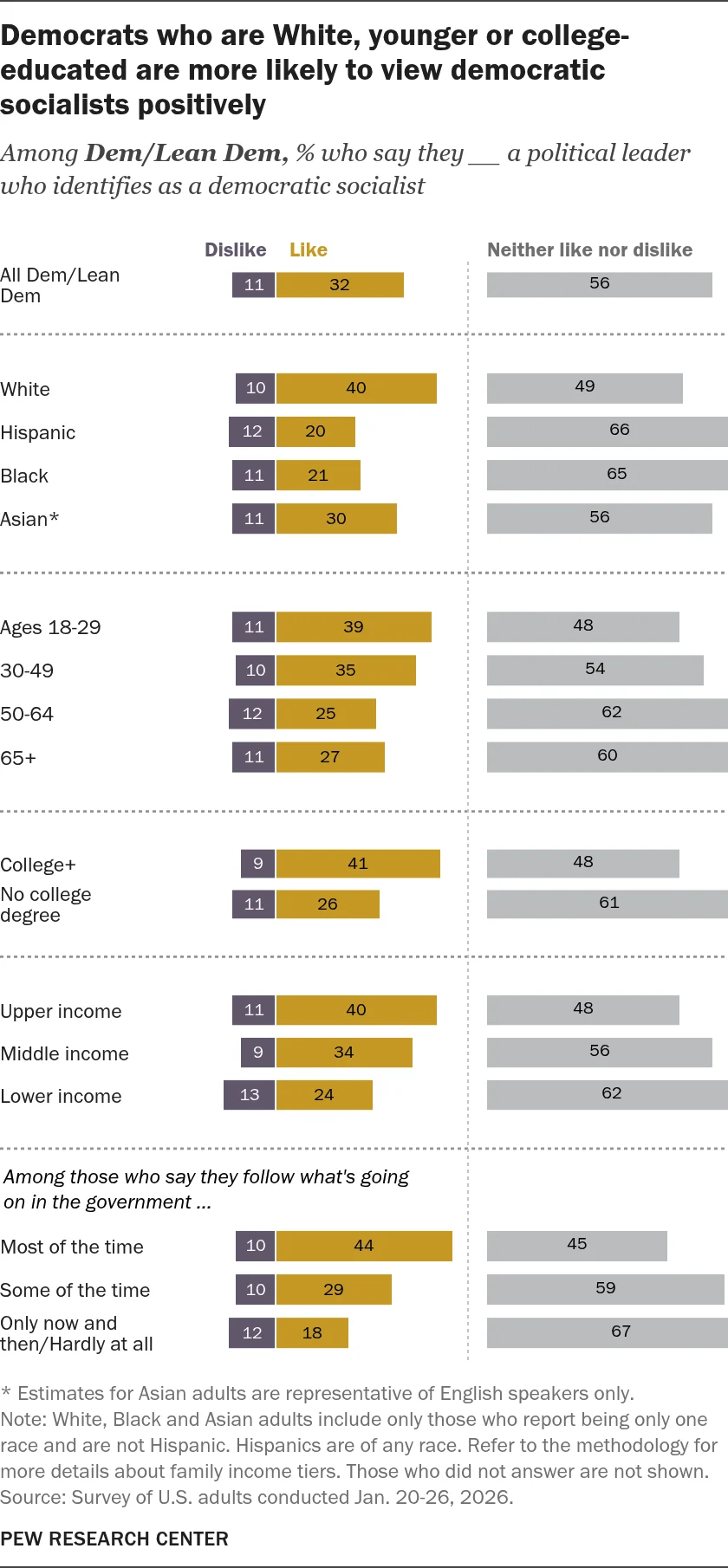
In recent weeks, the American political landscape has been punctuated by a series of high-profile electoral victories for candidates running under the banner of "democratic socialism." From the halls of power in Washington, D.C., to the municipal government in New York City, these candidates—such as NYC Mayor Zohran Mamdani and D.C. mayoral hopeful Janeese Lewis George—have managed to mobilize grassroots support and secure primary wins that have captured national attention.
However, despite these localized successes, a new comprehensive study by the Pew Research Center reveals a striking disconnect between the political momentum of these candidates and the broader national sentiment. While the label "democratic socialist" has become a potent rallying cry for a specific wing of the Democratic Party, it maintains only modest traction among the national electorate, including the broader base of Democratic-leaning voters.
The State of the Field: Main Facts
The term "democratic socialist" has evolved from a fringe identifier to a mainstream political label within the last decade. As candidates utilizing this branding continue to win primary contests, they are testing the limits of the American political palate.
Data from the Pew Research Center’s January 2026 survey of 8,512 U.S. adults indicates that the American public is far from a consensus on these figures. Nationally, more Americans report a dislike for politicians identifying as democratic socialists (38%) than those who express a positive view (17%). Yet, the most significant finding is the sheer scale of the "undecided" middle; 43% of the total population reports that they neither like nor dislike these political leaders, suggesting that for a plurality of the country, the brand is either misunderstood or not yet a defining factor in their political identity.

A Chronology of the Current Surge
The current moment is the culmination of a decade-long shift in internal party politics. Following the 2016 and 2020 primary cycles, which saw democratic socialist ideas gain significant airtime, the 2026 election cycle has served as a proving ground for the movement’s ability to transition from activism to governance.
- Mid-2010s: Democratic socialism emerges as a recognizable force, largely centered around high-profile national campaigns that brought terms like "Medicare for All" and "Green New Deal" into the mainstream discourse.
- Early 2024: Institutional consolidation begins as local organizations backed by democratic socialist platforms start winning consistent seats in city councils and state legislatures.
- June 2026: A wave of primary victories in major urban centers—notably New York and Washington, D.C.—signals that the movement has successfully tapped into local grievances regarding housing, transit, and economic inequality.
- Current Status: The movement faces a strategic pivot. While they have successfully captured core urban primary electorates, they are now encountering the "general election" reality: a national public that remains largely indifferent or skeptical of the ideological branding.
Supporting Data: The Demographic Divide
The Pew Research study provides a granular look at which segments of the population are most receptive to the democratic socialist label. Among Democrats and those who lean toward the party, 32% express a positive view of these leaders, while 11% hold a negative view. The remaining 56% remain neutral.
Ideological and Demographic Stratification
The support for democratic socialist leadership is not distributed evenly. It is deeply tied to ideology, race, education, and age.
- Ideology: The divide is stark. Among liberal Democrats, 52% express a positive view of democratic socialist leaders, with only 4% expressing dislike. In contrast, among conservative and moderate Democrats, only 17% express a positive view, with 66% reporting that they feel "neither positive nor negative" toward these leaders.
- Race and Ethnicity: White Democrats are the most likely to view these leaders positively (40%), compared to Asian (30%), Black (21%), and Hispanic (20%) Democrats.
- Age and Education: Youth and academic attainment are strong predictors of support. 39% of Democrats under 30 favor these leaders, and 41% of college-educated Democrats express a positive view. Conversely, support drops significantly among older demographics and those without a college degree.
- Political Engagement: Perhaps most telling is the correlation with civic engagement. 44% of Democrats who follow government affairs "most of the time" express a preference for democratic socialist leaders, compared to only 18% of those who follow politics "hardly at all." This suggests that the label is most resonant among the most politically active and informed segments of the electorate.
The Typology Perspective
The 2026 Political Typology report further clarifies these findings by moving beyond party labels. The data highlights two specific groups—"Leftward Progressives" and "Loyal Liberals"—as the primary engines of support.

- Leftward Progressives: A staggering 66% of this group likes democratic socialist leaders.
- Loyal Liberals: 53% of this group holds a positive view.
Combined, these groups represent 17% of the total U.S. public but hold outsized influence within the Democratic coalition. At the opposite end of the spectrum, groups such as "No Apologies Right" and "Faith First Conservatives" exhibit near-total rejection of the brand, with disapproval ratings reaching as high as 95% and 83%, respectively.
Official Responses and Political Context
While the Democratic Party establishment has often been wary of the democratic socialist label—fearing that it alienates swing voters in purple districts—the success of candidates like Mamdani and Lewis George has forced a re-evaluation of the party’s "big tent" strategy.
Supporters of these candidates argue that the high number of voters who "neither like nor dislike" these leaders represents an opportunity rather than a barrier. They contend that the neutral, large plurality is a group that can be converted through policy-focused messaging that avoids the "socialist" label and instead highlights tangible results in housing and public services.
Conversely, critics within the party often point to the national data as a warning. They argue that as the movement moves out of deep-blue urban enclaves and into suburban or battleground districts, the national disapproval rate of 38% could become a liability in broader legislative or presidential contests.

Implications for the Future
The implications of these findings are twofold. First, the "democratic socialist" brand is currently a successful niche strategy. In high-density, highly-educated, and deeply liberal urban areas, the brand functions as a signal of ideological purity and a commitment to systemic change. This allows candidates to differentiate themselves in crowded primary fields and mobilize a dedicated base.
Second, the data suggests that for the Democratic Party at large, the term remains a polarizing element that risks neutralizing the "middle" of the party. The fact that a 56% majority of Democrats are neither for nor against these leaders is perhaps the most critical takeaway. It indicates that the average Democratic voter is not necessarily wedded to the ideology but is also not yet repelled by it.
As we move toward the next federal election cycle, the challenge for democratic socialist candidates will be to maintain their current momentum without alienating the large, moderate, and often disengaged segments of the party. If they can frame their specific policy successes—such as rent stabilization, expanded public transit, and climate resilience—in ways that appeal to the broader 43% of the public who are currently indifferent, they may successfully transition from local agitators to national power brokers.
However, if the brand continues to be viewed through the lens of the "ideological extremes" as defined by the current political typology, it may find itself hitting a ceiling. The 2026 election cycle is proving that while democratic socialism is no longer a political pariah, it has yet to become a national mandate. The future of the movement will depend on whether its leaders can bridge the gap between their enthusiastic, young, and college-educated base and the cautious, neutral, and broader American electorate.
 Muslim
  Nana Muazin
  Siti Muinah