
 By Suro Senen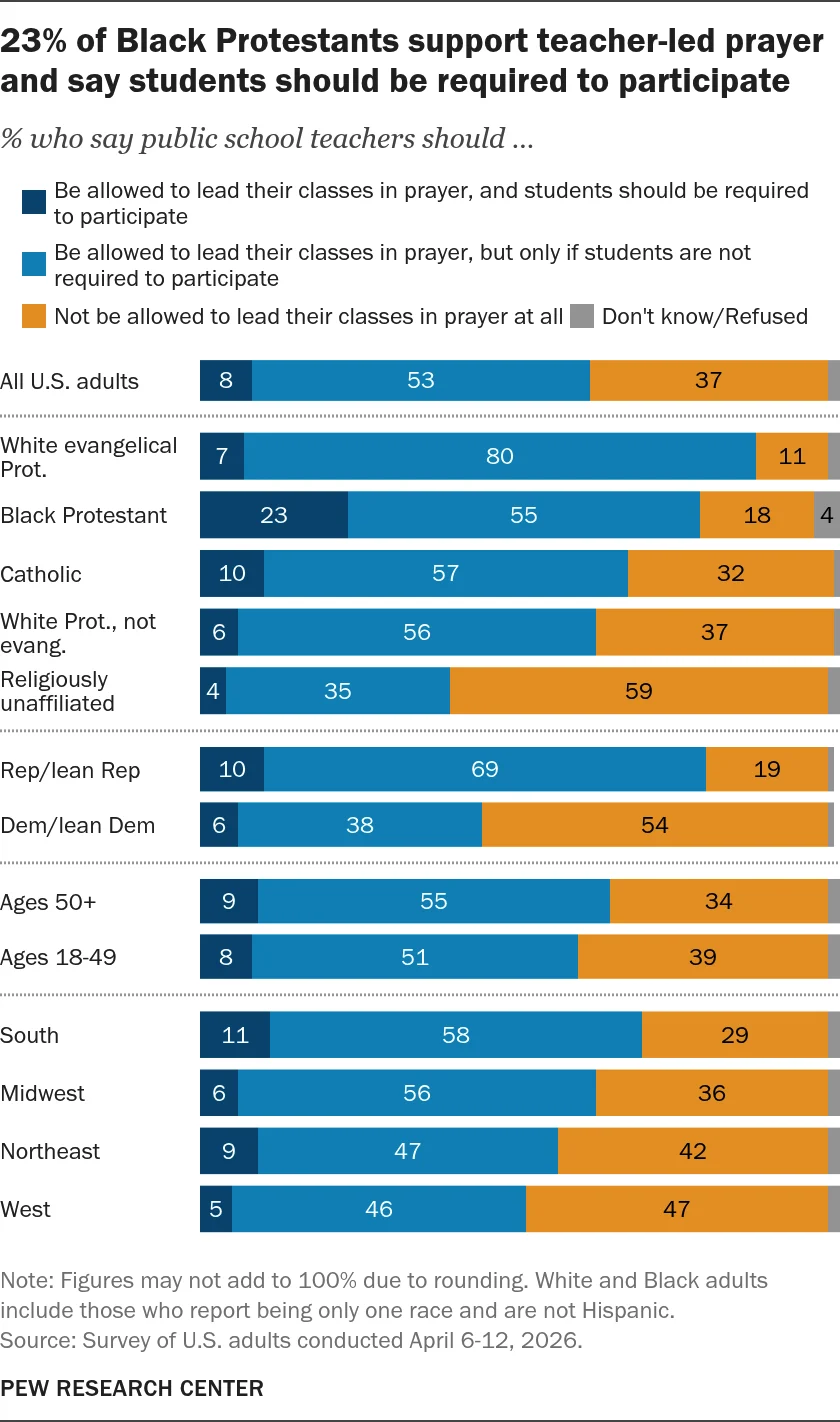
As state legislatures across the United States increasingly push to integrate religious displays and practices into public education, a new survey from the Pew Research Center offers a complex snapshot of American sentiment. The data, collected in April 2026, illustrates that while a significant portion of the public is receptive to religious expression in schools, the consensus fractures quickly when specific mandates or institutional endorsements are introduced.
The debate, which has recently intensified in states like Texas—where officials have sought to mandate the display of the Ten Commandments and incorporate designated prayer time—is far from settled. While the political class argues over the constitutionality and necessity of these measures, the American public remains deeply conflicted, balancing a respect for religious tradition against the foundational principles of a pluralistic, secular public education system.
The Landscape of Religious Expression in Schools
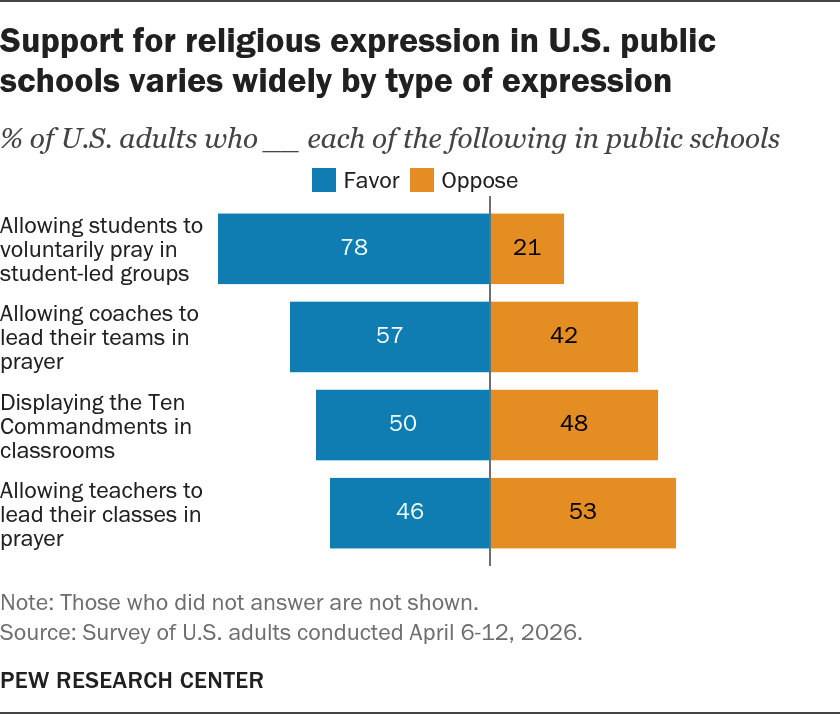
The Pew Research Center’s April 2026 survey of 3,592 U.S. adults reveals that public opinion is highly conditional. Support for religious expression in schools is not monolithic; it varies wildly depending on the type of expression and the extent of institutional involvement.
The highest level of support is reserved for student-initiated activities. Roughly 78% of Americans favor allowing students to voluntarily pray in student-led groups, a figure that transcends many of the traditional partisan and religious divides. This widespread acceptance suggests that for the vast majority of the public, the preservation of individual religious liberty for students is a non-negotiable component of the school environment.

However, support drops significantly as the role of authority figures increases. When the survey asked about allowing coaches to lead their teams in prayer, support fell to 57%. When shifting the focus to the classroom—specifically, allowing teachers to lead their students in prayer—support drops even further, to 46%, with a slim majority (53%) expressing opposition.
Chronology of a Growing Controversy
The current legislative push is the culmination of years of legal and cultural skirmishing. For decades, the precedent established by the Supreme Court in the mid-20th century—most notably in Engel v. Vitale (1962)—largely restricted state-sponsored prayer in public schools.
- Mid-20th Century: The legal framework for separation of church and state in public education was solidified, creating a standard that prohibited school-led religious activities.
- Early 2020s: A shift in the federal judiciary, paired with an emboldened state-level legislative movement, began to challenge the status quo. Several states introduced "religious freedom" bills designed to allow for prayer and religious displays in schools.
- 2025–2026: The movement reached a fever pitch in states like Texas, where Attorney General Ken Paxton and other lawmakers actively championed the display of the Ten Commandments and the reintroduction of prayer into public school curricula. These actions prompted immediate legal challenges and intense public debate.
- April 2026: The Pew Research Center conducted its extensive survey to gauge how these high-profile political maneuvers reflect the actual will of the American people.
Supporting Data: A Deep Dive into Demographics
The data underscores that the American public is divided not only by geography but by faith, age, and partisan affiliation.
The Teacher-Led Prayer Dilemma
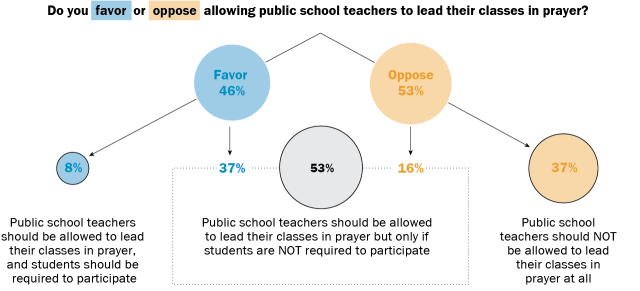
Perhaps the most telling finding in the study is the distinction between "allowing" prayer and "mandating" it. When researchers combined responses to gauge support for teacher-led prayer, they found that only 8% of Americans believe teachers should lead prayer and that students should be required to participate.
Conversely, 53% support the idea of teacher-led prayer, but only on the condition that participation remains entirely voluntary. This suggests that while a majority of the country is comfortable with a religious presence in the classroom, they remain fundamentally protective of the individual student’s right to abstain.
Partisan and Religious Fractures
The divide is perhaps most stark when looking at political affiliation. Republicans and Republican-leaning independents are significantly more likely to support both coach-led prayer and the display of the Ten Commandments. In contrast, a clear majority of Democrats and Democratic-leaning independents oppose these measures.
Religion also plays a primary role. White evangelical Protestants and Black Protestants remain the strongest proponents of religious expression in schools. For instance, 83% of White evangelical Protestants favor displaying the Ten Commandments, compared to just 24% of those who identify as religiously unaffiliated.
Regional Variations
Geographically, the "Bible Belt" influence remains visible. Those residing in the South and Midwest are consistently more supportive of religious expression in schools than their counterparts in the Northeast and the West. This regional divergence suggests that the national conversation on school prayer is, in many ways, a conversation between different cultural interpretations of American identity.
Official Responses and Political Implications
The legislative efforts to promote religious displays in schools have drawn strong reactions from both sides of the aisle. Proponents argue that the removal of religion from the public square has contributed to a decline in moral instruction and that allowing displays like the Ten Commandments is a return to America’s historical roots.
"Our schools should be places where students can freely express their faith," one state legislator argued in a recent hearing. "Protecting these expressions is not about forcing religion on anyone; it is about ensuring that we do not silence the voices of the faithful."
Conversely, critics and civil liberties groups argue that such measures violate the Establishment Clause of the First Amendment. They contend that the school environment is a place of learning for children of all backgrounds—including those from minority faiths and those with no religious affiliation—and that government-sanctioned religious displays serve to alienate these students.
"The classroom is a public space, funded by taxpayers of all beliefs," a spokesperson for a national civil liberties organization noted. "When the state puts its thumb on the scale in favor of one religion, it inevitably tells those who do not share that faith that they are secondary citizens in their own school."

The Implications for Future Policy
As states continue to test the limits of current constitutional interpretations, the implications of this study are profound. The data suggests that politicians who push for mandatory religious participation are likely acting against the will of the majority, even among those who are sympathetic to religious expression.
The real challenge for policymakers lies in the "voluntary" caveat. While 53% of Americans support teacher-led prayer only if it is voluntary, implementing such a policy in a classroom setting is fraught with complexity. Can a prayer led by an authority figure truly be considered "voluntary" in the eyes of a student who may feel pressure to conform? This is the core issue that legal scholars and school boards will continue to grapple with in the years to come.
Furthermore, the data suggests that as long as these issues are treated as binary "all or nothing" debates, the national discourse will remain polarized. The high levels of support for student-led prayer (78%) offer a potential middle ground—an avenue where religious expression is allowed to flourish without infringing upon the rights of others or requiring the state to endorse a specific creed.
Conclusion
The 2026 Pew Research survey provides a crucial reality check for those engaged in the "culture wars" surrounding public education. It reveals an American public that is largely tolerant of religious expression, yet deeply wary of state mandates.

As we move further into the decade, the question will not necessarily be whether religion has a place in schools, but rather how that place is negotiated. Will schools become forums for pluralistic expression, or will they become battlegrounds for competing ideological visions? The answer to that question will likely be decided not just in the halls of state capitols, but in the day-to-day interactions between teachers, students, and parents across the nation.
Ultimately, the data suggests that for the average American, the freedom to practice one’s religion is inextricably linked to the freedom not to. Balancing these two rights will remain the central challenge for American public education for the foreseeable future.
 Muslim
  Nana Muazin
  Siti Muinah