
 By Asro

In the fast-paced ecosystem of digital marketing and e-commerce, a single immutable law governs sustainable growth: what worked yesterday will almost certainly not work tomorrow. Consumer attention spans are fracturing, inboxes are more saturated than ever, and gut feelings are increasingly proving to be an expensive substitute for empirical data.
For modern entrepreneurs and marketing executives, A/B testing has evolved far beyond a casual "nice-to-have" tactic. It is now a critical, non-negotiable operational framework.
Smart founders no longer rely on unverified assumptions about what catches a consumer’s eye. Instead, they test everything systematically—from subject lines and call-to-action (CTA) buttons to precise send times and sender identities. This methodical approach is rooted in a powerful mathematical reality: small wins compound. When a marketer secures a 5% lift in open rates here and a 10% bump in click-through rates there, an existing email list can suddenly generate 30% more revenue without requiring a single additional dollar in advertising spend.
Main Facts: The Evolution of Email Optimization and Conversion Science
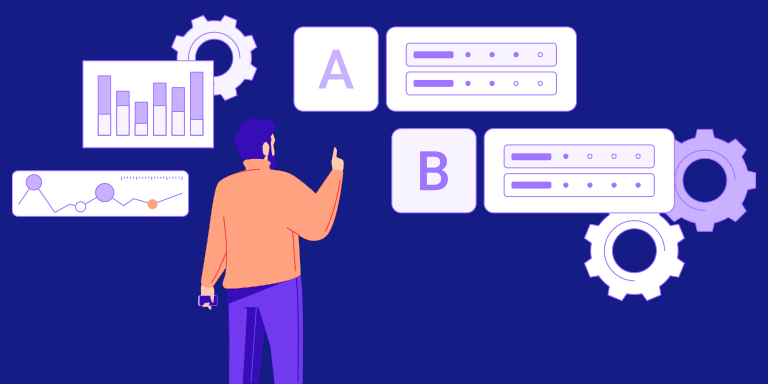
At its core, A/B testing (or split testing) involves comparing two versions of a digital asset—such as an email campaign, landing page, or automated flow—against a single variable to determine which variation performs better against a defined metric.
Recent industry data underscores just how impactful these minor tweaks can be when scaled across an entire customer lifecycle. According to comprehensive benchmark research from e-commerce marketing platform Omnisend, average open rates among merchants rose from 22.9% in 2022 to 25.1% in 2023, while click-through rates ticked upward from 1.2% to 1.5%. These gains were not accidental; they were the direct result of increasingly sophisticated testing architectures and hyper-targeted audience segmentation.
Furthermore, automated email flows—such as welcome series, browse abandonments, and cart recovery sequences—consistently outperform standard batch-and-blast campaigns. Omnisend’s data reveals that automated messages yield 52% higher open rates, 332% higher click rates, and an astonishing 2,361% better conversion rate than traditional campaigns. However, the efficacy of these automated funnels is heavily dependent on continuous optimization through rigorous split testing.
Chronology: From Static Broadcasts to Real-Time Dynamic Funnels
To understand the current state of A/B testing, it is helpful to look at how email and digital marketing have matured over the past two decades:
- The Early 2000s (The Broadcast Era): Marketing departments relied on static, one-size-fits-all email blasts. Segmentation was primitive, and optimization was largely limited to manual visual inspections before hitting "send."
- The 2010s (The Introduction of Split Testing): Email service providers began baking rudimentary A/B testing tools directly into their dashboards. Marketers could finally test two different subject lines on a small percentage of their list before the platform automatically deployed the winner to the rest.
- The COVID-19 Pandemic & Digital Boom (2020–2022): With global commerce shifting heavily online, inbox congestion skyrocketed. Brands could no longer rely on broad demographic targeting. Testing expanded from simple subject lines to complex behavioral triggers and multi-variate automation flows.
- The Present Day (Continuous Optimization & AI-Driven Insights): Testing is no longer viewed as a reactive measure deployed only when performance dips. Leading e-commerce brands and SaaS startups now maintain a permanent testing cycle, ensuring that at least one high-leverage element is always being evaluated in real time.
Supporting Data: The Statistics Driving Conversion Economics
The argument for continuous testing is backed by compelling behavioral statistics and financial outcomes:
- The Power of the Subject Line: A staggering 43% of consumers decide whether or not to open an email based solely on the subject line, according to Omnisend research. Conversely, poorly crafted or misleading copy causes approximately 69% of users to flag an email as spam or junk, directly harming sender reputation and long-term deliverability.
- Personalization Yields Dividends: Personalized subject lines have been shown to boost open rates by up to 26%, a metric that amplifies exponentially when combined with automated behavioral triggers.
- The Compound Effect on Revenue: Omnisend customers who actively test and refine their abandoned cart workflows report average extra monthly sales gains of approximately $5,000. These revenue spikes are rarely achieved through massive structural overhauls; rather, they are the accumulation of small, consistent improvements in open and click-through rates over several months.
What High-Growth Brands Should Be Testing
Effective A/B testing requires discipline. Rather than testing random elements, high-performing marketers focus their testing frameworks on high-leverage components across the customer journey:
1. Subject Lines and Preheader Text
- The Goal: Maximize initial visibility and open rates.
- What to Test: Curiosity-driven hooks versus direct benefit statements, the inclusion of emojis, personalization tokens (such as first names), and varying preheader text lengths to see what naturally complements the primary subject line.
2. Call-to-Action (CTA) Copy and Placement
- The Goal: Transform passive readers into active buyers, subscribers, or clickers.
- What to Test: Action-oriented micro-copy (e.g., "Claim My 50% Discount" versus a generic "Learn More"), button colors, visual hierarchy, and whether text-based links outperform styled buttons within specific email templates.
3. Send Times and Frequency
- The Goal: Ensure maximum visibility during peak engagement windows.
- What to Test: Morning deployments versus evening rushes, weekday sends versus weekend dispatches, and identifying optimal delivery intervals to prevent subscriber fatigue without sacrificing brand presence.
4. Sender Names and Identities
- The Goal: Build immediate trust and human connection.
- What to Test: Corporate brand names versus a recognizable human sender (e.g., "Support at Brand" versus "Sarah from Brand"), which often fosters higher intimacy and response rates.
5. Audience Micro-Segments
- The Goal: Deliver hyper-relevant messaging tailored to specific buyer personas.
- What to Test: VIP buyers versus first-time browsers, active past purchasers versus lapsed subscribers, and behavioral cohorts based on specific product categories viewed.
Official Perspectives and Industry Insights
Industry veterans and e-commerce strategists emphasize that testing is fundamentally an intelligence-gathering exercise rather than a purely mechanical task.
"Every single test you run yields data that can—and should—be repurposed across your entire marketing ecosystem," notes a lead conversion optimization strategist. "If you learn that curiosity-based subject lines dramatically outperform benefit-driven ones for your specific audience, that insight shouldn’t live in a vacuum. It should inform your paid social ad copy, your landing page hero sections, and your SMS marketing strategy."
This perspective highlights a core differentiator between average brands and market leaders: market leaders use testing to build an institutional intelligence library, allowing them to make faster, more accurate strategic decisions with minimal financial risk.
Implications: Building a Sustainable Testing Framework
Transitioning from sporadic experiments to a continuous testing culture requires a disciplined, repeatable framework. Without a structured approach, marketers risk falling into the trap of comparing unverified guesses.
Experts recommend following a five-step protocol for every experiment:
- Formulate a Clear Hypothesis: Avoid random testing. Define what you hope to discover before launching. Bad hypothesis: "Let’s try a red button." Good hypothesis: "We believe a benefit-driven CTA (‘Claim My Discount’) will increase click-through rates by 10% compared to a generic control (‘Learn More’)."
- Isolate a Single Variable: To accurately attribute a performance shift to a specific change, alter only one element at a time (e.g., the subject line or the CTA copy). Changing multiple elements simultaneously obscures the underlying data.
- Select the Appropriate Metric: Align your testing goal directly with the variable being altered. Use open rates to measure subject line efficacy, and click-through rates to evaluate body copy and CTA performance.
- Ensure Statistical Significance: Avoid acting on false positives. Platforms like Omnisend generally recommend testing with a minimum of 1,000 recipients per variant to secure statistically meaningful results. For smaller lists, a split-testing allocation—such as sending Variant A to 20%, Variant B to 20%, and the winning variant to the remaining 60%—helps protect overall campaign performance.
- Document and Apply Learnings: Maintain an internal repository of past tests, documenting what worked, what failed, and the contextual reasons behind those outcomes. Over time, this documentation becomes an invaluable proprietary asset.
The Bottom Line for Founders
Achieving exceptional marketing performance does not require an endless marketing budget or a complete overhaul of your brand strategy. Instead, it requires a commitment to intentional, continuous experimentation. By systematically refining subject lines, CTAs, segmentation, and timing through structured A/B testing, businesses can unlock compounding gains from their existing audiences.
For e-commerce brands looking to streamline this process, modern tools like Omnisend offer integrated solutions that allow marketers to build sophisticated automated flows, execute effortless audience segmentation, and optimize every send without juggling disjointed software stacks. By embracing a data-driven testing mindset, brands can stop guessing, start converting, and secure a lasting competitive advantage in an increasingly crowded digital marketplace.
 Evan Lee Salim
 Azzam Bilal Chamdy
 rifanmuazin
