
 By Asep Darmawan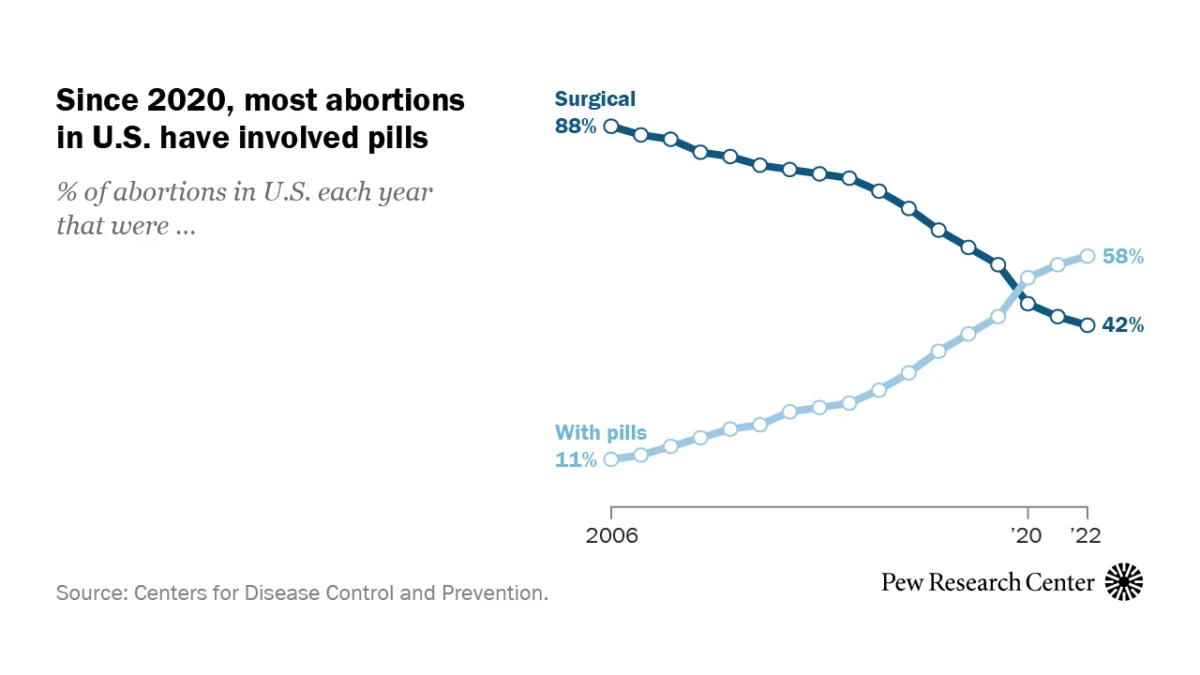
As the United States moves further into the post-Roe v. Wade era, the landscape of reproductive health continues to evolve. Four years after the Supreme Court’s landmark decision to end the federal constitutional right to abortion, the national conversation remains as polarized as it is complex. While public opinion continues to show that a significant majority of Americans favor legal access to abortion in most or all circumstances, the logistical and medical realities of the procedure are shifting rapidly.
Understanding this landscape requires a deep dive into the historical data provided by the U.S. Centers for Disease Control and Prevention (CDC) and the Guttmacher Institute. By examining over half a century of records, we can discern the trajectory of abortion rates, the changing methods of care, and the evolving demographic profile of those seeking these services.
Main Facts: The Current Landscape
In a January 2026 survey, Pew Research Center found that 60% of U.S. adults believe abortion should be legal in all or most cases, while 38% believe it should be illegal in all or most cases. This public sentiment exists against a backdrop of varying state-level restrictions that have fundamentally altered access.
The most striking trend in recent years is the transition from surgical procedures to medication-based abortions. As of 2022, the CDC reported that 58% of all abortions in the United States involved the use of medication—specifically, the two-pill regimen of mifepristone and misoprostol. This shift marks a significant departure from the late 20th century, when surgical intervention was the standard of care.
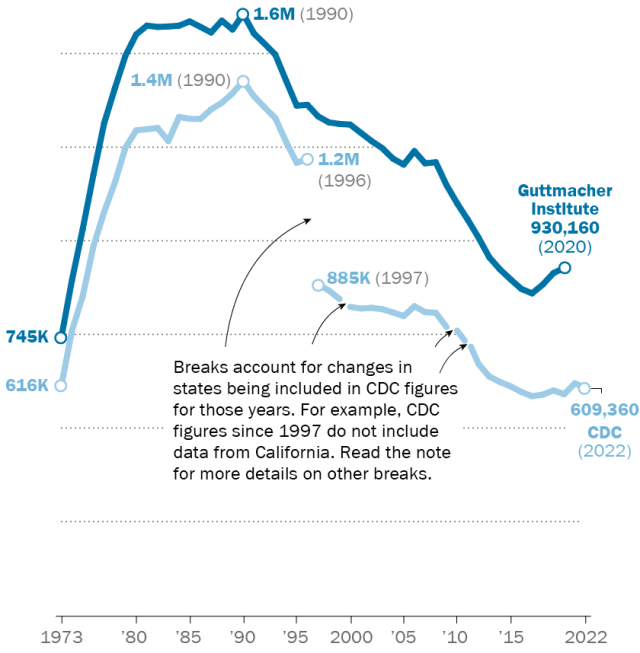
However, precise measurement of these trends remains a challenge. The CDC relies on voluntary state reporting, a system that has seen gaps since the mid-1990s, particularly with major states like California opting out of data submission. Conversely, the Guttmacher Institute, a private nonprofit, conducts direct surveys of all known abortion providers. While these two entities often report different figures due to their distinct methodologies, both datasets converge on a single truth: the long-term trend of abortion in the U.S. has been one of gradual, sustained decline since its peak in the late 1980s.

A Half-Century Chronology: From 1973 to the Present
To understand where the country stands today, one must look at the timeline established by the 1973 Roe v. Wade decision.
The Peak Years (1973–1991)
Following the legalization of abortion nationwide, the annual number of procedures climbed steadily, reaching its zenith in the early 1990s. During this era, providers were more numerous, and access was largely standardized across the country. Guttmacher recorded approximately 1.6 million abortions in 1990, while the CDC reported roughly 1.4 million.
The Era of Decline (1992–2017)
Beginning in the mid-1990s, a "slow yet steady" decrease in the abortion rate began. This decline occurred even as the population of women of reproductive age (15–44) grew. Researchers have attributed this to a variety of factors, including increased access to contraception, shifting social norms, and the implementation of state-level regulations that began to close clinics and limit access. By 2017, the annual number of abortions had dropped significantly from the highs of the early 90s.
Recent Fluctuations and the Post-Roe Environment (2018–Present)
The years leading up to the 2022 Supreme Court ruling saw a slight uptick in abortion numbers. However, the subsequent overturning of Roe introduced a new variable: the surge in medication abortions, often obtained through telehealth or informal channels outside of traditional clinical settings. While traditional clinics have seen a reduction in numbers, the total volume of abortions remains difficult to quantify because the data does not fully capture the rise in "pills-by-mail" and other non-clinical avenues.
Supporting Data: Demographics and Medical Realities
The demographics of those seeking abortions provide a nuanced view of the procedure’s role in American healthcare.
Who is Seeking Care?
Data from 2022 indicates that women in their 20s account for 57% of all abortions. Those in their 30s represent 31%, while teens (13–19) and those over 40 make up smaller segments of the total. Perhaps most notably, 88% of those seeking abortions are unmarried.
Race and ethnicity also play a significant role in the data. Non-Hispanic Black women accounted for 39% of abortions in 2022, while non-Hispanic White women made up 32%, and Hispanic women 21%. When looking at rates per 1,000 women, the disparities are clear, with Black women experiencing higher rates of abortion than their White or Hispanic counterparts.
Reproductive History
Interestingly, a majority of patients (56%) are seeking an abortion for the first time. Furthermore, 41% of those who had an abortion in 2022 had no previous live births, challenging the common misconception that abortion is primarily sought by those who have already completed their families.
Safety and Complications
Medical safety has improved dramatically over the last 50 years. The CDC reports that the case-fatality rate—the number of deaths per 100,000 legal abortions—has dropped from 2.09 in the 1970s to 0.46 in the 2013–2021 period. Modern medication abortion protocols, when administered under clinical guidance, are widely regarded by the medical community as safe and effective.
Official Responses and Political Implications
The data regarding abortion providers highlights a stark shift in the healthcare infrastructure. In 1982, there were nearly 3,000 facilities providing abortions; by 2020, that number had fallen to 1,603. The primary driver of this decline was the exit of hospitals from providing the service, leaving a disproportionate burden on specialized clinics.
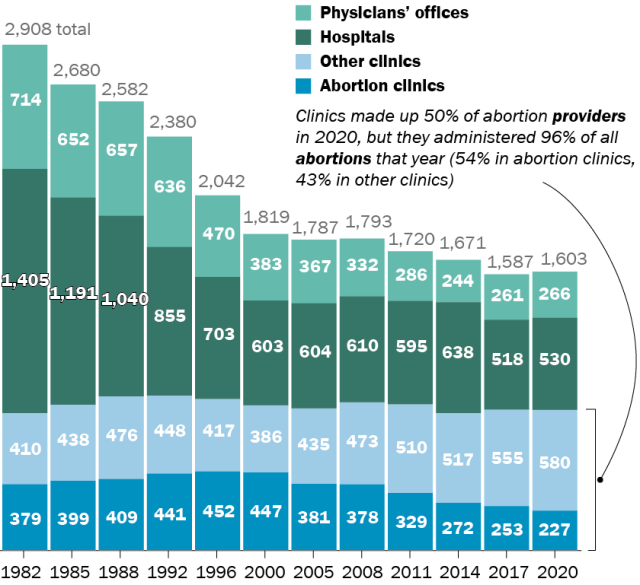
Since the 2022 Supreme Court decision, the number of clinics has continued to shrink—from 807 in 2020 to 753 by the end of 2025. This has led to a rise in cross-state travel for care. In 2022, approximately 16.5% of abortions were performed on women who traveled outside their home state to receive them, a significant increase from 10.9% just one year prior.
This migration pattern has prompted a fierce legislative response. Pro-life organizations often point to the decline in clinic numbers as a success for their advocacy, while pro-choice groups emphasize the health risks associated with the resulting "care deserts." Both sides, however, utilize the Guttmacher and CDC data to bolster their respective arguments, proving that while the numbers are empirical, their interpretation is deeply ideological.
Implications for the Future
The reliance on medication abortion signals that the future of reproductive care may be increasingly decentralized. As the FDA continues to monitor the safety of mifepristone and as states grapple with the legality of telehealth abortion services, the traditional model of "clinic-based care" is being challenged.
The implications are threefold:
- Health Equity: The widening gap in access between states with protective laws and those with restrictive laws is likely to deepen existing healthcare disparities, particularly for marginalized communities.
- Data Transparency: As more abortions occur outside of traditional clinical settings, the ability of organizations like the CDC and Guttmacher to provide an accurate, real-time picture of national trends will be severely tested.
- Public Policy: The ongoing debate will likely shift from the legality of the procedure itself to the regulation of medication and the protection of patients who travel for care.
In conclusion, while the number of abortions has followed a downward trend for decades, the post-2022 era represents a fundamental rupture in how that care is delivered. Whether the current fluctuation in numbers represents a temporary adjustment or a permanent change in behavior, the data clearly shows that the American experience of abortion is, and will remain, a deeply fractured and evolving phenomenon. As the nation watches the data unfold in the coming years, the balance between state-level policy and individual health needs will remain the central tension in the American story of reproductive rights.
 Muslim
  Nana Muazin
  Siti Muinah