
 By Sagoh
In the hyper-connected theater of modern social media, few metrics carry as much humiliation as being "ratioed" by a corporate brand. Even fewer spectacles match the poetic irony of the owner of a multi-billion-dollar social media platform enduring that exact fate on his own turf.
Tech billionaire and X (formerly Twitter) owner Elon Musk recently found himself on the receiving end of a viral roasting courtesy of the official Assassin’s Creed X account. The public pile-on—which quickly amassed hundreds of thousands of likes and triggered an avalanche of memes—highlights a recurring theme in Musk’s digital footprint: his tumultuous, often meme-fueled relationship with the global gaming community.
What began as a routine online spat involving prominent culture-war commentators and leftist streamers rapidly evolved into a masterclass in corporate wit, dredging up Musk’s recent embarrassments in the virtual realm and cementing a new chapter in internet lore.
Main Facts
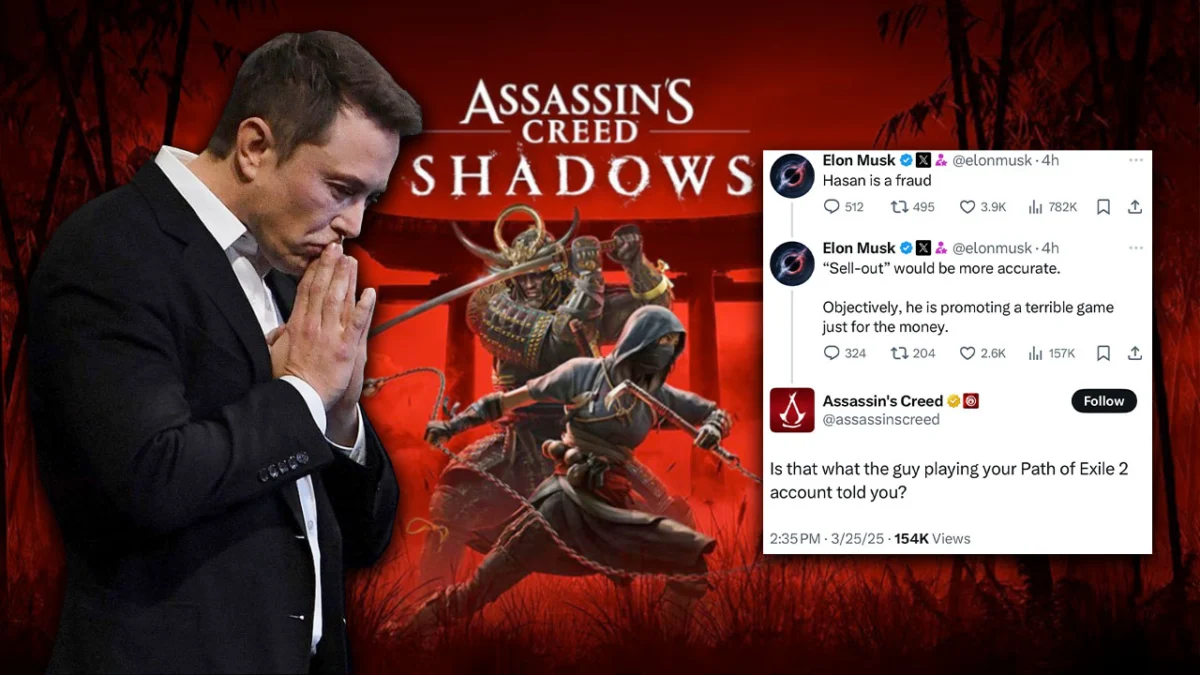
The core of the controversy centers on a public exchange sparked by video game critic Mark Kern, widely known online as @Grummz. Kern took aim at Ubisoft, the developer behind the upcoming Assassin’s Creed: Shadows, criticizing the studio for sponsoring leftist Twitch streamer Hasan "HasanAbi" Piker to promote the game.
The critique caught the attention of Elon Musk, who frequently engages with political and cultural debates on X. Musk weighed in directly, labeling Piker a "fraud" and a "sellout" for allegedly promoting a "terrible game just for the money."
Rather than letting the attack slide or relying on traditional public relations damage control, the social media team behind @AssassinsCreed saw an opening. They delivered a devastating counter-punch that bypassed the political debate entirely, choosing instead to target Musk’s personal gaming credibility:
"Is that what the guy playing your Path of Exile 2 account told you?"
The tweet was a direct reference to a scandal earlier this year wherein Musk was exposed for allegedly using boosted accounts in Grinding Gear Games’ Path of Exile 2. The corporate riposte immediately outperformed Musk’s own post, garnering over 400,000 likes overnight and sparking widespread amusement across the platform. Users flooded the replies with classic internet adages, ranging from "I wasn’t really familiar with your game" to jokes about Musk spending $44 billion to acquire a platform specifically to be publicly humbled.
Chronology of the Dispute
To understand how a corporate video game account landed such a devastating blow, one must trace the timeline of events that preceded the clash, beginning with Musk’s earlier misadventures in the gaming sphere.
Early 2025: The Path of Exile 2 Fraud Gamer Controversy
Months prior to the Assassin’s Creed spat, Musk’s gaming habits came under intense public scrutiny. Known for frequently streaming or posting about his gaming exploits, Musk began showing off a high-rank character in the notoriously difficult action RPG Path of Exile 2.
However, Path of Exile veterans quickly noticed glaring discrepancies. Despite operating an elite-tier character, Musk’s gameplay footage revealed a baffling lack of fundamental mechanics. He blundered awkwardly across maps, missed basic cues, and made elementary mistakes that seasoned players immediately recognized as incompatible with someone who legitimately earned that rank.
Adding fuel to the fire, publicly available game telemetry data indicated that the account was operating out of Asia—or utilizing a VPN routed through the region—raising immediate suspicions of account sharing and paid progression services ("boosting"). Under mounting pressure from the community, Musk eventually copped to the practice, posting a defense claiming, "It’s impossible to beat the players in Asia if you don’t, as they do!" For the gaming community, the admission solidified his status as a "fraud gamer."
The Assassin’s Creed: Shadows Catalyst
Fast forward to the present day: Ubisoft’s upcoming release, Assassin’s Creed: Shadows, has been a frequent flashpoint in broader culture-war discussions surrounding representation and developer choices in modern game design.

When Grummz criticized Ubisoft for partnering with Hasan Piker—a prominent, progressive political streamer—to showcase the game, it set the stage for a classic internet dogpile. Musk stepped into the fray to amplify the criticism, calling Piker a fraud.
This prompted a swift counter-offensive from Piker himself, who engaged in a series of digital barbs mediated by Grummz screenshots. Piker challenged Musk to a "duel" in FromSoftware’s notoriously punishing Elden Ring, while Musk retaliated by calling Piker "chickens***" for allegedly blocking him on X.
Yet, amidst the political posturing and streamer drama, it was the official @AssassinsCreed account that completely hijacked the narrative, pivoting the conversation away from streaming politics and directly onto Musk’s humiliated gaming resume.
Supporting Data and Community Reaction
The public response to the @AssassinsCreed tweet demonstrated a rare moment of unified consensus across a deeply polarized platform. Internet users, ranging from casual scrollers to chronically online meme historians, immediately recognized the sharpness of the corporate burn.
- Engagement Metrics: The official Assassin’s Creed response skyrocketed past 400,000 likes within its first 24 hours online, vastly outstripping the engagement on Musk’s original post criticizing Piker.
- The "Corporate Ratio": In internet culture, a "ratio" occurs when a reply or quote-tweet receives significantly more engagement (likes, reposts, views) than the original post, signaling public disapproval or a successful roasting. The incident joined the ranks of legendary corporate X burns.
- Consumer Sentiments: In a bizarre twist of marketing success, several X users—such as user @soundaholism—publicly vowed to purchase Assassin’s Creed: Shadows at full price immediately upon release, purely out of respect for the social media manager’s willingness to openly mock the platform’s billionaire owner.
The comment sections were flooded with classic internet memes:
- Animated GIFs of people eating popcorn.
- Images referencing the "I owe you an apology, I wasn’t really familiar with your game" template.
- Jokes reiterating the sunk-cost fallacy of the $44 billion platform acquisition, with users quipping that buying a social media network is an expensive way to get publicly "cooked" by a medieval stealth-action franchise.
Official Responses and Stakeholder Posturing
The dynamics of this interaction highlight a fascinating evolution in how corporate entities interact with high-profile platform owners. Historically, corporate accounts on X (formerly Twitter) maintained a sanitized, hyper-polite tone designed not to ruffle feathers, especially those of platform executives or major advertisers.
However, under the current algorithmic landscape of X—where engagement, controversy, and "edgy" personality-driven branding often yield higher algorithmic reach—brands have increasingly leaned into casual, unfiltered banter.
- Ubisoft’s Stance: By deploying a sharp, meme-literate counter-punch, the Assassin’s Creed social media team bypassed weeks of traditional advertising spend, generating millions of organic impressions globally. While Ubisoft has faced intense scrutiny and culture-war battles over Assassin’s Creed: Shadows, this single post temporarily shifted the public narrative from political grievance to corporate comedy.
- Hasan Piker’s Involvement: Piker’s inclusion in the narrative underscored the bizarre intersection of political streaming, tech billionaires, and video game marketing. By challenging Musk to Elden Ring, Piker utilized the attention to lean into the absurdity of the discourse.
- Elon Musk’s Silence: Notably, following the devastating ratio by the corporate account, Musk largely retreated from that specific thread, choosing not to engage directly with the Assassin’s Creed social media manager—a rare instance of restraint for a public figure known for having the last word on his platform.
Implications for Corporate Branding and Platform Culture
The incident involving Elon Musk, Hasan Piker, and the Assassin’s Creed account carries broader implications for both digital marketing and the culture of social media platforms:
1. The Death of Deference to Tech Elites
The traditional hierarchy of social media—where platform owners and tech titans enjoyed a baseline of corporate deference from verified brand accounts—has thoroughly eroded. When an official publisher feels comfortable publicly mocking the platform’s owner using an inside joke about cheating in a video game, it signals a cultural shift. Platforms are no longer viewed by brands as sacred corporate halls, but as digital arenas where bare-knuckle PR brawls are fair game.
2. The Weaponization of Engagement Algorithms
X’s current algorithmic structure heavily rewards conflict, controversy, and high-velocity engagement. By leaning into a public beef with the platform’s owner, the Assassin’s Creed account maximized its visibility far beyond its traditional core demographic. For digital marketers, the takeaway is clear: cultural resonance and viral humor frequently outperform polite, risk-averse messaging.
3. The Inescapable Shadow of Online Accountability
For high-profile figures who project an image of supreme competence—whether in business, engineering, or gaming—internet communities maintain long memories. Musk’s Path of Exile 2 booster controversy proved that the modern internet cannot be easily fooled by superficial displays of gaming prowess. When public figures step into gaming spaces to critique others, they open themselves up to immediate, data-backed reality checks.
Ultimately, the clash between a billionaire tech mogul and a stealth-assassin franchise will go down in digital history as a prime example of the unpredictable nature of online discourse. It proved once again that on the internet, no one is immune to being cooked—not even the person who owns the kitchen.
 rifanmuazin
 Nana
 Iffa Jayyana
