
 By Basiran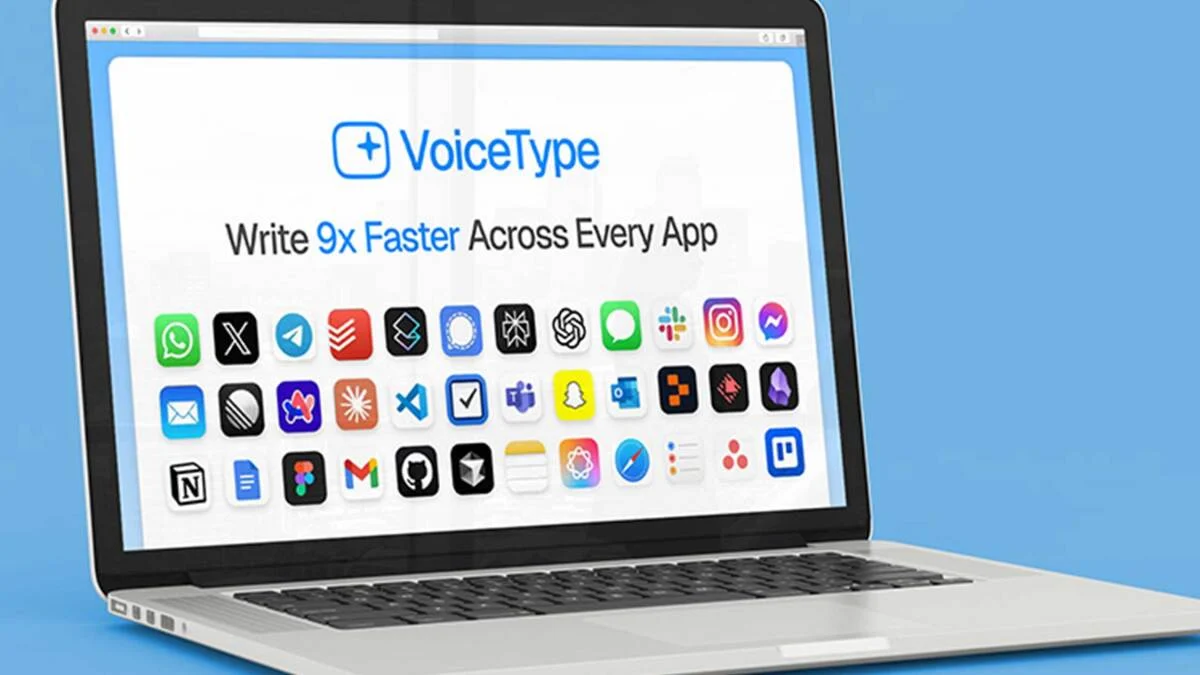
In an era dominated by digital communication, the keyboard has remained the primary bridge between human thought and machine execution. However, as professional workloads expand and cognitive fatigue sets in, the limitations of manual typing have become increasingly apparent. While the average professional types at a rate of 40 words per minute (WPM), human speech routinely clocks in at more than triple that speed.
Historically, the bottleneck preventing the widespread adoption of voice-to-text technology has not been speed, but accuracy. Early dictation systems required tedious training, struggled with accents, and demanded manual editing that often erased any time saved.
A new entrant in the productivity space, VoiceType, seeks to fundamentally alter this dynamic. Leveraging advanced artificial intelligence, the software boasts an accuracy rate of up to 99.7% while processing speech at speeds of up to 360 WPM. To accelerate market penetration, the developers have partnered with StackSocial to offer a lifetime subscription for a one-time payment of $39.97—a massive discount from its standard retail value of $419. This promotional offer, running through July 12 at 11:59 p.m. PT, highlights a broader shift in how modern professionals interact with their operating systems.
1. Main Facts: The Architecture of VoiceType
VoiceType is designed as a system-wide, background-running utility compatible with both macOS (version 11 or later) and Windows (10 or later, 64-bit). Unlike legacy dictation tools that operate within proprietary sandboxes, VoiceType integrates directly into the operating system’s input pipeline. This allows users to dictate text into any active application, including email clients, project management platforms like Notion and Linear, text editors, and integrated development environments (IDEs) used for coding.
+-----------------------------------------------------------------+
|                         VOICETYPE ENGINE                        |
+-----------------------------------------------------------------+
                                |
        +-----------------------+-----------------------+
        |                       |                       |
        v                       v                       v
 [Tone Match Engine]     [Context Awareness]     [Whisper Mode Engine]
        |                       |                       |
        v                       v                       v
Adjusts register based   Scans active window     Detects low-decibel
to active application    to resolve homophones   vocalizations for
(e.g., Slack vs. Email)  and industry terms      shared workspaces
The software’s feature set is tailored to mitigate the historical pain points of voice dictation:
- Real-Time Formatting and Grammar Correction: As the user speaks, the software automatically inserts appropriate punctuation, manages capitalization, corrects grammatical errors, and suggests stylistic refinements without interrupting the flow of dictation.
- Tone Match: One of the tool’s most innovative features, Tone Match dynamically adjusts the linguistic register of the output based on the active application. For example, a dictated message in Slack will retain a casual, conversational tone, while the same spoken words directed into a formal email client or legal document will be formatted with appropriate professional syntax.
- Context Awareness: To prevent the misspelling of proper nouns, industry-specific jargon, or technical terms, VoiceType analyzes the context of the active window. This semantic awareness allows the system to differentiate between homophones (e.g., "site" versus "cite") based on the surrounding text.
- Whisper Mode: Addressing the social and practical constraints of open-office environments, Whisper Mode utilizes high-sensitivity acoustic modeling to accurately capture sub-vocalizations and low-decibel speech, allowing users to dictate quietly without disturbing colleagues.
- Multilingual Support: The platform supports over 35 languages, catering to global teams and multilingual professionals.
2. Chronology: The Evolution of Speech-to-Text Technology
To understand the significance of VoiceType’s 99.7% accuracy claim, it is necessary to examine the historical trajectory of speech recognition technology over the past several decades.
[1952] Bell Labs' "Audrey" (Single-speaker digit recognition)
  |
[1970s] DARPA Harpy System (1,011-word vocabulary, strict grammar)
  |
[1997] Dragon NaturallySpeaking (Continuous speech, required heavy profile training)
  |
[2010s] Cloud-Assisted Siri/Google Assistant (Acoustic models, high latency)
  |
[2022] OpenAI Whisper & Transformer Revolution (Contextual semantic processing)
  |
[Present] VoiceType System-Wide Integration (99.7% accuracy, 360 WPM, Zero-training)- 1952 – The Auditory Pioneer: Bell Labs develops "Audrey," the first recognizable speech recognition system. Audrey could only comprehend spoken digits (0-9) from a single speaker with about 90% accuracy, requiring massive vacuum-tube hardware.
- 1970s – Vocabulary Expansion: Under the auspices of DARPA, the Harpy system at Carnegie Mellon University achieves a vocabulary of 1,011 words. However, it requires highly structured grammatical rules and significant processing time.
- 1997 – Continuous Speech Recognition: Dragon Systems releases Dragon NaturallySpeaking, the first commercially viable continuous speech recognition software. While revolutionary, it required users to read standardized texts for hours to "train" the software to recognize their vocal patterns.
- 2010s – The Cloud and Mobile Era: The integration of deep neural networks and cloud computing births virtual assistants like Apple’s Siri, Google Assistant, and Amazon Alexa. Dictation becomes ubiquitous on mobile devices, but desktop integration remains siloed, and latency issues persist due to heavy reliance on remote servers.
- 2022 – The Transformer and LLM Breakthrough: OpenAI releases Whisper, an open-source automatic speech recognition (ASR) model trained on 680,000 hours of multilingual and multitask supervised data. This shifts the paradigm from simple acoustic matching to contextual, semantic prediction.
- Present – Seamless OS Integration: Tools like VoiceType emerge, productizing these advanced transformer models into lightweight, system-wide desktop applications. By moving past the need for user-specific voice profiles, VoiceType achieves a plug-and-play architecture that serves over 650,000 users globally.
3. Supporting Data: The Productivity Mathematics of Dictation
The primary value proposition of VoiceType lies in the optimization of cognitive and physical throughput. Below is a comparative analysis of traditional typing versus AI-assisted dictation.
WPM Comparison: Typing vs. Dictation
| Metric | Average Keyboard User | Professional Typist | VoiceType Dictation |
|---|---|---|---|
| Speed (WPM) | 40 WPM | 80 WPM | Up to 360 WPM |
| Accuracy Rate | ~92% | ~97% | Up to 99.7% |
| Physical Strain | High (Repetitive Motion) | High (Repetitive Motion) | Minimal |
| Cognitive Load | High (Focus on mechanics) | Medium (Muscle memory) | Low (Focus on composition) |
For a professional writing a 1,500-word report:
- At 40 WPM, raw drafting takes 37.5 minutes of continuous typing.
- With VoiceType at a conservative conversational speed of 150 WPM, the draft is completed in 10 minutes, representing a 73.3% reduction in raw drafting time.
Financial and Market Comparison
The decision by VoiceType’s distributors to offer a lifetime subscription for $39.97 contrasts sharply with the prevailing Software-as-a-Service (SaaS) subscription model.
Estimated Cumulative Cost Over 5 Years:
--------------------------------------------------
VoiceType (Lifetime Deal):  $39.97  [===================]
Traditional SaaS Dictation: $600.00 [==================================================]
(Based on a standard $10/month subscription)
By eliminating the recurring monthly fee, VoiceType positions itself as an attractive utility for freelancers, developers, and writers seeking to optimize their fixed overhead costs.
4. Technical Infrastructure and Corporate Strategy
The architectural footprint of VoiceType highlights a deliberate focus on professional desktop workflows rather than casual mobile use.
Platform Constraints and Requirements
VoiceType requires an active internet connection to process transcriptions, indicating that while the application runs locally in the background, it leverages cloud-based API endpoints to perform heavy transformer-based speech-to-text processing. This hybrid model ensures that local system resources (CPU and RAM) are not overly taxed, allowing developers to run resource-heavy IDEs or designers to run graphics suites simultaneously.
The lack of a mobile application is a notable strategic choice. By focusing exclusively on macOS and Windows, the developers target high-value professional output—coding, technical writing, project management, and administrative documentation—where users are already seated at a workstation and require system-wide accessibility.
Market Strategy: The Lifetime Deal Model
The utilization of StackSocial as a distribution channel is a common strategy for software companies seeking rapid user acquisition and immediate liquidity. By offering an unlimited, uncapped word-count tier for a one-time fee of $39.97, VoiceType secures capital to fund ongoing server and development costs while simultaneously building a massive testing cohort. The data and telemetry gathered from over 650,000 active users provide the necessary feedback loop to refine the underlying machine learning models before transitioning to a more traditional B2B enterprise subscription model.
5. Implications: The Future of Human-Computer Interaction
The democratization of high-accuracy, low-cost dictation software has profound implications across several domains:
1. Accessibility and Ergonomic Health
For individuals suffering from physical disabilities, chronic conditions like arthritis, or Repetitive Strain Injuries (RSI) such as Carpal Tunnel Syndrome, the keyboard is a barrier to employment and expression. Highly accurate dictation tools transition computing from a motor-intensive task to an auditory one, leveling the playing field for disabled professionals.
2. Software Development and "Voice-Coding"
Traditionally, writing code via voice was considered impractical due to the highly specific syntax, punctuation, and formatting required by programming languages. With Context Awareness and customizable formatting, developers can dictate logic and comments seamlessly, reducing physical fatigue during long development cycles.
[Spoken Input] ---> "Create a function called calculate margin that takes revenue and cost"
                                     |
                                     v
                        [VoiceType Context Engine]
                                     |
                                     v
[Written Output] -> "def calculate_margin(revenue, cost):"
3. The Eradication of "SaaS Fatigue"
Consumers are increasingly pushy about the proliferation of monthly subscription models for basic utility software. The enthusiastic response to VoiceType’s lifetime license indicates a strong market appetite for standalone software purchases. As AI capabilities become commoditized, companies that offer transparent, one-time pricing models may find a significant competitive advantage over traditional SaaS giants.
Summary
Ultimately, VoiceType represents more than just a temporary discount on a productivity tool; it serves as a case study for the current state of artificial intelligence in daily workflows. By achieving a 99.7% accuracy rate at speeds that far outpace human typing, the software shifts voice dictation from a frustrating novelty to a highly viable professional standard. As the promotional offer concludes on July 12, the broader impact of this technology will continue to reshape how we conceptualize the relationship between human thought and the digital canvas.
 Raul Delapena Setiawan
  Ali Ikhwan
  Evan Lee Salim