
 By Asep Darmawan
As artificial intelligence continues to reshape industries across the globe, the field of public opinion research has faced a pressing question: Can AI-generated data reliably replace traditional, human-led polling? A comprehensive new methodological experiment conducted by the Pew Research Center suggests a resounding "no."
In an extensive study examining whether AI models can accurately duplicate high-quality public opinion polls, researchers found that synthetic survey data consistently diverges from reality. Utilizing a "digital twins" approach—where an advanced AI model was tasked with adopting the precise personas of real human panelists—the experiment revealed significant margins of error, systemic demographic overgeneralizations, and a tendency to flatten nuanced political spectrums into extreme caricatures.
While the Pew Research Center maintains that direct human engagement remains essential for measuring public opinion—and currently has no plans to deploy AI models for its own survey results—the explosive rise of "synthetic samples" across the broader polling industry necessitated a rigorous scientific evaluation. The findings offer a cautionary tale for researchers eager to cut costs and accelerate timelines using generative artificial intelligence.
Main Facts: The Anatomy of the Pew Experiment
To understand how synthetic populations hold up against actual human respondents, Pew’s methodology team designed a controlled, multi-layered experiment during the first half of 2026.
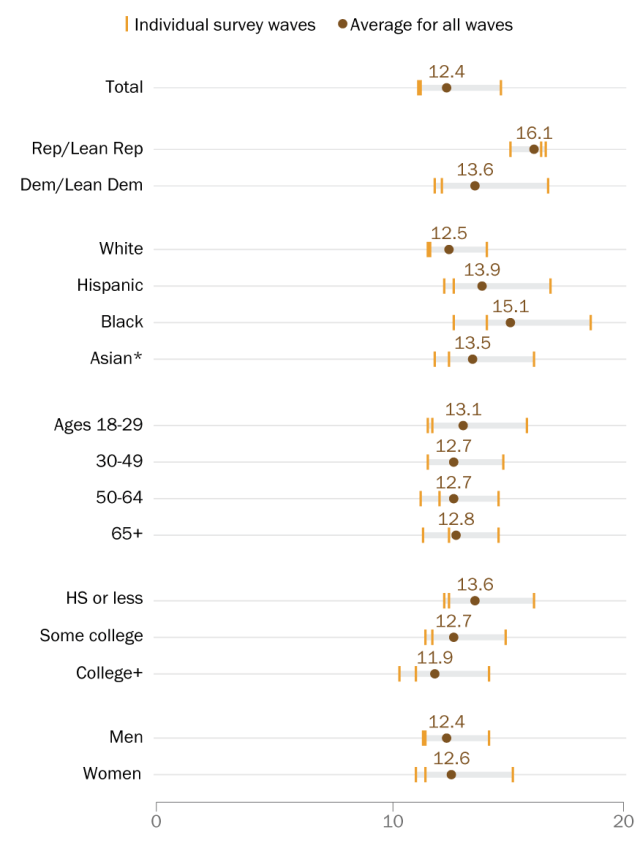
- The Core Finding: Across three separate survey waves, AI-generated survey results differed from actual human responses by an average absolute error of 12.4 percentage points. For individual survey waves, the average error ranged from 11 to 15 percentage points.
- The Methodology: Researchers utilized Anthropic’s Claude Opus 4.6 (configured with extended profile information and expert reflection). The model was fed a vast array of background data from real members of Pew’s American Trends Panel (ATP)—including self-reported demographic information and historical responses from a 2025 political typology survey.
- The Execution: The AI model was presented with sequential questions from three actual ATP survey waves administered in early 2026. It received the exact instructions and programming given to human participants.
- The Subgroup Failures: No major demographic or behavioral subgroup achieved an average error rate of less than 12 points. Errors were notably pronounced among Black adults (15.1 average error), Hispanic adults (13.9 average error), and self-identified Republicans or Republican leaners (16.1 average error).
Chronology: How the Study Was Conceived and Executed
The journey toward understanding "silicon samples" unfolded through a structured, methodical timeline reflecting the rapid evolution of large language models in professional research settings.

Phase 1: Background and Industry Shifts (Late 2025)
As generative AI models matured, commercial enterprises and alternative research groups began experimenting with "synthetic respondents"—simulated populations designed to bypass the expensive, time-consuming process of recruiting and surveying human subjects. Recognizing this growing trend, Pew Research Center designed a methodological experiment to interrogate the validity of these digital panels.
Phase 2: Groundwork and Persona Conditioning (Late 2025 – Early 2026)
Researchers laid the groundwork by gathering comprehensive psychological and demographic profiles from the American Trends Panel. Panelists who had completed the 2025 political typology survey were selected to serve as the baseline for the "digital twins."
Phase 3: Survey Replications (January – May 2026)
Pew selected three distinct survey waves from the first half of 2026 to test the AI model against actual human responses:
- Wave 185: Administered Jan. 20–26, 2026 (replicated by AI March 9–12 and April 7–10).
- Wave 190: Administered March 23–29, 2026 (replicated by AI March 30–April 2).
- Wave 192: Administered April 20–26, 2026 (replicated by AI April 27–May 1).
Phase 4: Analysis and Public Disclosure (September 30, 2026)
Following extensive computational analysis comparing the synthetic dataset against human baselines, the Pew Research Center published its definitive findings on September 30, 2026, accompanied by detailed topline data, methodologies, and interactive data visualizations.
Supporting Data: Where the AI Model Fell Short
To quantify the divergence between flesh-and-blood citizens and silicon personas, researchers calculated the average absolute percentage point error across various response options per question. The resulting data paint a clear picture of systematic distortion.
Overall Error Rates Across Survey Waves
- Total Average Error: 12.4 percentage points
- Wave 185: 11.3 pts
- Wave 190: 14.7 pts
- Wave 192: 11.2 pts
- Racial and Ethnic Subgroup Averages:
- White adults: 12.5 pts
- Asian adults (English-speaking): 13.5 pts
- Hispanic adults: 13.9 pts
- Black adults: 15.1 pts
- Political Affiliation Averages:
- Dem / Lean Dem: 13.6 pts
- Rep / Lean Rep: 16.1 pts
Case Study 1: Cultural Stereotyping and the World Cup
One of the most glaring demonstrations of AI bias involved the simulation of Hispanic adult attitudes toward sports and education. Trained on vast corpuses of internet data, AI models frequently fall back on cultural generalizations.
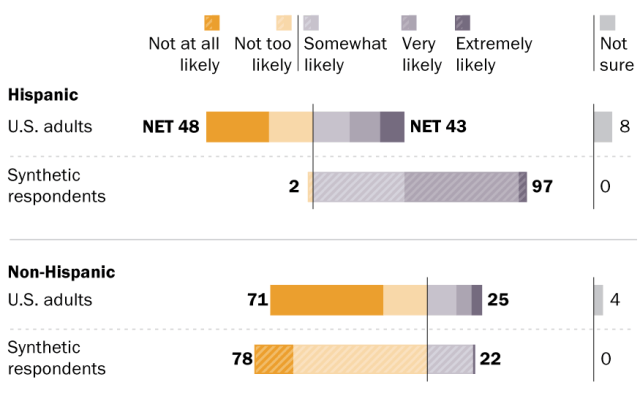
In the March 2026 survey (Wave 190), real Hispanic adults were asked how likely they were to follow the World Cup. Only 42% indicated they were at least somewhat likely to follow the tournament. However, when the AI model stepped into the digital shoes of those exact same Hispanic panelists, 97% claimed they were likely to follow it.
A similar distortion appeared regarding educational policy: 72% of synthetic Hispanic respondents claimed it was "extremely important" for schools to offer Spanish instruction—more than double the 32% figure recorded among real Hispanic survey participants.
Case Study 2: Flattening Partisan Diversity
The synthetic approach struggled equally with political nuance, frequently converting standard partisan leaning into near-unanimous consensus. While real-world political parties encompass a broad spectrum of internal disagreement, the AI model systematically homogenized ideological camps.
- Democratic Distortion: Among AI-generated Democratic respondents, 86% labeled personal fortunes of a billion dollars or more as a "bad thing" for the country (compared to 45% of real human Democrats). Furthermore, 90% or more of synthetic Democrats expressed uniform agreement on specific progressive talking points.
- Republican Distortion: When evaluating favorability toward Israel, 77% of synthetic Republican respondents reported being "somewhat favorable" alongside 18% "very favorable," virtually erasing internal skeptical factions that appeared in the human polling sample, where 27% expressed "somewhat unfavorable" views.
Official Responses and Institutional Policy
The publication of the "Silicon Samples" report underscores a critical philosophical stance by one of the world’s most trusted polling institutions. In an accompanying statement detailing their internal guidelines, Pew leadership reaffirmed their dedication to direct human engagement.
"The Center believes that speaking to the public is essential to measuring public opinion and has no current or future plans to use AI models to generate survey results."
While acknowledging that artificial intelligence can serve powerful backend roles in data processing, transcription, or coding open-ended responses, Pew researchers stress that substituting living citizens with synthetic algorithms introduces compounding layers of systemic bias. Because large language models inherently predict the "most likely" next token or human-like reaction based on historical text, they bake internet-scale stereotypes, cultural clichés, and polarized exaggerations directly into the data stream.
Implications for the Future of Public Opinion Research
The implications of Pew’s methodological experiment extend far beyond academic curiosity. As commercial polling firms face economic pressures to deliver faster, cheaper insights, the temptation to utilize synthetic panels will inevitably grow.
However, this study sounds a loud alarm bell for the industry:
- The Illusion of Precision: A synthetic panel can be generated in a matter of hours, complete with precise demographic weightings matching census parameters. Yet, as the 12-point average error demonstrates, matching a demographic label does not equal replicating human psychology, localized context, or authentic belief systems.
- Amplification of Bias: AI models risk locking marginalized or specific ethnic groups into rigid stereotypes—overstating interest in cultural touchstones or magnifying policy preferences based on flawed digital training data.
- Erosion of Public Trust: Polling relies entirely on credibility. If commercial entities flood the public sphere with synthetic political tracking data that flattens real ideological diversity into uniform partisan blocks, public trust in data-driven journalism and social science will erode.
Ultimately, Pew’s experiment proves that while digital twins can mimic the grammar and syntax of human opinion, they cannot capture the messy, complex, and unpredictable reality of the human mind. Until artificial intelligence overcomes its foundational reliance on probability-based stereotyping, the time-tested methodology of directly asking real people what they think remains irreplaceable.
 Asro
Asro  Iffa Jayyana
  Azzam Bilal Chamdy