
 By Asro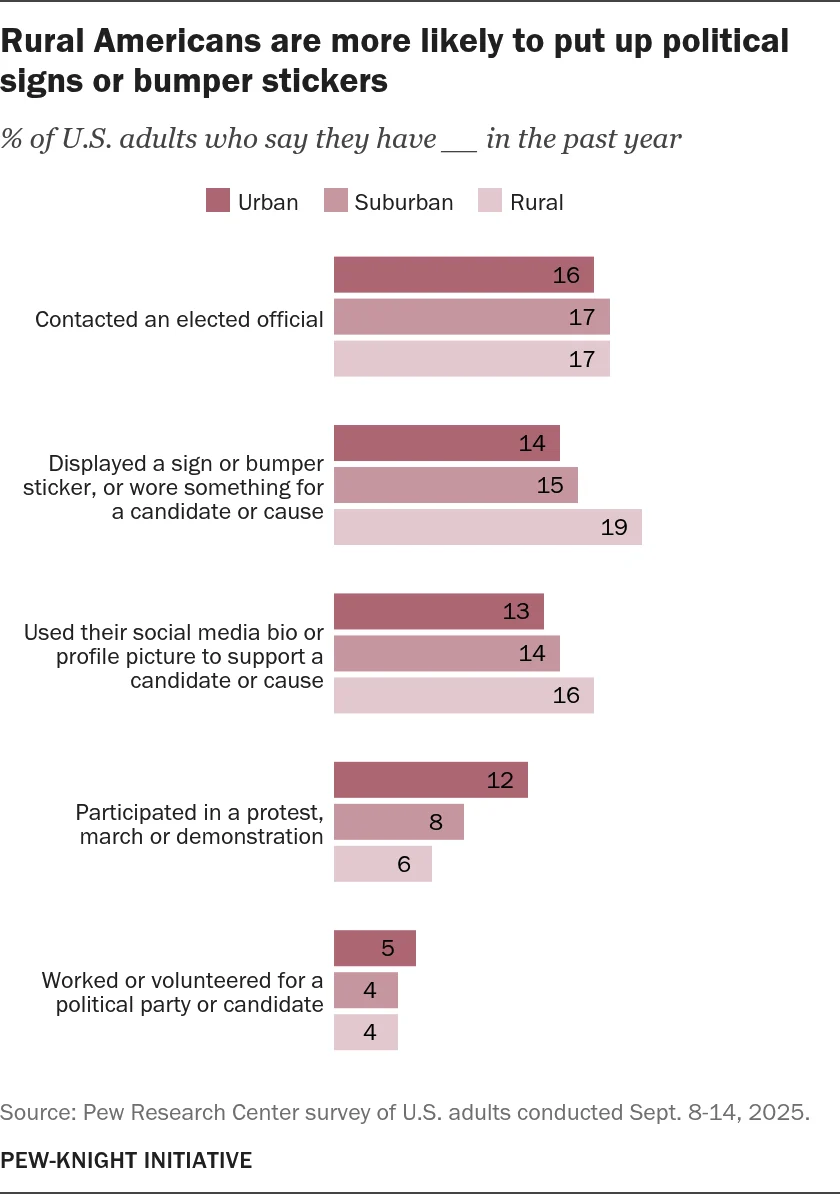
WASHINGTON — Where an American lays down roots has long been a defining feature of the national narrative, conjuring distinct images of bustling metropolitan skylines, sprawling suburban cul-de-sacs, and quiet rural main streets. Yet, when it comes to the fundamental ways citizens participate in public life, the boundaries dividing these communities are often more nuanced than conventional wisdom suggests.
A comprehensive new study released by the Pew-Knight Initiative—a collaborative research effort between the Pew Research Center and the John S. and James L. Knight Foundation—reveals that while urban, suburban, and rural Americans engage with their communities at broadly comparable overall rates, they diverge significantly in how they choose to participate. From the mediums they use to connect with local clubs to the methods they favor for political expression, geography quietly shapes the American civic experience.

Main Facts: The Geography of Engagement
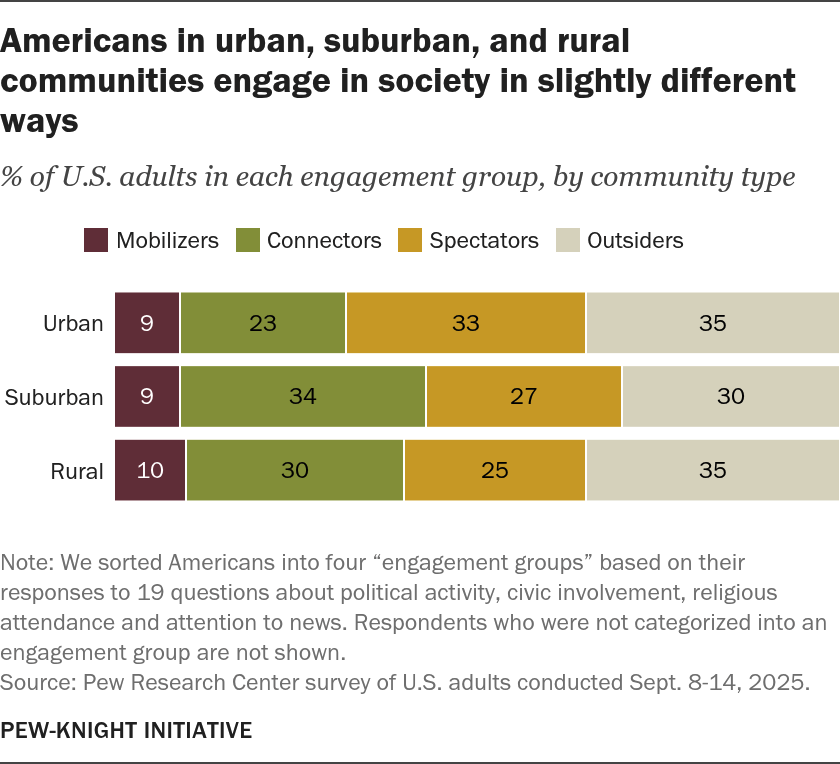
To understand how the public interacts with society, researchers sorted U.S. adults into four distinct "engagement groups" based on their responses to 19 targeted questions concerning political activity, civic involvement, religious attendance, and attention to news:
- Mobilizers (The All-In Participants): Making up a small slice of the population—roughly 9% of urban, 9% of suburban, and 10% of rural residents—this group is highly active across virtually every measured category of public life.
- Connectors (The Community Builders): Accounting for 23% of urban, 34% of suburban, and 30% of rural adults, these individuals are deeply invested in volunteering, donating, and joining local organizations, though they tend to steer clear of intense political friction.
- Spectators (The News Watchers): Comprising 33% of urbanites, 27% of suburbanites, and 25% of rural residents, this cohort primarily engages by keeping a close eye on the news rather than participating directly in physical or political events.
- Outsiders (The Disengaged): Representing roughly a third of the population across all regions (35% in cities, 30% in suburbs, and 35% in rural areas), this group reports the lowest levels of participation in voting, civic life, and news consumption.
While the macro-level distribution of these groups remains relatively steady across geographic lines, looking deeper into specific activities exposes clear behavioral divides driven by community type.
Chronology and Context: Tracking Public Participation
The findings are rooted in an expansive research initiative designed to capture a holistic view of American behavior following a volatile political and social cycle.
- Late 2024 to Late 2025: Pew Research Center fielded comprehensive surveying to measure public habits. Many survey questions asked respondents to reflect on activities undertaken "in the past 12 months"—a window that notably captured the height of the 2024 presidential election cycle.
- July to December 2025: The organization deployed its Cross-Sectional Engagement Survey, reaching 5,393 adults via online, paper, and telephone formats to ensure hard-to-reach, low-engagement populations were accurately represented.
- September 8–14, 2025: Wave 179 of the American Trends Panel surveyed 5,195 adults by web and phone, serving as the foundational dataset for community-type comparisons. This timing also captured the immediate aftermath of nationwide demonstrations—such as the "No Kings" protests against the administration—providing a timely baseline for measuring public protest and political sign-display habits.
- July 2026: Initial findings from the broader Pew-Knight Initiative project were published, setting the stage for subsequent deep-dives.
- September 2026: The specialized breakdown comparing urban, suburban, and rural civic behavior was officially published, providing the empirical foundation for current discussions on localism and democratic health.
Supporting Data: Numbers Behind the Map
While demographic traits such as age, race, income, and political ideology frequently serve as powerful predictors of human behavior, community type introduces distinct behavioral variations that persist even when controlling for other factors.

Social and Religious Life
- Volunteering: Suburban residents hold a slight edge in volunteerism, with 31% reporting that they volunteered in the past year, compared with 26% of urban and 26% of rural residents.
- Group Memberships: Similarly, 37% of suburban adults belong to a group, organization, or club, outpacing rural (33%) and urban (30%) participants.
- In-Person vs. Online Interaction: Among those who belong to groups, the nature of interaction varies dramatically by geography. Rural members are far more likely to report that their groups interact mostly in person (63%), compared to 57% in the suburbs and just 47% in cities. Conversely, urban group members are the most likely to report that their associations meet mostly online (22%), versus 20% in the suburbs and 14% in rural sectors.
- Religious Engagement: Rural Americans outpace their urban and suburban counterparts in religious devotion. 42% of rural adults attend religious services (either in person or online) at least monthly, compared to 37% of suburbanites and 33% of urbanites. Rural residents are also significantly more likely to report praying multiple times a day.
Political Action
When examining political behavior, roughly one-third of adults in all three community types have engaged in at least one of five primary political actions over the past year, but the choice of which action to take depends heavily on context:
- Contacting Officials: Rates are nearly identical across regions, with 16% of urban residents and 17% of both suburban and rural residents reaching out to an elected official.
- Yard Signs and Apparel: Rural Americans lean heavily into physical displays of political support. 19% of rural adults report displaying a sign, bumper sticker, or wearing campaign apparel in the past year, compared to 15% of suburbanites and 14% of urbanites.
- Social Media Advocacy: 16% of rural residents, 14% of suburbanites, and 13% of urbanites updated their social media bios or profile pictures to support a candidate or cause.
- Protests and Demonstrations: In stark contrast to yard signs, urban residents led the way in physical demonstrations. 12% of urban adults participated in a protest, march, or rally, compared to 8% of suburbanites and 6% of rural residents.
Official Perspectives and Expert Analysis
The Pew-Knight Initiative was established to decode the evolving relationship between citizens, civic institutions, and the information ecosystem. Analysts behind the study emphasize that studying public engagement requires looking beyond isolated metrics like voter turnout.

"People participate in public life in myriad ways—from voting and volunteering to following the news and taking part in religious or community activities," researchers noted in project documentation. "However, researchers often study these behaviors separately, making it difficult to see how they converge in people’s day-to-day lives. We designed this project to show how the public engages in civic life more broadly."
Experts point out that the high rate of urban protest activity captured in the late 2025 data is heavily tied to partisan demographics. Because urban centers lean heavily Democratic, and Democrats demonstrated a higher propensity for street-level protest during that specific phase of the political cycle, city dwellers naturally registered higher participation in demonstrations. At the same time, the propensity for rural residents to utilize yard signs and bumper stickers highlights a reliance on neighborhood-level visibility in communities where physical distance can make digital organization less immediate than face-to-face community presence.

Implications for the Future of American Communities
The findings carry significant weight for civic leaders, non-profits, political campaigns, and local organizers striving to build cohesive communities.
- Tailored Outreach Strategies: Political campaigns and civic organizations cannot rely on a one-size-fits-all approach. While digital organizing may find fertile ground among urban populations accustomed to online association, rural communities rely heavily on robust, face-to-face institutional pillars such as local clubs and religious organizations.
- The Suburban Civic Advantage: The data suggests that suburban areas currently serve as incubators for localized group membership and volunteerism. Understanding what fosters high rates of "Connector" behavior in suburban spaces could offer valuable lessons for revitalizing civic engagement in urban and rural areas alike.
- Bridging the Disengaged Third: With roughly 30% to 35% of residents across all community types classified as "Outsiders"—individuals largely detached from news, politics, and civic organizations—local leaders face a shared nationwide challenge in lowering barriers to civic participation.
Ultimately, while the physical layouts of American towns and cities shape the contours of daily life, the desire to connect, worship, and make one’s voice heard remains a powerful, if diversified, constant across the American landscape.
 Iffa Jayyana
  Asep Darmawan
  Azzam Bilal Chamdy