
 By Jia Lissa
The cinematic landscape is currently undergoing its most significant transformation since the advent of digital color grading. For decades, the film industry has operated on a high-stakes, high-risk model where a single "box office bomb" can devastate a studio’s quarterly earnings. From the $200 million loss attributed to Disney’s Strange World to the $150 million shortfall of DC’s The Flash, the fragility of blockbuster economics is a constant pressure point. With industry data suggesting that roughly 10% of major productions fail to turn a profit, studios are under immense pressure to optimize every facet of the filmmaking process.
Enter generative AI—a technology often viewed through a lens of existential dread by the creative community. However, beneath the headlines of AI-generated actors and algorithmic screenwriting lies a more nuanced reality: the most successful integration of AI in Hollywood is currently happening in the "boring" corners of production. By automating the logistical, administrative, and data-heavy tasks that define pre-production, technology is quietly saving millions of dollars and millions of hours, all while sidestepping the creative backlash that has crippled other AI-driven initiatives.
The High Cost of Cinematic Ambition: A Chronology of Conflict
To understand why the industry is turning to automation, one must look at the historical trajectory of production costs and the friction between technology and labor.
The Era of Manual Inefficiency (Pre-2015)
For over a century, filmmaking logistics were defined by paper-based workflows. Assistant directors and production managers spent weeks manually breaking down scripts—identifying every prop, character, location, and costume needed for each scene. This was a process prone to human error; a single missed detail in a script breakdown could lead to costly reshoots or logistical nightmares on set.
The Rise of Digital Disruption (2015–2022)
As software began to digitize these tasks, the industry saw an incremental improvement. However, the sheer volume of data in modern multi-million dollar productions meant that even "digital" processes remained slow. Filmmakers were still spending thousands of hours on tasks that did not directly contribute to the artistry on screen.
The AI Inflection Point and the 2023 Strikes
The year 2023 marked a definitive turning point. As generative AI tools became accessible, some studios attempted to bypass human talent in creative roles—writing, acting, and background design. The industry responded with a massive, historic labor action. The SAG-AFTRA strike was, in many ways, a line in the sand. It highlighted that while the industry was eager for efficiency, the creative workforce was unwilling to accept a future where their roles were cannibalized by algorithms. The strike resulted in a $5 billion ripple effect through the economy, serving as a stark warning to studios: prioritize efficiency over artists, and face total production paralysis.
The Dichotomy of AI: Creative Gimmickry vs. Operational Optimization
There is a widening chasm between how AI is perceived and how it is actually being utilized to improve profitability.
The Risk of "Creative" AI
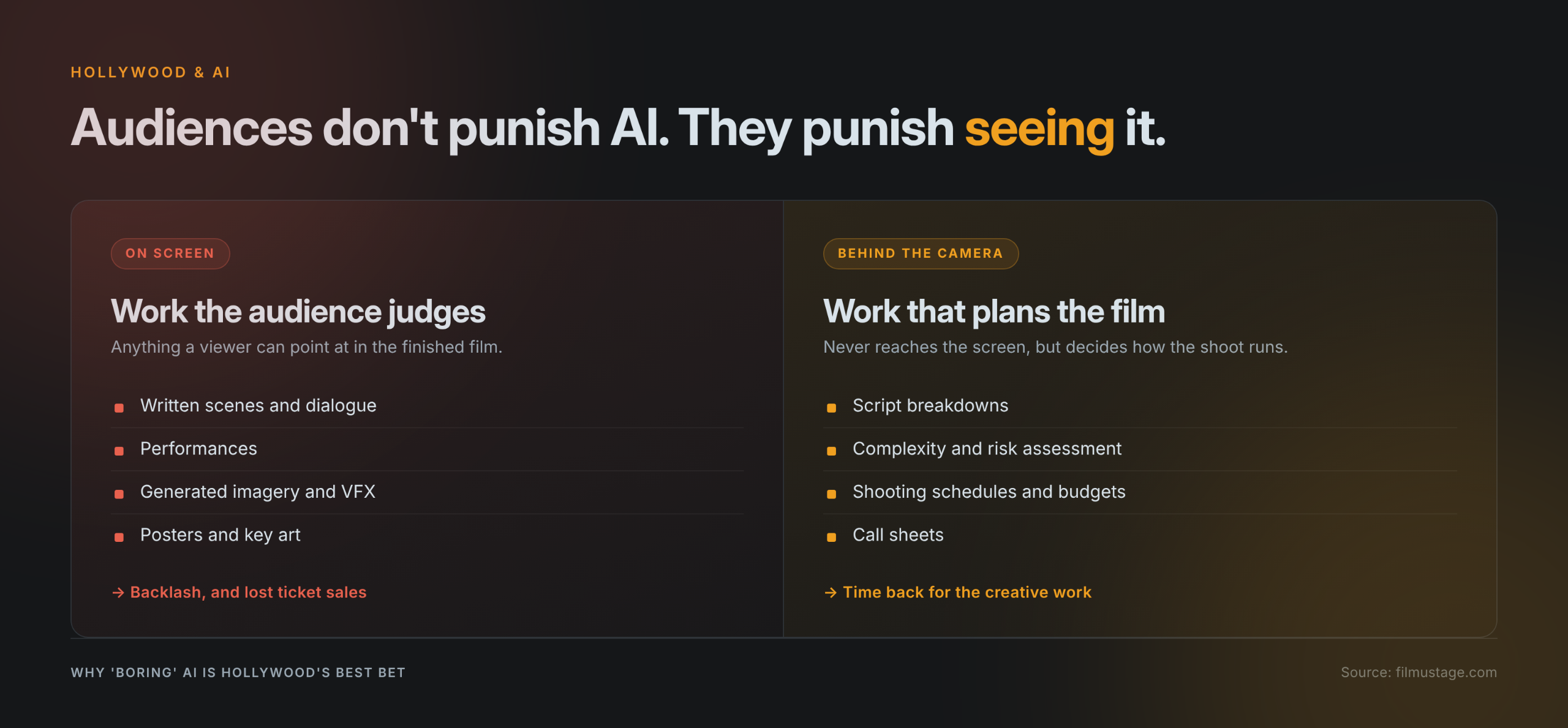
Projects that lean heavily on AI for creative output—such as the film Misaligned, which featured AI-generated actors, or productions that use AI for promotional materials—have been met with intense audience hostility. Even when used sparingly, the "AI label" often functions as a scarlet letter, triggering negative critical reception. This backlash stems from the inherent flaws in current generative models: they are prone to producing "uncanny" imagery, repetitive tropes, and inconsistent narratives that break audience immersion.
The Success of "Invisible" Automation
Conversely, productions like Netflix’s The Gentlemen have utilized AI with great success. The critical and commercial triumph of the series was not hindered by its use of technology because the AI was kept firmly behind the scenes. It was employed by companies like Filmustage to perform the "heavy lifting" of pre-production: breaking down scripts, scheduling shoots, and managing resource allocation.

Egor Dubrovsky, CEO of Filmustage, notes that his platform has helped over 30,000 filmmakers save 3.5 million hours. This is not about replacing a director’s vision; it is about replacing the 16-hour days spent poring over call sheets with automated precision.
Supporting Data: The Economics of Efficiency
The financial impact of automating pre-production is not merely academic. Pre-production accounts for approximately 10% to 15% of a film’s total budget. By leveraging AI to manage these costs, studios can achieve significant savings without compromising the final product.
- Time Savings: Traditional scene breakdown and scheduling for a feature film can take months. AI can accomplish these tasks in a matter of minutes, effectively reducing pre-production timelines by weeks.
- Budgetary Impact: Consider a film like Star Wars: The Force Awakens, which had a reported production cost of $537 million. A 15% reduction in pre-production overhead—achieved through smarter resource management and automated planning—could have saved the studio roughly $80 million.
- Aggregated Efficiency: To date, AI-driven pre-production tools have saved the industry over 5.2 million hours of manual, repetitive labor. This shift allows human teams to focus on the high-value, high-creativity tasks that define a blockbuster’s success.
The Human-Centric Future: A Professional Perspective
From a management standpoint, the integration of AI is not a threat to the creative hierarchy; it is a tool for professional survival. In the high-stress environment of a film set, burnout is a significant factor in staff turnover and production delays.
"I worked as a director’s assistant in Hollywood," notes one industry observer. "The vast majority of the industry’s workforce would be happy handing over these tasks. Nobody suffers through a 16-hour day because they love calculating expenses item by item or hunting for scheduling clashes. They suffer through it because they are committed to the art."
The industry is learning that the most effective way to use AI is to delegate the "boring" tasks—the ones that computers are objectively better at. Because AI can process massive datasets without succumbing to fatigue or boredom, it eliminates the human errors that often lead to on-set confusion.
Implications: Where Does the Industry Go From Here?
The narrative that "AI is coming for Hollywood" is only half the story. The real story is that Hollywood is evolving to use AI as a strategic partner, provided that the boundary between "the machine" and "the artist" remains clear.
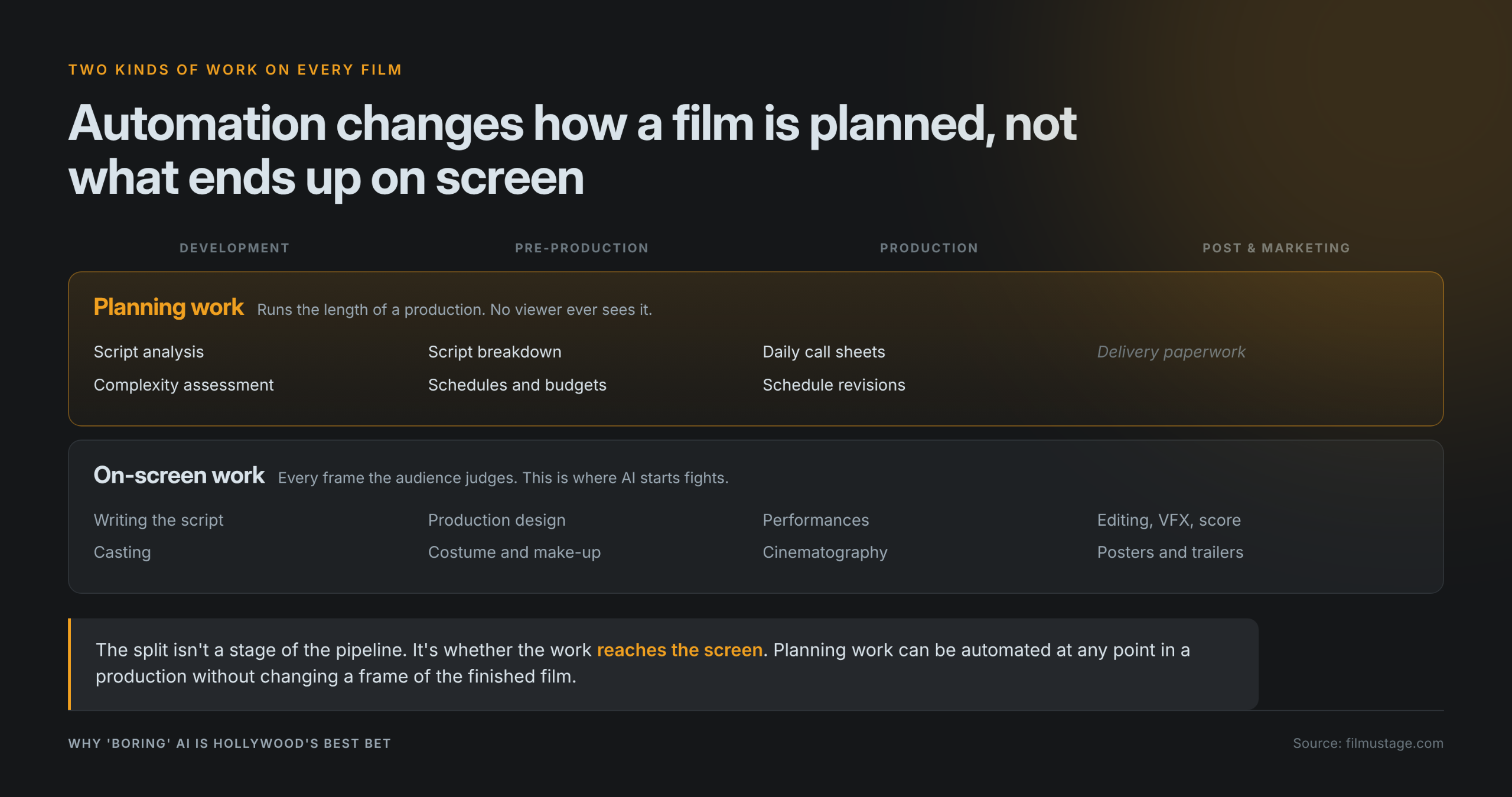
1. The Death of the "Gimmick"
Studios are realizing that marketing a film as "AI-made" is a losing strategy. As audiences become more tech-literate, they are demanding higher standards for human-led storytelling. We can expect to see a decline in AI-generated creative gimmicks as studios focus on "invisible" AI that enhances the quality of the final product rather than replacing the people who make it.
2. Refocusing Capital
If studios successfully reduce the "logistical tax" of filmmaking through automation, the saved capital will likely be reallocated. The objective should not be to cut the overall budget, but to shift that budget toward higher-quality script development, more polished visual effects, and better compensation for the creative talent that actually drives the audience’s emotional connection.
3. The New Creative Contract
Moving forward, the industry will likely see a formalization of how AI is used. Contracts and guild agreements will continue to evolve, likely creating a "safe list" of administrative AI tasks—such as scheduling and budgeting—that are universally accepted, while keeping creative roles strictly protected.
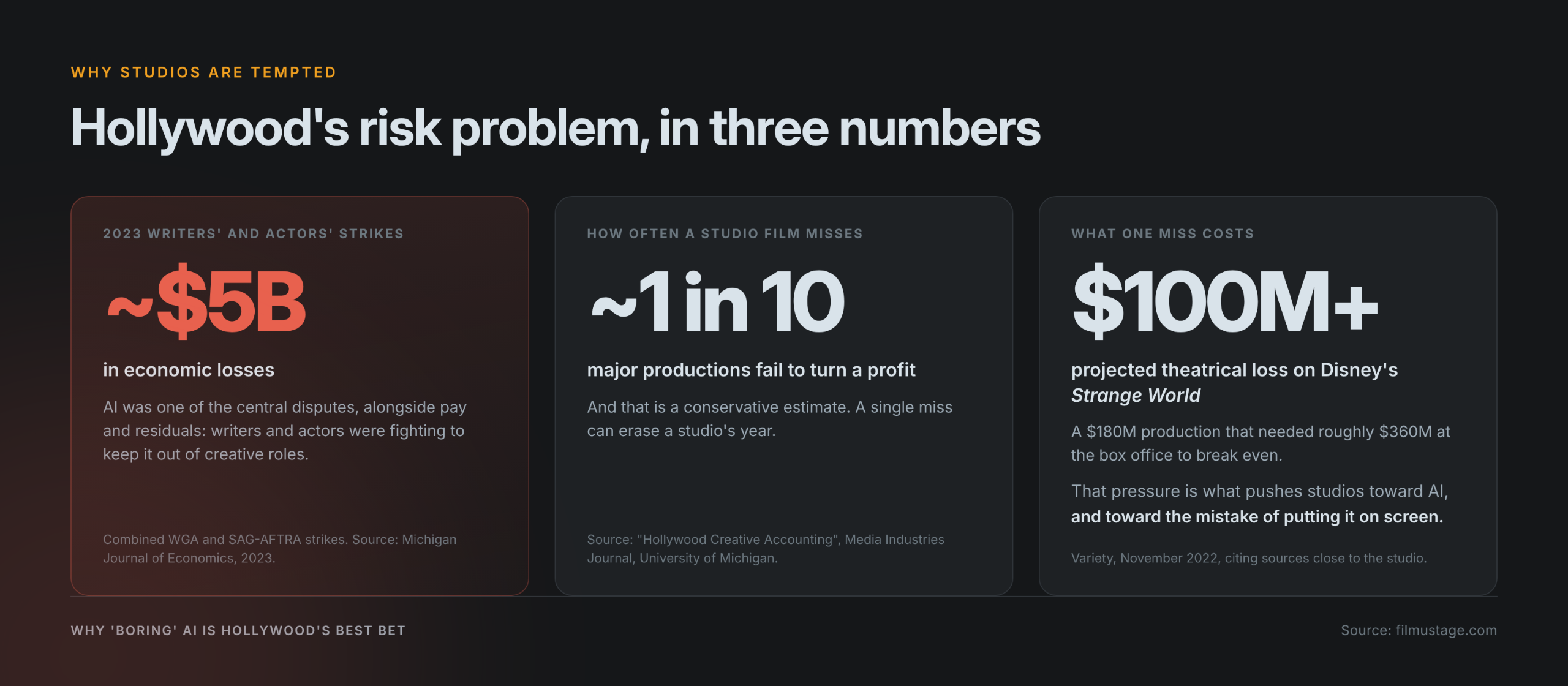
Conclusion
The tension between AI and the entertainment industry is a classic case of technological disruption. However, the industry is finding that the most profitable path forward is not to replace the human element, but to protect it. By automating the tedious, high-stress, and repetitive tasks that occupy the back office, AI can actually serve to strengthen the human-centric nature of the final film.
The goal for the future of cinema shouldn’t be to see how much of a movie a computer can make, but to see how much of a human’s time can be reclaimed. When the "boring" work is handled by an algorithm, the director, the writer, and the cinematographer are freed to do what they do best: create something that resonates with an audience. As Hollywood continues to navigate this new era, the winners will be the studios that understand that AI is a tool for the production office, not a replacement for the heart of the film.
 Pevita Pearce
  Nana Muazin
  rifanmuazin