
 By Suro Senen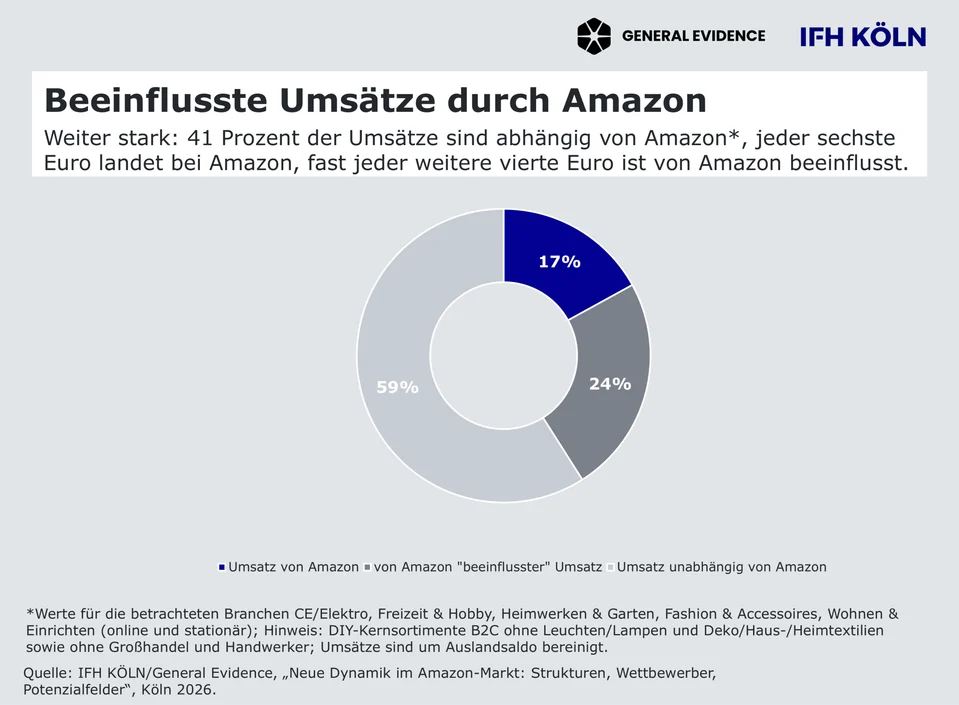
The landscape of German commerce is undergoing a profound transformation, one defined increasingly by the shadow of a single entity. According to a comprehensive new study conducted by the IFH KÖLN (Institut für Handelsforschung) in collaboration with General Evidence, Amazon has solidified its status as the undisputed heavyweight of the German retail sector. Its influence, however, extends far beyond simple sales figures, weaving itself into the very fabric of how German consumers shop, compare prices, and perceive convenience.
As of the latest fiscal analysis, Amazon—inclusive of its vast third-party marketplace—commanded a staggering 63 percent share of Germany’s online retail market last year. The data suggests that Amazon is no longer merely a retailer; it is the primary infrastructure upon which the modern German consumer experience is built.
Main Facts: The Numbers Behind the Dominance
The scale of Amazon’s operation in Germany is difficult to overstate. Last year, the platform facilitated a massive 69.1 billion euros in sales, marking a 3.2 billion euro (5 percent) increase over 2024 figures. This growth is particularly striking given the maturation of the German e-commerce market and the entry of aggressive new international competitors.
The core of this revenue stream is not Amazon’s own inventory, but rather its ecosystem of "selling partners." Of the 63 percent total market share, the company’s third-party marketplace participants accounted for 46.1 percent of all online retail spending in the country. Amazon’s direct retail operations contributed 17.2 percent. This structural reliance on third-party sellers underscores Amazon’s transition from a merchant into a gatekeeper—a marketplace operator that extracts value from every transaction regardless of who owns the underlying goods.
Beyond the raw financials, the behavioral data is equally telling. A representative consumer survey revealed that 97 percent of German online shoppers make purchases on Amazon, and 59 percent are registered Prime members. This level of penetration suggests that Amazon has effectively achieved "utility status" within German households, becoming the default destination for everything from household consumables to electronics.
Chronology: From Bookstore to Retail Infrastructure
To understand Amazon’s current dominance, one must look at the steady, methodical expansion that has defined its history in Germany.
- 1998 – The Entry: Amazon entered the German market by acquiring ABC Bücherdienst, signaling its intent to dominate the European book market.
- The 2000s – Diversification: The company rapidly expanded beyond books, launching specialized categories and pioneering its "Marketplace" model, which allowed smaller retailers to piggyback on Amazon’s massive traffic.
- 2010s – The Prime Era: The introduction and aggressive marketing of the Prime membership program transformed Amazon from a store into an essential service. The focus shifted from mere retail to logistics, with billions invested in fulfillment centers across Germany.
- 2020s – The Omnichannel Shift: With the pandemic accelerating online adoption, Amazon shifted its focus toward integrating its influence into offline retail. By leveraging data to influence product discovery, the company began to dictate trends that ripple into physical storefronts.
- 2025-2026 – The Modern Plateau and Competition: Despite reaching a near-saturation point with 97 percent of consumers using the site, Amazon continues to invest in logistics, even as new, lower-cost international competitors like Temu and Shein begin to erode its share of price-sensitive customer segments.
Supporting Data: The Anatomy of Market Power
The IFH KÖLN report provides a granular look at how Amazon maintains this grip. One of the most significant metrics is the "influence" factor. While Amazon accounts for 17 percent of total retail spending (inclusive of both online and offline channels), it exercises a direct or indirect influence over an additional 24 percent of spending in the categories studied. This means that for roughly 41 percent of all product-related expenditure in Germany, Amazon is either the point of sale or the primary point of research.
The Rise of the Chinese Challengers
The report identifies a subtle but undeniable shift in the competitive landscape. While Amazon grew by 3.2 billion euros last year, the combined growth of German retail giants Otto and Zalando—long considered the primary domestic alternatives—totaled 1.4 billion euros. Simultaneously, the Chinese platforms Shein and Temu recorded combined growth of roughly 1 billion euros.
While the absolute growth figures favor Amazon, the rate of growth for these Chinese entrants is causing market analysts to take notice. According to the study, one in eight Amazon shoppers now admits to shifting some of their purchasing behavior toward these platforms. This trend is driven almost exclusively by price sensitivity, as the low-cost, high-volume model of Temu and Shein appeals to shoppers looking to bypass the premium often associated with the Amazon ecosystem.
Official Responses and Strategic Outlook
In light of these findings, the industry is grappling with the question of sustainability. Amazon’s response to these trends has been a doubling down on its core value proposition: speed and reliability.
While consumers are tempted by the low prices offered by newer entrants, the IFH KÖLN report highlights a critical defensive moat for Amazon. The study notes: "On key performance indicators such as product range, ease of ordering and delivery speed, however, Amazon still clearly performs best from the consumer’s perspective."
Industry experts suggest that Amazon is not necessarily competing with Temu on the same terms. Instead, Amazon is betting that its logistics network—currently receiving hundreds of millions of euros in fresh investment—will keep the "convenience-first" shopper loyal, even if a cheaper alternative exists elsewhere.
Implications: A Market at a Crossroads
The implications of this data for the German economy are multifaceted.
1. The Death of Independent Discovery
With 97 percent of consumers using Amazon, the platform has become the de-facto search engine for products. For German manufacturers and retailers, this creates a "pay-to-play" reality. If a business is not performing well on Amazon’s internal algorithm, it is effectively invisible to the vast majority of the German market.
2. The Offline-Online Blur
The finding that Amazon influences 41 percent of total retail spending demonstrates that the "online vs. offline" debate is effectively over. Physical retailers are now effectively acting as showrooms for Amazon, where consumers view items in person before checking reviews and pricing on the Amazon app. This places immense pressure on physical retail margins, as brick-and-mortar stores must now compete not just with other physical shops, but with the algorithmic efficiency of a global tech giant.
3. Regulatory Scrutiny
The sheer scale of Amazon’s market share—and its role as both a marketplace operator and a direct retailer—is likely to draw further attention from European competition regulators. When a company controls the infrastructure (the marketplace) and the data (consumer purchasing habits), the potential for anti-competitive behavior becomes a central concern for policymakers.
4. The Future of Logistics
Amazon’s continued investment in its logistics network is a signal that it intends to remain the "fastest" option in the market. By controlling the delivery process, Amazon reduces friction. As long as Amazon can deliver a package in 24 hours while competitors struggle with international shipping times, the company will maintain a significant psychological advantage over newer entrants.
Conclusion
The IFH KÖLN study serves as a wake-up call for the European retail sector. Amazon’s dominance in Germany is no longer just a trend; it is the baseline. While the emergence of Chinese competitors like Shein and Temu introduces a new variable into the equation, the core pillars of Amazon’s strategy—logistics, Prime loyalty, and the marketplace model—remain remarkably resilient.
As Germany moves further into the digital age, the central challenge for policymakers, domestic retailers, and consumers alike will be to navigate a market where one company holds the keys to both the supply chain and the consumer experience. Whether this results in a more efficient, consumer-friendly market or one plagued by the risks of a monopoly remains the defining question of the next decade in German commerce. The data is clear: Amazon is not merely participating in the German market; it is defining it.
 Ammar Sabilarrohman
  rifanmuazin
  Nila Kartika Wati