
 By rifanmuazin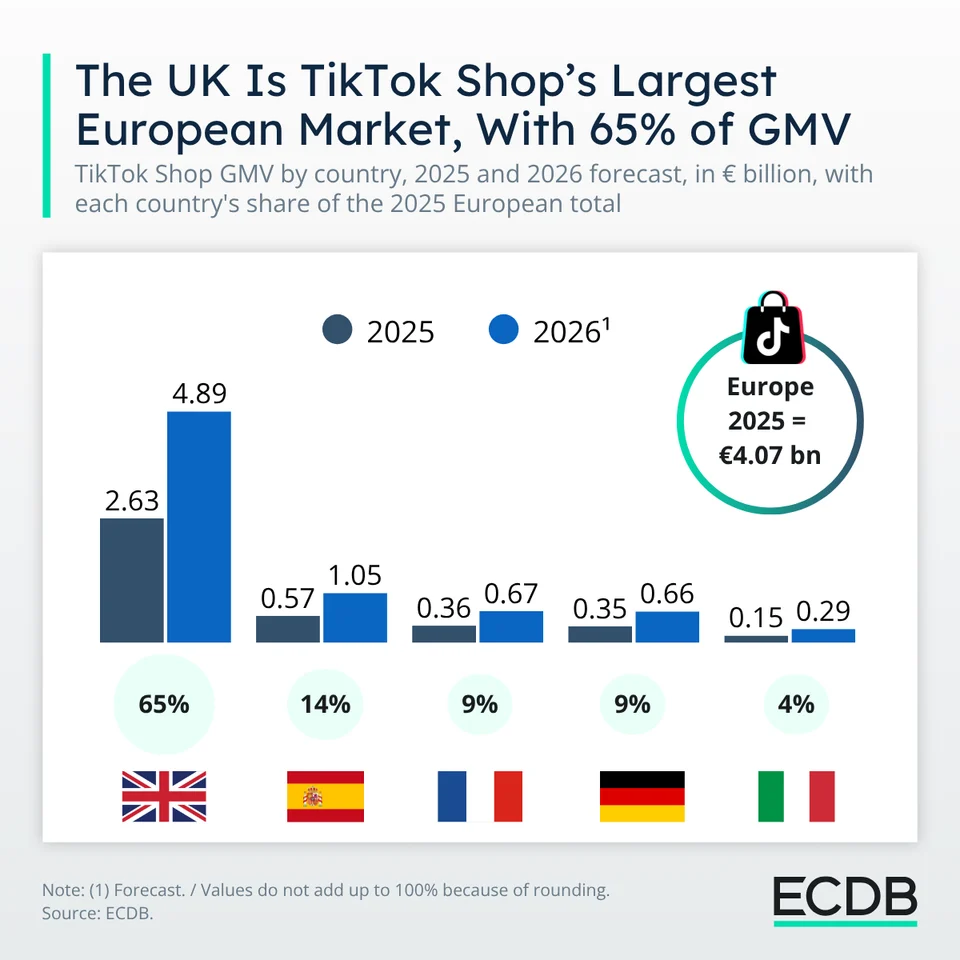
The landscape of European e-commerce is undergoing a radical transformation as social media giant TikTok pivots from a content-first platform to a retail powerhouse. According to the latest data from the German e-commerce research firm ECDB, TikTok Shop is witnessing explosive growth, with the United Kingdom maintaining a staggering lead as the platform’s primary revenue driver. As the company pushes further into continental Europe, the industry is witnessing a shift in consumer behavior that merges entertainment with instant gratification, turning "scroll-time" into "shop-time."
Main Facts: The UK as the European Anchor
At the heart of TikTok Shop’s European strategy lies the United Kingdom. Having served as the platform’s pioneering market since its initial launch in 2021, the UK has become a blueprint for how social commerce can disrupt traditional retail.
The figures provided by ECDB are stark: in 2024 alone, the United Kingdom accounted for a dominant 65 percent of all European spending on TikTok Shop, equating to a Gross Merchandise Value (GMV) of 2.63 billion euros. Looking ahead to the close of 2025, that figure is projected to nearly double, reaching approximately 5 billion euros. This meteoric rise is supported by a massive ecosystem of over 300,000 British small and medium-sized enterprises (SMEs) that have integrated the platform into their daily sales operations.
While the UK enjoys a mature position, the rest of Europe is playing a rapid game of catch-up. TikTok’s strategy has evolved from localized testing to a comprehensive, pan-European expansion, aimed at capturing the high levels of online spending power concentrated in the region.
Chronology of Expansion: From Pilot to Pan-European Powerhouse
TikTok Shop’s journey in Europe has been marked by a measured yet aggressive rollout, prioritizing markets with high digital penetration.
- 2021: The inaugural launch of TikTok Shop takes place in the United Kingdom, marking the platform’s entry into the Western European market.
- Late 2024: TikTok Shop officially enters the Spanish market, signaling the beginning of its broader expansion into the European Union. Simultaneously, the platform launches in Ireland, further widening its footprint.
- March 2025: A massive synchronized launch sees the shopping feature introduced to France, Germany, and Italy. This period marked the company’s intent to compete directly with established regional e-commerce giants.
- June 2025: The platform expands into the Netherlands, Belgium, Poland, and Austria, cementing its presence across key economic zones in Northern and Central Europe.
- September 21, 2025: TikTok launches a pilot program for cross-border sales between the European Union and the United Kingdom, removing friction for merchants looking to tap into international consumer bases.
- October 19, 2025: The broad rollout of the EU-UK cross-border sales feature, creating a unified marketplace of twelve European countries.
Supporting Data: Comparative Market Performance
The data provided by ECDB offers a clear picture of how consumer appetite for social commerce varies by region. Following the UK’s lead, Spain established itself as the second-largest market in 2024, generating 570 million euros in GMV—a 14 percent share of the total European market at the time.
France and Germany, despite being among the largest economies in the world, each trailed with 360 million euros and 350 million euros respectively, representing 9 percent shares each. Italy rounded out the top tier with 150 million euros, or 4 percent of the total share.
What is most remarkable about the 2025 forecasts is the projected trajectory. Despite the varying maturity levels of these markets—with the UK having years of head-start—ECDB predicts a near-universal doubling of GMV across the board. This indicates that the "learning curve" for European consumers is short; once the tool is introduced, adoption rates climb sharply, regardless of whether the market was an early adopter or a late entrant.
Official Responses and Strategic Pivot
While TikTok has remained relatively guarded regarding its internal growth metrics, the platform’s shift toward "Sell Across Europe" reflects a clear strategic response to the fragmentation of the European market. By enabling cross-border commerce, TikTok is effectively solving one of the most persistent problems for European SMEs: the logistical and regulatory complexity of selling across national borders.

The launch of the EU-UK cross-border pilot is particularly significant. It addresses the friction created by post-Brexit trade complexities, allowing British merchants to reach EU customers with significantly reduced administrative overhead. By positioning itself as a "pan-European marketplace," TikTok is not merely competing with retailers; it is competing with traditional cross-border platforms like Amazon and eBay, leveraging the viral nature of its short-form video content to drive traffic in a way that traditional search-based e-commerce cannot.
Implications: The Future of Retail
The rise of TikTok Shop carries profound implications for the retail sector, ranging from supply chain management to the nature of digital marketing.
The Death of the Traditional Funnel
Traditionally, the retail funnel moved from awareness to interest, then to search, and finally to purchase. TikTok Shop collapses this entire funnel. A consumer may be watching a creator demonstrate a beauty product or a kitchen gadget, and with two clicks, the purchase is complete without ever leaving the app. This creates an environment where impulse buying is optimized, favoring products that are visually striking and easily demonstrated.
Impact on SMEs
For small and medium-sized enterprises, TikTok Shop is a double-edged sword. On one hand, it provides a massive, pre-existing audience and a logistical infrastructure that would be impossible for an independent brand to build on its own. On the other, it creates an intense dependency on the platform’s algorithm. A business’s success is now tied to its ability to create viral, engaging content, which requires a new set of skills that traditional retailers may lack.
Competitive Pressure on E-commerce Giants
Amazon and regional players like Zalando are watching closely. The primary competitive advantage of TikTok is the "discovery" element. Unlike a traditional e-commerce site where a consumer goes with a specific search intent, TikTok brings the product to the consumer. As this model matures, it is likely to capture a larger share of "non-essential" retail spending, forcing traditional players to rethink their own social and video-based discovery strategies.
The Regulatory Landscape
As TikTok Shop grows, it will inevitably come under greater scrutiny from European regulators. Issues regarding data privacy, product safety, and the "dark patterns" of social commerce will likely take center stage. The EU’s Digital Services Act (DSA) will be a critical hurdle for the company as it scales, particularly as it moves to integrate cross-border logistics that involve diverse consumer protection laws.
Conclusion: A New Era of Commerce
The data provided by ECDB confirms that we are at an inflection point. The transition of TikTok from a viral video platform to a multi-billion-euro shopping destination is not a temporary trend but a fundamental shift in how digital economies operate.
As the platform moves toward its goal of becoming the dominant pan-European marketplace, its success will depend on its ability to maintain trust, ensure logistical reliability across diverse customs zones, and keep the user experience seamless. With GMV figures set to double in 2025, the message to retailers is clear: in the modern European market, the storefront is no longer a physical location or a static website—it is the screen in the palm of the consumer’s hand, refreshed every few seconds by an algorithm that knows exactly what they want before they even search for it.
 Nila Kartika Wati
  Lina Irawan
  Basiran