
 By Raul Delapena Setiawan
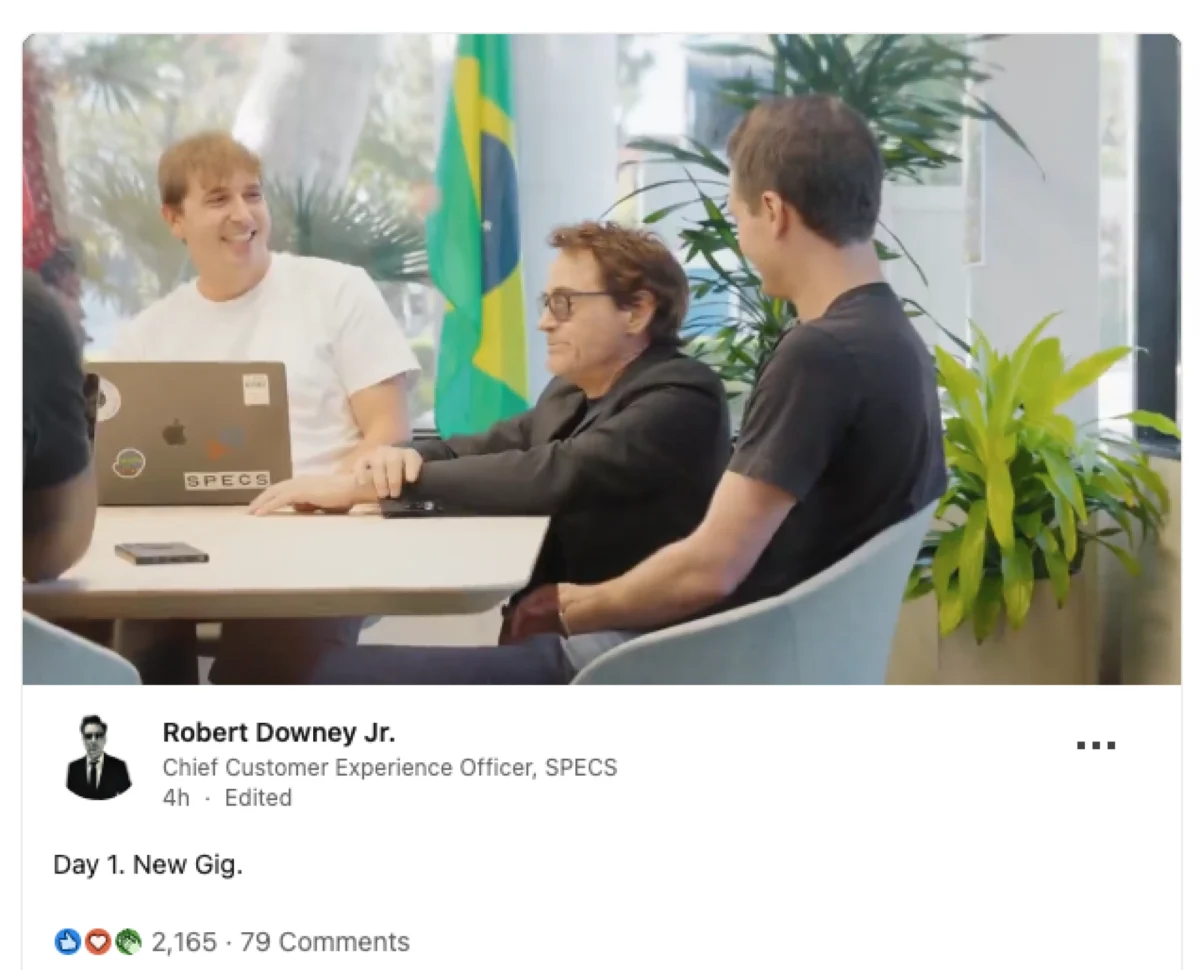
"Life imitates art—imitates life!"
With those words, Robert Downey Jr. has officially bridged the gap between his most iconic cinematic role and the cutting edge of real-world consumer technology. On October 20, 2026, the Academy Award-winning actor stepped into a new professional chapter, assuming the role of Honorary Chief Customer Experience Officer for Snap’s augmented reality (AR) hardware division, Specs.
For a generation that grew up watching Downey command holographic interfaces as Tony Stark in the Marvel Cinematic Universe, the appointment feels less like a corporate hiring and more like a preordained destiny. Yet, beneath the Hollywood flair lies a significant business maneuver—a calculated effort by Snap to translate the "Iron Man" effect into market dominance in a crowded, skeptical, and rapidly evolving wearable tech landscape.
The Convergence of Fiction and Hardware
The partnership between Downey and Snap is multifaceted, extending far beyond a traditional celebrity endorsement. According to the official announcement, the collaboration will span original content creation, bespoke AR software development, hardware design input, and high-profile, in-person activations.
Downey’s enthusiasm for the product appears genuine, rooted in a career defined by an obsession with technological potential. "Trying is believing," Downey noted in his statement. "Having tested practically every wearable tech that’s come to market in the last 20 years, and been largely unimpressed, I was absolutely sold on SPECS within 40 seconds."
The actor’s first major contribution, a 30-second promotional spot that debuted during Game 1 of the 2026 World Series, frames the glasses as an essential utility for the modern human experience—seamlessly transitioning from high-stakes boardroom meetings to leisure activities like golf and creative design. The campaign, which is currently being distributed via the official Specs website and YouTube, serves as a mission statement for the brand: to move AR from the realm of science fiction into the fabric of daily life.

Chronology of a Tech-Forward Career
Downey’s transition into this role is the culmination of a long-standing fascination with the intersection of humanity and artificial intelligence. His journey into the tech sphere has been both intellectual and financial:
- 2018: Downey hosted and executive produced the YouTube series The Age of AI, a deep dive into how machine learning is reshaping social dynamics, medicine, and manufacturing.
- 2021: He signaled his serious intent as an investor by participating in the $65 million Series C funding round for Forethought, an enterprise AI company that automates customer service workflows.
- 2024: Downey made headlines with a firm, public stance on AI ethics. During an interview on On With Kara Swisher, he famously threatened legal action against any future studio executives who might attempt to use AI to replicate his likeness after his death, asserting, "My law firm will still be very active."
- 2025: His Broadway debut in McNeal served as a meta-commentary on the nature of authorship in the age of generative AI, utilizing real-world AI tools to explore the boundaries of artistic creation.
- 2026: Beyond his new role at Snap, he has continued his work with Aura, an identity protection firm, utilizing AI-assisted visual effects to demonstrate the dangers—and protections—of modern digital life.
This track record suggests that Downey is not merely a brand ambassador for Snap, but a stakeholder who has carefully curated his public alignment with technology that balances innovation with personal agency.
Decoding the Hardware: What Are Specs?
Snap’s "Specs," introduced in June 2026, represent a bold, high-stakes gamble on the future of computing. With a preorder price of $2,195 and a $200 deposit, the device is positioned as a premium standalone computer rather than a simple accessory.
Unlike the camera-fed virtual reality (VR) headsets that have dominated the market, Specs utilize see-through lenses to overlay digital assets onto the wearer’s physical environment. The interface is controlled via hand tracking and voice, removing the need for handheld controllers.
Analysts have noted that the device bears more structural similarity to Apple’s Vision Pro in its conceptual ambition, yet it maintains a form factor that aspires to the "glasses" aesthetic. Timothy Beck Werth, writing for Mashable, observed that while the device is "impressively light, compact, and wireless" for a full-featured computer, it remains "undeniably chunky" by traditional eyewear standards.
Snap CEO Evan Spiegel has been transparent about the device’s current limitations, noting that initial adoption is targeted primarily at developers and early adopters. "It’s obviously a high consideration purchase," Spiegel admitted during an August earnings call. He tempered expectations for mass-market saturation, suggesting that widespread consumer ubiquity likely won’t materialize until the end of the decade.

The Competitive Landscape and Market Skepticism
Snap enters a volatile market where the giants have already staked their claims. Meta, in partnership with EssilorLuxottica, has achieved significant scale, shipping over 7 million units of their AI-enabled glasses in 2025 alone. Meta’s eyewear accounted for over 81% of all AI-glasses shipments in the first half of 2026, creating a formidable "Meta-Ray-Ban" hegemony.
However, market dominance has brought with it significant scrutiny. Privacy concerns regarding discreet, always-on cameras have spurred regulatory bodies, including the European Data Protection Board, to issue formal warnings about the future of smart glasses. Snap is attempting to differentiate itself by positioning Specs as a tool for "sharing experiences" rather than simply "recording others," a subtle but vital branding distinction.
The company’s history with hardware—most notably the $39.9 million inventory write-down following the initial Spectacles launch in 2017—looms large. Snap is acutely aware that to avoid the mistakes of the past, they must do more than ship hardware; they must cultivate a ecosystem of utility.
Official Responses and Industry Implications
The reaction from the tech community to the Downey appointment has been largely electric, with a mix of genuine excitement and inevitable pop-culture ribbing. Snap CEO Evan Spiegel publicly welcomed his new "Chief Customer Experience Officer" on LinkedIn, signaling a high level of executive commitment to the partnership.
Industry analysts suggest that the hire is designed to solve the "Why?" problem. While Meta has succeeded by selling a fashion-forward, low-friction product, Snap is selling a high-end, futuristic computer. By hiring the actor who represents the cultural archetype of the "tech billionaire genius," Snap is attempting to imbue its product with the aspirational quality required to justify a $2,195 price point.
"If you want to convince a consumer to wear a computer on their face, you need to make it feel like a superpower," says one industry consultant. "Robert Downey Jr. is the human embodiment of that sentiment."

The Ethical Tightrope
A core component of the brand’s messaging involves distancing itself from the increasingly controversial term "AI glasses." In the promotional video, a metaphorical "AI glasses" box is discarded in the trash, suggesting that Specs aim to provide a more intuitive, human-centric experience than the current crop of voice-assistant-heavy wearables.
However, the ethics of AR are inescapable. As the device gathers environmental data to facilitate its digital overlays, it will inevitably run into the same privacy hurdles that have plagued Meta. Downey’s involvement provides a layer of credibility, but it also places the burden of responsibility on him. His past statements about AI replication and data protection suggest he will likely be a vocal advocate for "ethical AR"—a potential USP (Unique Selling Proposition) for Snap as they look to build trust where competitors have struggled.
Looking Toward the Future
As the decade winds down, the "Specs" project represents the most critical hardware pivot in Snap’s history. The company is betting that the combination of proprietary AR technology, a massive developer community, and the cultural cachet of Robert Downey Jr. will allow them to carve out a niche that is both profitable and culturally relevant.
For the consumer, the question remains: Are we ready to live in the world of Tony Stark? The technology is here, the hardware is shipping, and the face of the brand is now the man who once famously quipped, "I am Iron Man." Whether this results in a revolution in personal computing or remains a high-end curiosity for the tech-obsessed will be the defining narrative of the next four years.
For now, the vision is clear: Snap is no longer just a social media app—it is a hardware company, and it has just hired the ultimate consultant to ensure that its future looks exactly like the movies.
 Neng Nana
 Asep Darmawan
