
 By Evan Lee Salim
Executive Summary & Main Facts
Long before the era of mainstream cloud computing and decentralized web applications, the name LimeWire was universally recognized as a titan of peer-to-peer (P2P) file sharing, defining the digital media landscape of the early 2000s. Today, the brand has undergone one of the most radical corporate and technological rebirths in internet history. Reimagined as an AI-powered content publishing and generative art platform, LimeWire has successfully transitioned from a controversial music-sharing client into a cutting-edge ecosystem for digital creators.
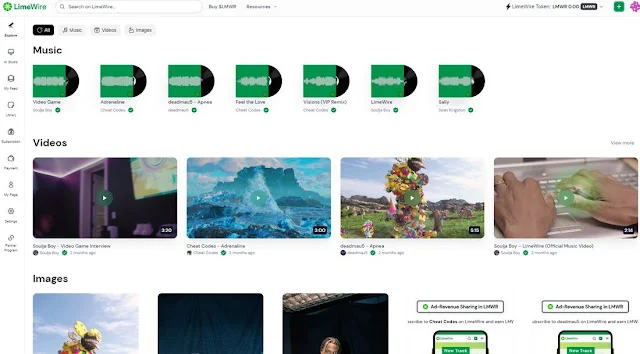
Operating under the banner of LimeWire AI Studio, the platform fuses state-of-the-art generative artificial intelligence with blockchain technology. It enables users—ranging from novice hobbyists to established cultural icons like Deadmau5, Soulja Boy, and Sean Kingston—to generate, publish, own, and monetize digital media. By integrating industry-leading AI models such as Stable Diffusion (2.1 and XL) and OpenAI’s DALL-E 2, alongside a proprietary native utility token (LMWR) and automated NFT minting on the Polygon and Algorand blockchains, LimeWire has carved out a distinct niche in the creator economy.
Key structural facts defining the modern LimeWire platform include:
- Core Technology: Multi-model AI image generation supporting diverse artistic styles, with upcoming expansions into AI-driven music and video creation.
- Monetization Architecture: A dual-revenue system incorporating ad-revenue sharing (ranging from 50% to 70% based on subscription tiers) and a 2.5% creator royalty on secondary NFT trades.
- Blockchain Integration: Automatic minting of digital creations as Non-Fungible Tokens (NFTs) on the Polygon and Algorand networks, providing verifiable digital ownership.
- Economic Unit: Transactions and payouts are facilitated through LMWR, a liquid cryptocurrency token traded on major global exchanges including Kraken, ByBit, and Uniswap.
Chronology of Transformation: From Napster-Era Rival to Web3 AI Hub
To understand LimeWire’s current market position, one must trace its extraordinary operational timeline spanning more than two decades.
[2000–2010] ──> [2010–2022] ──> [2022] ──> [Present Day]
P2P Era         Dormant Phase   Crypto Rebrand AI Studio Launch
The P2P Era (2000–2010)
Founded in 2000 by Mark Gorton, LimeWire operated as a Java-based Gnutella-compatible client that allowed millions of users worldwide to download and share digital files, primarily music. At its peak, it was installed on tens of millions of computers globally. However, the platform became embroiled in catastrophic copyright infringement litigation brought by the Recording Industry Association of America (RIAA). In October 2010, a U.S. federal judge issued a permanent injunction shutting down the core file-sharing software, leading to a decade-long dormancy.
The Rebrand and Crypto Pivot (2022)
In 2022, Austrian entrepreneurs Julian and Paul Zehetmayr acquired the intellectual property rights to LimeWire with a vision to rehabilitate the nostalgic brand. Initially conceived as a digital collectibles marketplace primarily targeting music fans and high-profile artists, the platform quickly pivoted to capture the exploding wave of generative artificial intelligence technologies.
The Launch of LimeWire AI Studio (2023–Present)
Recognizing that the true bottleneck in the creator economy was content generation, LimeWire launched its AI Studio. This move democratized access to complex neural networks. By packaging high-end machine learning models into an intuitive web interface and coupling them with blockchain-based asset ownership, LimeWire positioned itself at the intersection of generative AI and Web3 infrastructure.
Technical Architecture & AI Image Generation Tools
At the heart of the LimeWire ecosystem is its AI Studio—a comprehensive suite designed to lower the technical barriers of digital art creation. While text-to-image engines have become ubiquitous, LimeWire differentiates itself through algorithmic flexibility and platform integration.
Multi-Model Integration
Rather than relying on a single proprietary engine, LimeWire incorporates an array of industry-standard and advanced generative frameworks, including:
- Stable Diffusion 2.1 & XL: Renowned for rendering photorealistic textures, complex lighting, and fine-grained anatomical details.
- DALL-E 2: Leveraged for its robust conceptual mapping and ability to translate abstract semantic prompts into vivid imagery.
- Proprietary Models: LimeWire’s internal engineering teams are actively training bespoke AI models optimized specifically for the platform’s community aesthetic, ensuring continual upgrades to output quality and stylistic range.
Granular Stylistic Control and Customization
Users navigating the AI Studio are not restricted to a singular aesthetic output. The interface allows creators to cycle through diverse artistic paradigms seamlessly:
- Cinematic & Photorealistic: Mimicking high-end camera lenses, focal lengths, and dramatic lighting conditions.
- Digital Art & Illustration: Tailored for concept artists and character designers seeking clean digital vectors or painted textures.
- Pixel Art & Retro Formats: Catering to indie game developers and nostalgic digital creators.
- Anime & Analog Film: Applying specific grain structures, color grading, and illustrative linework.
Advanced users can manipulate parameters such as samplers (e.g., Euler, DPM++), negative prompts to filter out unwanted artifacts, and prompt-weight balancing to achieve precise artistic alignment.
Supporting Data: Monetization Models & Subscription Tiers
LimeWire’s business model is explicitly engineered to reward content creators, shifting the financial paradigm away from traditional social media platforms that retain the vast majority of ad revenue.
The Ad-Revenue Share Mechanism
When creators publish content to LimeWire Studio—whether generated images, music, or forthcoming video assets—they become eligible for direct ad-revenue sharing. Depending on the user’s subscription tier, creators retain between 50% and 70% of all ad revenue generated when other users view their published works.
The LMWR Token Economy
All platform payouts and internal transactions are executed using LMWR, LimeWire’s native ERC-20/utility cryptocurrency. Distributed monthly, LMWR provides immediate financial liquidity, as holders can:
- Trade tokens on prominent centralized and decentralized exchanges, including Kraken, ByBit, and Uniswap.
- Spend LMWR credits directly within the ecosystem to fund high-volume generative AI prompts and computational requests.
Subscription Matrix and Financial Breakdown
| Feature / Tier | Free Tier | Basic Pro ($9.99/mo) | Standard Pro ($29/mo) | Advanced Pro ($49/mo) | Elite Pro ($99/mo) |
|---|---|---|---|---|---|
| Monthly Credits | 10 credits | 1,000 credits | 3,750 credits | 5,000 credits | 11,250 credits |
| Max Image Generations | Up to 20/day | Up to 2,000/mo | Up to 7,500/mo | Up to 10,000/mo | Up to 22,500/mo |
| Ad Revenue Share | 50% | 50% | 60% | 70% | 70% |
| Ad-Free Experience | No | Yes | Yes | Yes | Yes |
| Pro Profile Badge | No | Yes | Yes | Yes | Yes |
| Generation Speed | Standard | Fast | Fast | Priority | Maximum Priority |
Official Responses and Strategic Vision
Leadership at LimeWire has been vocal about the strategic necessity of bridging generative AI with decentralized asset ownership. In various corporate statements and interviews, executives have emphasized that traditional creators are structurally undervalued by legacy tech platforms that monetize user-generated attention without adequate financial reciprocity.
"We are building a world where the line between consumer and creator is blurred, and where every piece of digital art generated holds intrinsic, tradeable value from the second it is brought into existence," notes the LimeWire product development team in platform briefs.
Furthermore, industry adoption by major cultural figures—such as hip-hop artists Soulja Boy and Sean Kingston, alongside electronic music pioneer Deadmau5—serves as an official validation of the platform’s dual-purpose utility as both a creation engine and an NFT distribution channel. By utilizing LimeWire Studio to drop multimedia content directly to superfans, these artists have legitimized the platform’s tokenized ecosystem for a mainstream audience.
Implications for the Creator Economy and Future Outlook
The maturation of platforms like LimeWire carries profound implications for the broader digital media and technology sectors.
1. The Democratization of Professional Artistry
By lowering the technical threshold required to produce high-end visual assets, LimeWire allows writers, marketers, musicians, and independent entrepreneurs to generate bespoke media assets instantly, bypassing the high costs associated with traditional commercial design agencies.
2. Reinventing Digital Ownership via Blockchain
The automatic minting of content as NFTs on eco-friendly networks like Polygon and Algorand solves a fundamental issue of the internet age: provenance. By tying a cryptographic signature to every piece of generated media, creators retain verifiable ownership. Moreover, the implementation of smart contracts that guarantee a 2.5% royalty on all secondary trades introduces a perpetual passive income stream reminiscent of the resale rights long fought for by traditional fine artists.
3. Exclusivity vs. Open Distribution
LimeWire’s hybrid model—allowing creators to toggle between public discovery and gated, subscriber-only content—creates a micro-economy within the platform. Superfans are transformed into micro-investors and collectors who not only support their favorite creators financially via subscriptions but also hold tradeable digital assets that may appreciate in cultural and financial value.
4. Horizon Roadmap: Beyond Images
As LimeWire prepares to roll out dedicated AI music and video generation tools, the platform is poised to compete directly with standalone multi-modal AI labs. If executed successfully, the ability to generate synchronized audio, visual, and motion-picture assets under a single unified dashboard—backed by automated tokenized distribution—could establish LimeWire as a formidable cornerstone of next-generation digital content creation.
 Raul Delapena Setiawan
 Reynand Wu
