
 By Evan Lee Salim
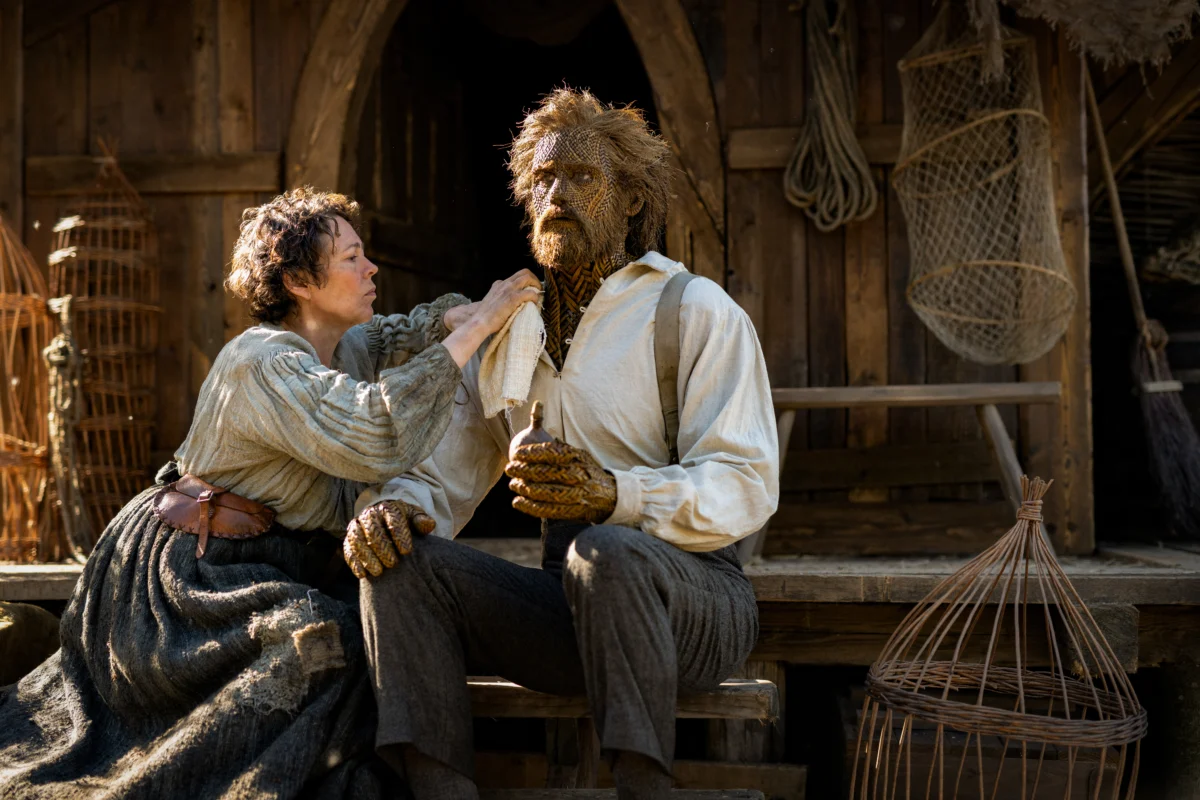
Believe the hype. Wicker, the highly anticipated feature now gracing theaters, has proven to be every bit as provocative, romantic, and technically miraculous as its initial trailers promised. At its core, the film is a bold, genre-defying exploration of desire and societal expectation, anchored by a powerhouse performance from Olivia Colman. But beyond the emotional resonance lies a staggering feat of cinematic engineering: the creation of a sentient, romantic, and entirely convincing "Wicker Husband," portrayed with stoic grace by Alexander Skarsgård.
The Narrative Foundation: A Medieval Tale of Worth and Willow
The story, adapted from Ursula Wills’ short story The Wicker Husband, centers on a spinster fisherwoman (Colman) living in a harsh, unforgiving medieval community. In this setting, a woman’s societal worth is measured strictly by her marital status. Despite her fierce independence and skill as a provider, she is relentlessly mocked by her peers. Seeking both companionship and a middle finger to the rigid structures of her village, she commissions a local basket weaver (Peter Dinklage) to craft her a husband out of wicker.
What follows is an unexpected romance that challenges the audience’s perceptions of beauty and human connection. The film’s success rests heavily on the credibility of Skarsgård’s character, a man constructed from woven fibers who must emote, move, and—crucially—interact intimately with his partner without appearing as a mere prop.
The Chronology of Creation: From Concept to Reality
The journey to bring the Wicker Husband to life was anything but simple. When the film’s directors, Alex Huston Fischer and Eleanor Wilson, approached the legendary Weta Workshop, their mandate was clear: "We want to make this practically."
The project kicked off with an intensive 18-month research and development phase. Prosthetic makeup designer Joe Dunckley and lead makeup FX artist Sarah Rubano were tasked with solving a paradox: how to make a character made of rigid, inanimate plant fibers appear to possess the fluidity of human muscle and the warmth of a living being.
- Phase One (Months 1–6): The team moved away from traditional molding, which would have resulted in static, heavy pieces. Instead, they embraced 3D digital sculpting and cutting-edge printing technology.
- Phase Two (Months 7–12): The team performed a full-body scan of Alexander Skarsgård to ensure the prosthetic suit would move in perfect harmony with his anatomy.
- Phase Three (Months 13–18): Final fabrication and integration. The suit was constructed of 50 individual, 3D-printed appliances, meticulously painted to mimic the texture and color of aged wicker before being attached to a flexible spandex base.
The Technology Behind the Weave
The technical hurdle was significant. Traditional prosthetics are designed to mimic the elasticity of skin; wicker is inherently inflexible. To overcome this, the Weta team utilized a revolutionary powder-bed laser-sintered printing process.
"It’s a volume of thermoplastic elastomer," explains Dunckley. "You shoot a laser into it, and where the focal point of the laser is, it fuses the powder. This allowed us to build the intricate weave and complex geometry that traditional molding simply couldn’t touch. The powder in the bed acts as a support, holding the strands apart while they set."

The resulting material is semi-flexible, providing a tactile experience that mimics the organic resistance of real wicker while remaining comfortable enough for Skarsgård to wear throughout long production days.
Supporting Data: The Anatomy of a Performance
The transformation of Skarsgård was a multi-layered process that required both technical precision and acting endurance. Rubano’s team developed a 10-piece prosthetic set for the face, including jaw pieces, eye bags, a forehead, and a nose.
- Facial Expression: To prevent Skarsgård from being "lost" under the makeup, the team used 3D animation software to map the expressive range of his face. They engineered the weave to sit atop these muscles, allowing the wicker to shift and flex when he smiled, squinted, or frowned.
- Organic Detailing: The character’s hair, beard, and eyelashes were crafted from muka—a silky-soft fiber derived from the New Zealand harakeke plant. This material was knotted directly into the weave, allowing stylists to cut, trim, and style it just like human hair.
- Efficiency: By the end of the production, the team had optimized the transformation process to a remarkable 90 minutes, a testament to the synergy between the makeup artists and the actor.
Official Responses and Behind-the-Scenes Realities
The production was not without its challenges. Filmed during a sweltering Hungarian spring, the suit proved to be a test of physical stamina. "He runs hot," admits Rubano. "The suit is inherently insulating, and filming in those conditions required Alexander to be incredibly disciplined."
Dunckley echoes this sentiment, praising the actor’s commitment. "The other big piece of the puzzle was Alexander himself. What a wonderful collaborator and team player! He was resilient. He was funny. He was so invested. He would sit as still as a statue in the chair for hours."
The question of the film’s more intimate scenes—specifically the "bonking" sequences—became a point of public fascination. Addressing the inevitable speculation regarding a "wicker penis," the team remained both professional and pragmatic.
"There’s been a lot of speculation about the mechanics and the potential danger," says Dunckley with a laugh. "But our basket maker character is a master of his craft. He’s traveled the world and learned from every culture. We assumed he would know exactly how to weave a, shall we say, ‘user-friendly’ addition."
The "wicker ween," as it was dubbed on set, was a last-minute addition designed by András Dániel Tóth and Attila Godena-Juhász. It utilized a puff-spandex base to ensure safety and comfort, color-matched to the rest of the body to maintain the illusion of seamless construction.

The Implications: A New Era for Practical Effects
The success of Wicker carries significant implications for the future of filmmaking. In an era dominated by CGI, the film proves that there is still a massive appetite—and a high bar of quality—for practical effects that provide tangible, authentic performances.
By merging 3D printing with traditional character makeup, the team behind Wicker has created a new blueprint for "creature" design. The ability to make a character feel both synthetic and sentient allows directors to push the boundaries of storytelling, moving into surrealist or folk-horror territories without losing the emotional grounding that keeps audiences invested.
Furthermore, the film challenges the industry’s reliance on digital "fixing." Because the effects were practical, the lighting on set interacted naturally with the wicker texture, creating a visual consistency that is often absent in CGI-heavy productions. The "Wicker Husband" feels like he is truly occupying the same space as Olivia Colman’s character, which is the primary reason the romance lands with such poignancy.
Final Reflections
Wicker is a triumph of imagination and execution. It is a film that asks us to suspend our disbelief, not just for the sake of a fantasy, but to engage with a profound question: Can we find love in the most unconventional of places?
With the combined talents of Olivia Colman, Alexander Skarsgård, and the visionary team at Weta Workshop, the film answers with a resounding "yes." It is a testament to the power of cinema to blend the impossible with the intimate, proving that sometimes, the most realistic performances are the ones that require the most artificial construction.
As the film continues its theatrical run, it will likely be remembered as much for its technical ingenuity as for its haunting, beautiful story. The "Wicker Husband" is not just a triumph of makeup and 3D printing; he is a character who, despite being made of straw and thermoplastic, feels more human than many of his peers in the cinematic landscape.
 Siti Muinah
 Ammar Sabilarrohman
 Layla Zulfa
