
 By Ammar Sabilarrohman
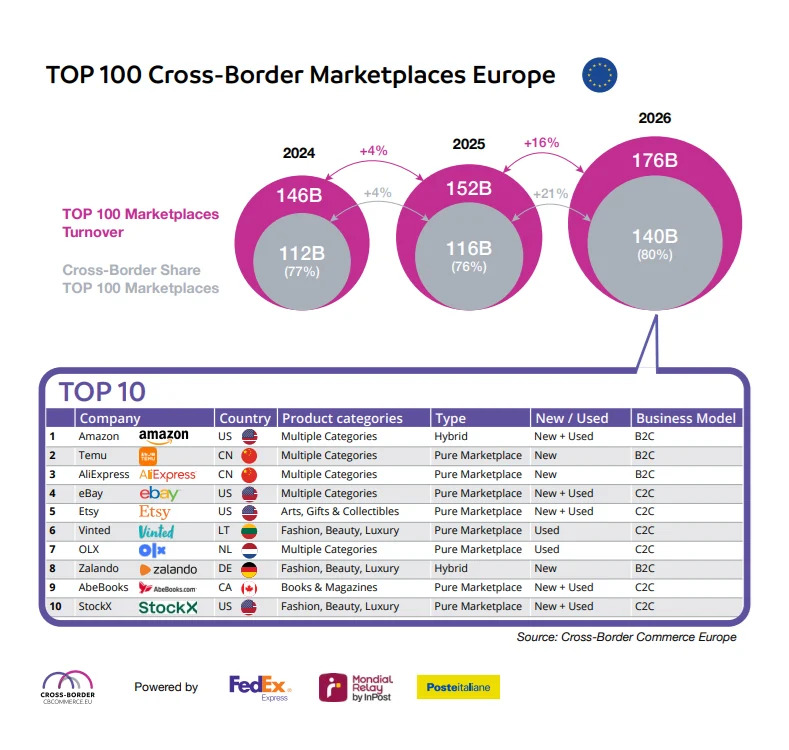
The European e-commerce landscape is undergoing a structural transformation, with cross-border activity emerging as the definitive engine of growth for the continent’s top-tier digital marketplaces. According to the seventh annual "Top 100 Cross-Border Marketplaces Europe" report, published by Cross-Border Commerce Europe, the digital economy is shifting toward a model where national borders are increasingly irrelevant to the consumer experience.
As the industry matures, the 100 most significant marketplaces operating within Europe are projected to generate a collective gross merchandise volume (GMV) of 175.8 billion euros. Perhaps more telling is the composition of this revenue: 79.5 percent of this total is derived from cross-border sales—transactions where the buyer and the seller reside in different countries. This data signals that the "European Digital Single Market" is no longer an abstract policy goal but a commercial reality driven by consumer demand for variety, price transparency, and seamless logistics.
The Chronology of Growth: From National Players to Continental Giants
The trajectory of European marketplaces has shifted significantly over the past decade. Historically, e-commerce was fragmented by language barriers, local payment preferences, and complex tax jurisdictions. However, the rise of sophisticated logistics networks and the ubiquity of high-speed mobile internet have accelerated the consolidation of the European market.
Phase 1: The Foundation (2018–2020)
During the early years of this research cycle, marketplaces focused on establishing "anchor" operations within specific European nations. The goal was to build trust and local brand recognition. During this period, cross-border sales were primarily opportunistic rather than strategic.
Phase 2: The Acceleration (2021–2023)
The global pandemic served as a massive catalyst, forcing both consumers and retailers to adopt digital-first strategies. Marketplaces expanded their footprints, investing heavily in cross-border fulfillment centers and localized customer support. This era saw the entry and rapid growth of non-European giants—such as Temu and AliExpress—which utilized aggressive pricing and algorithmic product discovery to disrupt traditional retail incumbents.
Phase 3: The Current Era (2024–2026)
As highlighted by the seventh edition of the report, we have entered an era of "Marketplace Maturity." The focus has shifted from mere geographic expansion to operational optimization. Companies are now competing on delivery speed, AI-driven personalization, and regulatory compliance. The projection that cross-border GMV will reach 139.8 billion euros by 2026 confirms that the cross-border model is now the standard operating procedure for the industry’s top performers.
Supporting Data: By the Numbers
The quantitative analysis provided by Cross-Border Commerce Europe offers a granular look at the economic power wielded by these platforms.
- Current Standing: The top 100 marketplaces are currently generating €175.8 billion in total GMV, with nearly 80% (approx. €139.7 billion) attributed to cross-border sales.
- The 2027 Outlook: Projections for the coming year suggest a robust expansion. Total GMV is expected to climb to approximately €190 billion, representing an 8% year-on-year growth rate.
- Cross-Border Dominance: Within this growth, cross-border GMV is expected to outpace the overall market, growing by 10% to reach €154 billion.
- Market Share Shift: By 2027, the proportion of total GMV derived from cross-border sales is set to rise to 81%, illustrating a widening gap between domestic-only marketplaces and those with a pan-European reach.
These figures underscore a critical reality for investors and retailers: if a platform is not optimizing for cross-border logistics, it is effectively ignoring the most profitable segment of the European consumer base.
The Titans of the Industry: The Top 10
The report identifies a hierarchy within the top 100, led by global heavyweights. The ranking methodology—which weighs cross-border sales, SEO performance, geographic coverage, and raw website traffic—places Amazon, Temu, and AliExpress at the pinnacle of the European market.
Amazon: The Infrastructure Master
Amazon remains the undisputed leader, largely due to its massive investment in European fulfillment infrastructure. By offering Prime delivery across multiple borders, Amazon has set the "gold standard" for the consumer experience, forcing competitors to scramble to match their logistics capabilities.
Temu and AliExpress: The Disruption of Discovery
The inclusion of Temu and AliExpress in the top tier signifies the power of AI-driven product discovery. These platforms leverage deep data analytics to serve hyper-personalized recommendations to users regardless of their location. Their business models, which effectively connect Asian manufacturing directly to European doorsteps, have fundamentally altered the price expectations of the average European consumer.

Implications: The Changing Face of Competition
The report highlights several key trends that are set to redefine the competitive landscape in Europe over the next three to five years.
1. The Rise of AI-Driven Product Discovery
We are moving beyond the era of "search-based" commerce. AI is now doing the heavy lifting, curating feeds based on user behavior, sentiment analysis, and predictive modeling. Marketplaces that fail to implement sophisticated AI discovery tools will find it increasingly difficult to retain the attention of Gen Z and Millennial shoppers.
2. The Social Commerce Revolution
Social media and marketplace functionality are converging. With the rise of "shoppable video" and influencer-led live commerce, the boundary between entertainment and retail is blurring. Platforms that can integrate social interaction directly into the checkout process are currently seeing the highest engagement rates in the European market.
3. Regulatory Complexity
As marketplaces grow, so does the scrutiny from European regulators. Compliance with the Digital Services Act (DSA) and evolving environmental regulations (such as the EU’s waste and recycling mandates) is becoming a major operational cost. Platforms must now invest as much in legal and compliance teams as they do in software development.
4. Infrastructure Localization
Perhaps the most paradoxical trend is that while marketplaces are becoming more "global" in reach, they are becoming more "local" in physical operation. To compete on delivery times, international giants are forced to set up local hubs, warehouses, and returns-processing centers within the EU. This "local-for-local" strategy is essential to overcome the logistical frictions of cross-border trade.
Official Commentary and Strategic Outlook
The researchers behind the study emphasize that European marketplace commerce has entered a "new era." In their recent findings, they note that the fierce competition is no longer just about who has the cheapest goods, but who has the most resilient supply chain and the most transparent regulatory profile.
Industry analysts suggest that the next few years will see a "shake-out" period. Smaller marketplaces that lack the scale to handle cross-border tax compliance or the capital to invest in AI-driven infrastructure will likely be absorbed by the giants or forced into niche markets.
"The dominance of cross-border sales is a testament to the success of the European consumer’s desire for choice," says one market analyst involved in the report. "However, the entry barrier is rising. To succeed in 2027 and beyond, platforms must be tech-native, logistically agile, and legally bulletproof."
Conclusion: The Path Forward
The data from the seventh edition of the "Top 100 Cross-Border Marketplaces Europe" is clear: the future of European retail is borderless. With cross-border GMV projected to hit €154 billion by 2027, the opportunity for growth is immense. Yet, this growth comes with significant responsibilities.
For existing marketplaces, the mandate is clear: accelerate the adoption of AI, localize fulfillment infrastructure to reduce delivery friction, and stay ahead of the evolving regulatory landscape. For new entrants, the path to the top 100 is narrow, requiring a high degree of technological sophistication and a clear strategy to navigate the complex, multi-layered European market.
As we look toward 2027, the companies that succeed will be those that view Europe not as a collection of separate markets, but as a singular, dynamic ecosystem defined by speed, intelligence, and a seamless cross-border experience. The shift is well underway, and for the European consumer, the world of retail is becoming smaller, faster, and more integrated than ever before.
 Pevita Pearce
 Iffa Jayyana
 Siti Muinah
