
 By Pevita Pearce
WASHINGTON — Artificial intelligence chatbots have rapidly woven themselves into the fabric of everyday digital life. Platforms like OpenAI’s ChatGPT, Microsoft’s Copilot, and Google’s Gemini are now routinely utilized by roughly half of all American adults to draft emails, summarize documents, brainstorm ideas, and solve technical problems. Yet, as the nation hurtles toward the high-stakes 2026 midterm elections, a striking paradox has emerged: when it comes to democratic participation and political decision-making, the American public is overwhelmingly giving AI a wide berth.
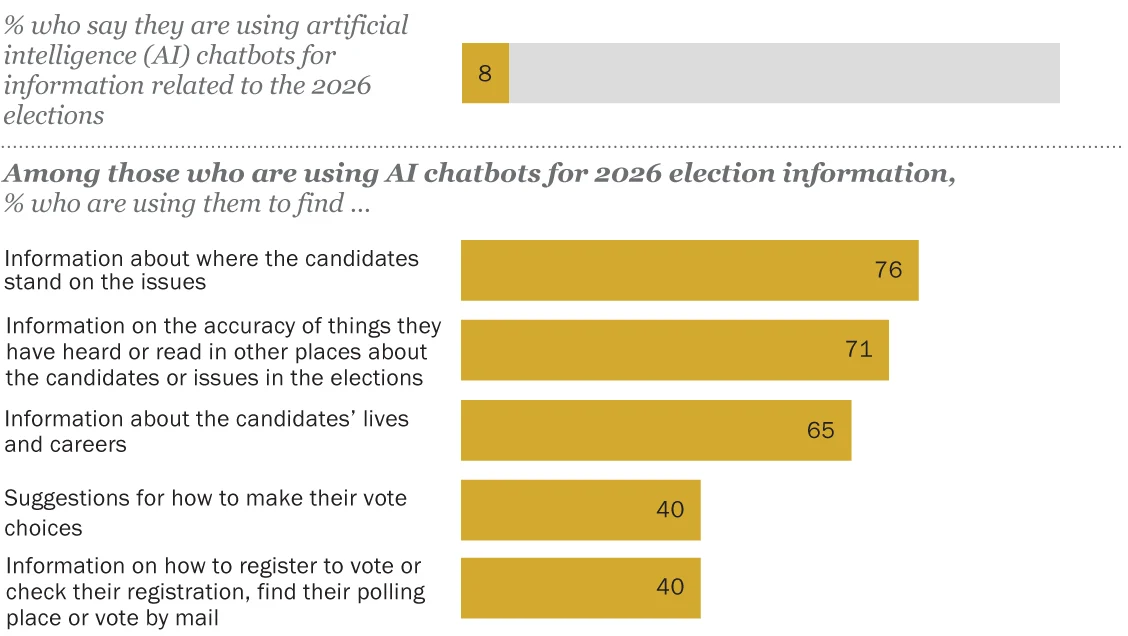
According to a comprehensive new national survey published by the Pew Research Center, only about one in ten U.S. adults—just 8% of the population—are actively utilizing artificial intelligence chatbots to source information regarding the upcoming midterm elections. While the broader societal adoption of generative AI tools continues its aggressive upward trajectory, the digital frontier has not yet become a primary battleground or research hub for political discourse.
For the small slice of the electorate that is turning to algorithms for guidance, however, their reliance is surprisingly deep. These users are leveraging chatbots not merely for casual curiosity, but to dissect complex policy positions, scrutinize candidate track records, and run fact-checks against the barrage of political messaging dominating television screens and social media feeds.
Main Facts: The Scope of AI Adoption in the 2026 Midterms
The Pew Research Center survey, conducted between October 12 and 18, 2026, among 5,273 U.S. adults via the nationally representative American Trends Panel, provides a definitive baseline of how emerging technologies intersect with modern democratic processes.
The core findings paint a picture of a technology that is simultaneously ubiquitous in daily life yet peripheral to political research:
- Low Overall Utilization: Just 8% of American adults report using AI chatbots to find information related to the 2026 midterm elections. Conversely, 92% say they are not utilizing these tools for election-related research.
- The Policy-Focused Minority: Among that 8% minority who do consult chatbots for political insights, the motivation is heavily focused on substantive issues. A resounding 76% use chatbots to research where candidates stand on the issues.
- The Fact-Checking Impulse: Close behind policy queries, 71% of AI-using voters turn to chatbots to verify the accuracy of claims they have encountered elsewhere about candidates or policy positions.
- Biographical Research: Roughly two-thirds (65%) use the technology to look up biographical details regarding candidates’ past careers and personal histories.
- Voter Logistics and Balloting Guidance: Trailing behind candidate research, 40% of these users look to chatbots for suggestions on how to make their vote choices, while an identical 40% seek practical administrative details, such as how to register to vote, check their registration status, locate polling places, or navigate vote-by-mail procedures.
- Demographic Divides: Mirroring broader technological trends, age plays a significant role in adoption. Adults under the age of 50 are nearly three times as likely as those 50 and older to use chatbots for election information (11% compared with 4%).
Chronology: The Rapid Rise of Chatbots and the Slow Drift Toward Politics
To understand the current state of AI in the 2026 midterms, it is necessary to examine how generative artificial intelligence evolved from a niche tech-industry novelty into a mainstream consumer utility over a remarkably compressed timeline.
Late 2022 to 2023: The Generative AI Explosion
The modern era of consumer artificial intelligence effectively began in November 2022 with the public launch of OpenAI’s ChatGPT. Within weeks, millions of users worldwide were experimenting with large language models. Early use cases centered on creative writing, coding assistance, and light entertainment. Political applications during the 2022 U.S. midterms were minimal, largely because the technology was too new and unpredictable for mainstream political deployment.
Throughout 2024 and 2025: Integration and Anxiety
As tech giants rushed to embed generative AI into search engines, operating systems, and productivity suites, American usage rates climbed steadily. By late 2024 and through 2025, roughly half of all U.S. adults reported using AI tools for various tasks in their personal and professional lives. Concurrently, watchdogs, political campaigns, and cybersecurity experts grew increasingly alarmed over the potential for AI-generated deepfakes, automated misinformation campaigns, and algorithmic bias to disrupt democratic integrity. Despite these fears, everyday citizens largely used chatbots for practical productivity rather than political navigation.
June 2026: Broad Baseline Established
A Pew Research Center study published in June 2026 confirmed that about half of U.S. adults were regular users of chatbots and smart devices. However, questions remained regarding how these powerful tools would be deployed when citizens faced actual civic decisions.
October 12–18, 2026: The Midterm Snapshot
With the 2026 midterm elections looming just weeks away, Pew fielded its specialized survey to capture how Americans were utilizing technology in real-time. The results revealed that while general AI adoption had plateaued or stabilized at roughly 50%, its crossover into the electoral sphere remained stubbornly low at 8%. This chronological progression highlights a distinct lag: while Americans are comfortable trusting AI to draft emails or summarize articles, they remain deeply hesitant to rely on algorithms when deciding who should represent them in Washington.
Supporting Data: Demographic Breakdowns and User Priorities
A deeper dive into the statistical data reveals clear patterns regarding who is using these tools and what they hope to achieve. While the overall percentage of users stands at 8%, segmentation across age, education, and political engagement paints a nuanced picture of the modern tech-savvy voter.
Age and Digital Literacy
The generational divide in AI usage for political information mirrors long-standing technology adoption curves. Younger Americans, who have grown up alongside rapid digital transformations, display greater comfort relying on algorithmic intermediaries.
- Under 50 Demographics: 11% of adults aged 18 to 49 report using AI chatbots for 2026 election information. This group’s general familiarity with platforms like ChatGPT and Copilot makes the barrier to entry negligible.
- Ages 50 and Older: Only 4% of Americans 50 and older report utilizing chatbots for the same purpose. This drop-off reflects both a lower baseline rate of overall chatbot adoption among older adults and heightened skepticism regarding the reliability and trustworthiness of AI outputs.
What the AI-Using Electorate Seeks
For the 8% who do consult chatbots, the depth of their reliance is noteworthy. Rather than treating chatbots as casual novelties, these users are treating them as virtual research assistants:
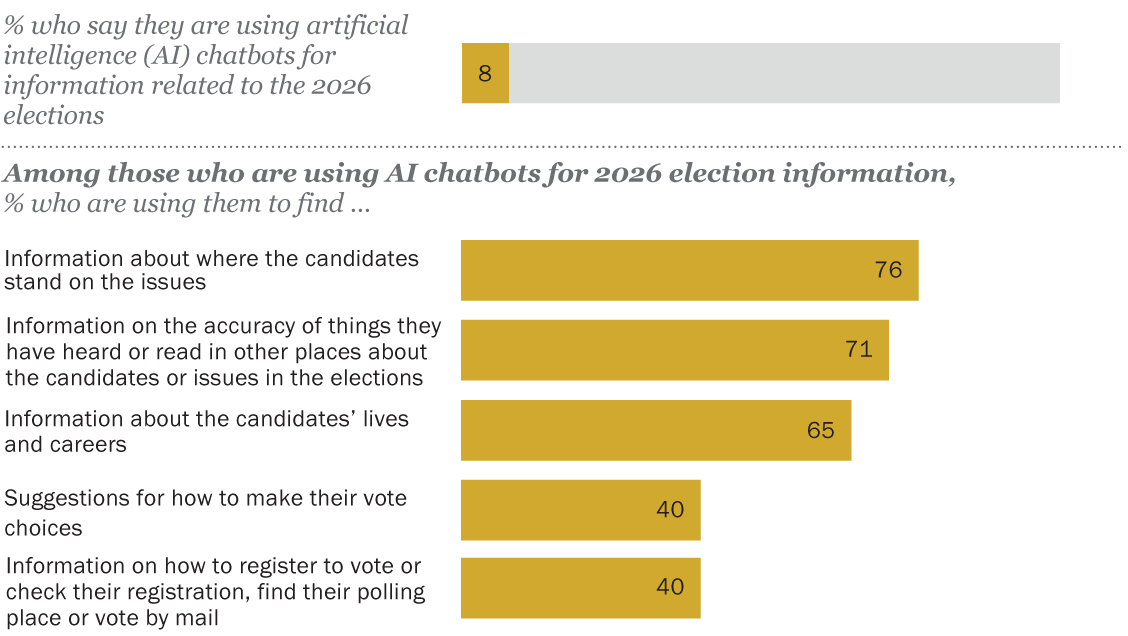
| Information Sought via AI Chatbots | Percentage of AI-Using Voters |
|---|---|
| Where candidates stand on the issues | 76% |
| Accuracy of claims heard/read elsewhere (Fact-checking) | 71% |
| Candidates’ lives and careers (Biography) | 65% |
| Suggestions for how to make vote choices | 40% |
| Voter registration, polling places, vote-by-mail info | 40% |
The prominence of fact-checking (71%) and policy research (76%) indicates that these users are often grappling with information overload. In an era where social media feeds are saturated with competing claims, political advertisements, and rapid-fire news cycles, a subset of voters is turning to AI to synthesize complex policy differences and arbitrate disputes over truth.
Conversely, the lower figures for voting logistics (40%) and ballot recommendations (40%) suggest that voters still prefer traditional, authoritative sources—such as official state election websites, local boards of elections, and trusted nonpartisan civic organizations—when executing the mechanics of voting or seeking direct counsel on candidate selection.
Official Responses and Expert Perspectives
The findings from the Pew Research Center have sparked considerable discussion among political scientists, election administrators, and technology ethicists regarding the future of campaigns and voter education.
The Cautionary View from Election Officials
State and local election officials have spent years preparing for potential AI-driven disruptions, primarily focusing on the threat of deepfakes, synthetic audio targeting candidates, and false instructions regarding polling locations disseminated via social media. The fact that 40% of AI-using voters turn to chatbots for registration and polling place information has raised eyebrows among election administrators.
"While 8% overall utilization may sound low, it still represents millions of Americans who are potentially querying algorithms for critical voting logistics," noted Dr. Elena Vance, a scholar of digital democracy at the Brookings Institution. "If a chatbot hallucinates a polling place address or provides outdated voter registration deadlines, the disenfranchisement risk is real, even if the absolute numbers are currently modest."
Major tech companies, including OpenAI, Google, and Microsoft, have instituted strict guardrails ahead of major election cycles. These measures typically include programming chatbots to direct users searching for voting logistics to official, authoritative portals like Vote.org or state-specific government websites, rather than attempting to generate real-time logistical data independently.
Campaign Strategists Adapt
Political campaigns have also taken note of shifting digital habits. While traditional advertising, targeted social media campaigns, and grassroots door-to-door operations remain the dominant modes of voter outreach, campaign technologists are increasingly aware of how their messaging appears to large language models.
"When 76% of AI-using voters ask a chatbot where a candidate stands on the issues, the phrasing, summaries, and policy positions indexed by those algorithms matter immensely," explained Marcus Holloway, a digital strategist who has managed campaigns at both the state and federal levels. "Campaigns are realizing that search engine optimization (SEO) is expanding into large language model optimization. If your policy platform isn’t cleanly and accurately represented in the training data or web-retrieval mechanisms of major chatbots, you risk losing a subset of highly engaged, analytical voters who rely on these tools."
Implications: What This Means for the Future of Democracy
As artificial intelligence continues to mature, the intersection of algorithms and elections will only grow more complex. The current data from the 2026 midterms provides several vital takeaways for the trajectory of American politics and public communication.
1. The Trust Deficit in Automated Politics
The primary reason overall chatbot usage for elections remains at 8% is not a lack of technological capability, but a profound trust deficit. Polls consistently show that Americans harbor deep reservations about the objectivity, accuracy, and political neutrality of artificial intelligence. Unlike search engines, which direct users to external web pages where they can evaluate sources themselves, chatbots synthesize information into a singular, authoritative-sounding response. For many voters, outsourcing political judgment to a "black box" algorithm feels fundamentally unnatural and risky.
2. A Glimpse of the Power-User Future
While 8% is a minority today, technological adoption curves rarely remain static. Younger generations who treat chatbots as native digital tools will age into more politically active demographics. As AI models become more reliable, transparent, and integrated into everyday digital environments, reliance on chatbots for policy research and fact-checking is likely to expand in future election cycles. The habits of today’s tech-forward minority may well preview the mainstream voter behavior of the 2030s.
3. The Imperative for Algorithmic Accountability
The finding that over 70% of AI-using voters rely on chatbots for issue research and fact-checking places an immense responsibility on the developers of these technologies. Tech companies are no longer just software providers; they are de facto arbiters of political information for a growing segment of the electorate. Ensuring that these systems remain politically neutral, transparent in their sourcing, and rigorously accurate regarding civic data is paramount to maintaining public trust.
Conclusion
The 2026 midterm elections find American voters standing at a digital crossroads. While artificial intelligence has revolutionized how we work, write, and organize our daily lives, the sacred act of choosing political leaders remains stubbornly human-centric. For now, the vast majority of Americans prefer to navigate the political landscape through traditional human networks, journalism, and personal conviction—leaving the robots on the sidelines of democracy.
 Neng Nana
 Azzam Bilal Chamdy
