
 By Raul Delapena Setiawan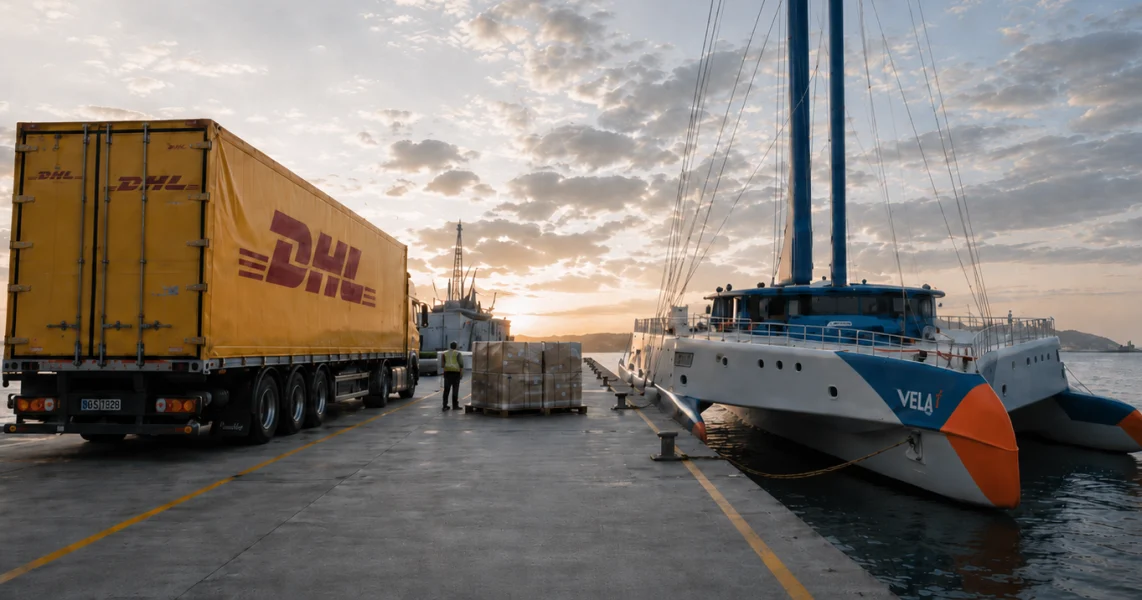
In a bold move to redefine the logistics landscape, global shipping giant DHL has announced a strategic partnership with Vela, an innovative designer and operator of wind-propelled cargo vessels. This collaboration marks a significant pivot in how high-value, temperature-sensitive goods traverse the Atlantic, replacing carbon-heavy fuel dependency with the clean, renewable power of the wind. As the logistics industry grapples with the urgent necessity of decarbonization, this partnership serves as a flagship initiative for DHL’s broader commitment to achieving net-zero emissions by 2050.
The Core Partnership: Merging Tradition with Technology
The collaboration leverages the unique strengths of both organizations: DHL’s expansive freight-forwarding network and Vela’s cutting-edge maritime engineering. Under the terms of the agreement, DHL Global Forwarding France will reserve capacity on Vela’s specialized fleet, allowing customers to utilize DHL’s comprehensive suite of services—including customs brokerage, warehousing, and logistics management—while their cargo is transported via wind-powered sailboats.
Vela’s vessels are not traditional sailboats; they are sophisticated, large-scale aluminum trimarans. Featuring a three-hulled design, these vessels are engineered to maximize stability and speed, maintaining an average of 14 knots. Measuring approximately 220 feet in length, each ship has the capacity to carry roughly 415 metric tons of cargo. Crucially, the cargo holds are equipped with advanced temperature-control systems, making these vessels an ideal logistics solution for industries that require strict environmental conditions, such as pharmaceuticals, luxury cosmetics, high-end spirits, and the aerospace sector.
Chronology: From Concept to Commercial Launch
The timeline for this project reflects a methodical approach to scaling sustainable maritime solutions:
- Early 2027: The anticipated launch of commercial service. Initial operations will focus on a direct, dedicated route connecting secondary, strategic ports: the Port of Caen-Ouistreham in Normandy, France, and the Port of New Haven in Connecticut, USA.
- Expansion Phase (2027–2030): Following the initial deployment, the companies plan to scale operations significantly. By 2030, the vision is to have a fleet of five vessels in operation, facilitating a consistent, weekly trans-Atlantic departure schedule.
- Operational Scaling: As the fleet grows, DHL has committed to increasing its cargo volume allocations, transitioning from a pilot-level engagement to a primary shipping method for its high-value, less-than-container load (LCL) shipments.
Supporting Data: Quantifying the Green Advantage
The environmental impact of this partnership is profound. By utilizing wind as the primary propellant, the collaboration aims to drastically reduce greenhouse gas (GHG) emissions. According to industry analysis, the Vela solution is expected to reduce GHG emissions by up to 99 percent compared to traditional air freight, and up to 90 percent compared to conventional containerized ocean freight on comparable trans-Atlantic routes.
For the purposes of this venture, the vessels will transport 600 European pallets per crossing. The target port-to-port transit time is set at 15 days, a competitive window that balances environmental stewardship with the speed requirements of modern supply chains.
Beyond the direct carbon savings, the partnership addresses operational inefficiencies. By utilizing secondary ports, the ships can bypass the chronic congestion often found at major global shipping hubs. This reduces the need for extensive transshipment—the process of moving cargo between different vessels or modes of transport—which typically increases both costs and the risk of damage or delays.
Official Perspectives: Aligning Vision with Impact
The leadership teams behind this partnership view it as a milestone in the "green transition" of global trade.
Michaël Fernandez-Ferri, managing director of Vela, emphasized the operational shift the company is spearheading. "We are taking a decisive step: making sail freight simpler, more accessible, and fully operational on a large scale," Fernandez-Ferri stated. "Our shared ambition is clear: to offer shippers a low-emission trans-Atlantic solution, without compromising on service excellence."
Laurent Terreyre, president of DHL Global Forwarding France, framed the partnership as a logical extension of DHL’s long-term sustainability roadmap. "This partnership with Vela allows us to take a further step by integrating a locally based, wind-powered maritime transport solution into our offering," Terreyre said. "This innovation, developed with a partner who shares our requirements for performance, speed, and excellence, fully illustrates our ambition: to combine logistics expertise and positive impact, without compromise."
The Broader Decarbonization Landscape
The Vela partnership is merely one pillar of a multi-faceted decarbonization strategy at DHL. The company is actively diversifying its approach to sustainability, acknowledging that a "one size fits all" solution does not exist for global logistics.
The CMA CGM Collaboration
In December of last year, DHL announced a partnership with ocean shipping titan CMA CGM to reduce the carbon footprint of container shipping. This initiative focuses on the adoption of lower-carbon biofuels. By committing to use 8,900 metric tons of biofuel, the two companies expect to eliminate approximately 25,000 metric tons of GHG emissions. This is facilitated through the "GoGreen Plus" program, which allows DHL’s clients to opt for sustainable fuel alternatives, resulting in up to an 80 percent reduction in carbon intensity compared to conventional bunker fuel.
The Air Freight Challenge
Air freight remains the most carbon-intensive segment of DHL’s business, accounting for 65 percent of its total logistics-related emissions. To address this, the company has heavily invested in Sustainable Aviation Fuel (SAF). In 2025 alone, DHL utilized 185,000 metric tons of SAF, representing 10 percent of its total jet fuel consumption—a nearly three-fold increase from 2024 levels. The company’s long-term goal is for sustainable fuels to constitute 30 percent of all air, ocean, and road transport fuel by 2030.
Strategic Investments in France
The Vela partnership coincides with a broader push by DHL to modernize its infrastructure in France. The company recently unveiled a 160 million euro ($182.7 million) investment program in the region. This capital injection is earmarked for several critical upgrades, including:
- Electrification: Expanding the electric vehicle (EV) fleet and developing robust charging infrastructure.
- Infrastructure Efficiency: Deploying solar energy arrays at logistics sites and upgrading to energy-efficient building technologies.
- Alternative Fuels: Transitioning heavy goods vehicles to biodiesel and other low-carbon fuel alternatives.
Implications for the Future of Global Trade
The implications of the DHL-Vela partnership extend far beyond the immediate reduction of carbon emissions. It represents a significant validation of wind-assisted propulsion as a viable commercial technology for the 21st century.
Economic and Operational Resilience
By decentralizing the supply chain through the use of secondary ports, the partnership creates a more resilient network. Modern logistics, which relies heavily on a few massive, congested ports, is inherently fragile. Small-scale, agile vessel operations like those proposed by Vela offer a "boutique" alternative that can operate independently of the bottlenecks that frequently paralyze global trade.
The Rise of Sustainable Luxury and High-Value Logistics
The target market for this service—pharmaceuticals, luxury goods, and high-value electronics—signals a shift in consumer and corporate demand. Companies are increasingly under pressure from stakeholders and regulators to prove the sustainability of their supply chains. A "wind-powered" shipping label is not just an environmental badge; it is a powerful marketing tool for brands looking to appeal to eco-conscious consumers who are willing to pay a premium for carbon-neutral logistics.
A Blueprint for Scaling
While 600 pallets per crossing is a modest start, the ambition to scale to a fleet of five vessels by 2030 suggests that DHL views wind-powered transport as a scalable business model. If successful, this project could provide a blueprint for other logistics providers to integrate specialized, low-emission vessels into their own fleets, effectively normalizing the use of wind-propulsion in the global shipping mix.
Conclusion: Navigating Toward a New Era
The partnership between DHL and Vela is a profound example of how legacy industry players can embrace radical innovation to solve systemic problems. By integrating wind-propelled vessels into their service offerings, DHL is proving that the pursuit of a net-zero future is compatible with the rigors of modern international commerce.
As the 2027 commercial launch approaches, the eyes of the logistics world will be on the trans-Atlantic route between Caen-Ouistreham and New Haven. If the initiative achieves its stated goals of speed, reliability, and drastic emission reductions, it will likely herald a new era in maritime logistics—one where the wind, once the primary driver of global trade, returns to center stage as the key to a cleaner, more sustainable future.
 Nana Muazin
  Nana
Nana  Ali Ikhwan