
 By Jia Lissa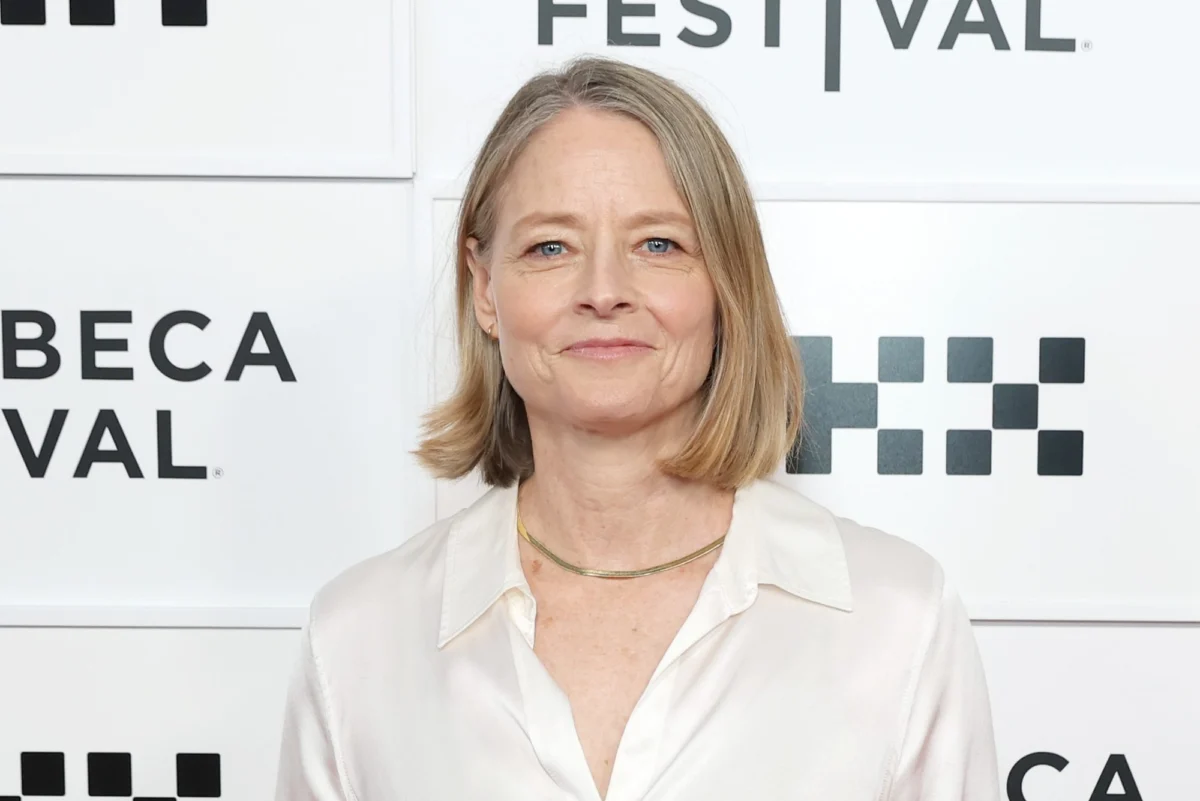
In the ever-evolving landscape of contemporary cinema, few figures command the intellectual respect of Jodie Foster. A veteran of the industry with a career spanning over five decades, Foster has navigated the transition from celluloid to digital, and now stands at the precipice of the most disruptive shift in the history of the medium: the integration of Artificial Intelligence.
During a high-profile appearance at this year’s Aspen Festival of Ideas, Foster engaged in a candid, wide-ranging discussion titled “Who Owns the Future of Hollywood” alongside former Sony Pictures CEO Michael Lynton. While the conversation touched upon the traditional evolution of filmmaking, the spotlight quickly turned toward the unsettling efficiency of modern blockbusters. Specifically, Foster pointed to Apple’s high-octane racing drama F1—starring Brad Pitt—as a quintessential example of how machine-learning models might be subtly reshaping the DNA of storytelling.
The "F1" Paradox: Efficiency Over Soul?
The central provocation of Foster’s commentary was not a condemnation of the film’s quality, but rather an observation of its structural perfection. F1, which has achieved significant commercial success with a global gross of $634 million and critical recognition including four Academy Award nominations and a win for Best Sound, serves as a litmus test for the modern studio model.
“I don’t say this disparagingly—how could I? This movie went on to make millions of dollars,” Foster remarked to the Aspen audience. “But I look at a movie like F1 and I’m like, ‘F1’ was made by AI. Wasn’t it? I mean, the structure was exactly the structure that you would learn in school. The actors say the lines exactly the way it would be written if a computer was writing exactly what would be the right thing for that time.”
Foster’s critique strikes at the heart of the "algorithmic" nature of modern tentpole films. In an era where data analytics dictate pacing, character beats, and even casting decisions to maximize international box office returns, the line between human intuition and predictive modeling has become increasingly porous. Foster suggests that F1 represents the apex of this trend: a film so optimized for consumption that it loses the jagged, unpredictable edges that historically defined human artistry.
A Chronology of Technological Disruption
To understand Foster’s skepticism, one must look at the timeline of Hollywood’s digital evolution. The industry has long been a laboratory for technological experimentation, each step fundamentally altering the labor force.
- The Early Digital Transition (1990s–2000s): The rise of Computer-Generated Imagery (CGI) marked the first major shift. What began as a tool for practical effects quickly became the backbone of world-building, leading to the decline of traditional matte painters and model makers.
- The Streaming Explosion (2010s): As distribution shifted from theaters to data-driven streaming platforms, studios began using viewer metrics to greenlight content, prioritizing "watchability" over auteur vision.
- The Rise of Generative AI (2023–Present): With the advent of Large Language Models and visual generation software, the threat has moved from the screen to the writers’ room and the soundstage. The 2023 WGA and SAG-AFTRA strikes were the first organized responses to this existential threat, establishing early precedents for how human labor should be protected against automation.
Foster contextualized these shifts during the Aspen event, noting that AI is simply “one more giant step forward into changing the industry.” She highlighted that the discomfort she feels regarding AI is not unique; it is a continuation of the same anxiety felt when practical sets were replaced by green screens.
The Economic Implications: Replacing the Human Element
The dialogue between Foster and Michael Lynton pivoted from artistic theory to the harsh economic reality of the industry. Lynton, drawing on his experience as a studio executive, asked the pointed question: "Is it going to replace actors and writers?"
Foster’s response was characteristically blunt. "We do replace people," she admitted. She pointed to the increasingly common practice of using digital replicants to fill out crowd scenes, a cost-saving measure that effectively erodes the entry-level job market for background actors.
"We’re getting rid of a lot of jobs," she said. "And hopefully, things like unions will be able to come in and say, ‘You can use my actor 20 times, but you’re going to pay him 20 times.’ And I think that’s fair."
This highlights the core tension of the current era. If AI can simulate a human presence—or even a human script—the incentive for studios is to minimize the overhead associated with the messy, expensive, and unpredictable nature of human talent. The economic implication is a potential "hollowing out" of the creative middle class, where only the top-tier stars remain "essential," while the supporting ecosystem of writers, background performers, and technicians is rendered obsolete by digital assets.
The Role of AI as a Tool vs. A Replacement
Despite her skepticism, Foster is not a Luddite. She acknowledged that AI serves a legitimate purpose in "small, helpful things," specifically citing pre-visualization (previz). Previz allows filmmakers to map out complex sequences—like car chases or action beats—before a single camera rolls. In this context, AI is a tool for efficiency rather than a substitute for creativity.
She shared an anecdote about her most recent project, My Private Life, where she experimented with AI-aided imagery for a dream sequence. She noted that while the resulting images were surreal and arguably "made no sense," they provided a unique texture that she found creatively successful.
“What we all would love is that filmmakers would be able to dominate AI, and never lose sight of that,” Foster explained. Her philosophy rests on the concept of agency: if the filmmaker remains the master of the machine, the technology remains a brush rather than a replacement for the painter. “If we are able to dominate AI consistently over time, we will be able to make things that reflect us, and we can make things better.”
Official Responses and Industry Reaction
As of the time of this writing, representatives for Apple and F1 screenwriter Ehren Kruger have not issued a formal response to Foster’s comments. However, the industry’s reaction to her remarks has been swift and polarized.
Proponents of modern studio filmmaking argue that films like F1 are not "made by AI" in a literal sense, but rather represent a sophisticated synthesis of decades of cinematic grammar. They contend that the "structure" Foster identified as robotic is actually the result of refining narrative patterns that audiences have consistently responded to for a century.
Conversely, critics and fellow artists have lauded Foster for her transparency. Many in the creative community feel that the industry is currently undergoing a "crisis of authorship," where the pressure to deliver "content" is stripping away the idiosyncratic nuances that make cinema a form of art rather than a manufacturing process.
The Future of Hollywood: A Philosophical Crossroads
The implications of Foster’s argument extend far beyond a single racing movie. We are moving toward a future where the distinction between "human-authored" and "AI-assisted" content will become increasingly difficult to discern.
If the public reaches a point where they cannot distinguish between a computer-generated structure and a human-written narrative, the value of the "human touch" may be diminished. Alternatively, as Foster suggests, this could lead to a cultural backlash, where audiences begin to crave imperfections, raw performances, and the inherent unpredictability of human emotion.
Foster’s challenge to the industry is clear: the technology is inevitable, but the surrender of creative control is not. The challenge for the next generation of filmmakers will be to "dominate" these powerful systems, ensuring that they remain subservient to the human experience rather than the primary architects of our collective imagination.
As Hollywood continues to grapple with these technological shifts, Foster’s voice remains a vital, grounding force. Her warning is not one of impending doom, but a call to maintain the humanity in an increasingly automated world. In the race for the future of entertainment, the question is no longer whether we can use AI, but whether we can do so without losing the very soul of the art form we strive to protect.
 Nila Kartika Wati
  Siti Muinah
  Ammar Sabilarrohman