
 By Siti Muinah
In the competitive landscape of local search, businesses often obsess over review counts and citation accuracy, believing these are the primary levers of Google Maps visibility. However, there is a powerful, frequently overlooked ranking factor that serves as both a trust signal and an algorithmic catalyst: visual content.
Bill Ross, founder of Emulent Digital Marketing, argues that photos and videos are not merely decorative elements for a Google Business Profile (GBP); they are essential data points that Google’s algorithm interprets to determine relevance, geographic authority, and user intent. As search evolves, the businesses that win are those that treat their image gallery as a living, breathing component of their SEO strategy.
The Hidden Power of Visual Content in Local Search
For many service-based businesses, particularly those without a physical storefront, establishing a presence in a specific geographic area is a constant struggle. Ross notes that his agency first identified the direct correlation between visual assets and rankings when working with service-area businesses.
"They were having trouble getting ranked for the geographic area they served because they lacked a brick-and-mortar address," Ross explains. "We found that by consistently uploading photos and videos—specifically content that proved they were active within those city limits—we could effectively signal to Google where their service area truly was."
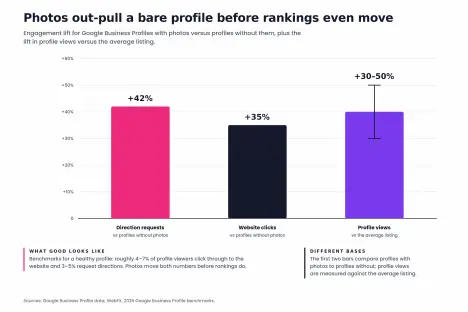
Beyond mere location verification, visuals act as a conversion multiplier. Data confirms that profiles with active photo galleries receive 42% more requests for driving directions and 35% more website click-throughs than their image-deprived counterparts. In a landscape where consumer standards for trust are at an all-time high—with many users ignoring any business rated below 4.5 stars—the "visual proof" provided by a robust gallery is often the deciding factor in a customer’s journey.
Chronology of an Optimized Visual Strategy
To maximize the impact of visual assets, businesses must move away from sporadic, "one-off" uploads and toward a disciplined, recurring cadence. According to Ross, the gap between a profile that ranks and one that stalls is often defined by the volume and frequency of new content.
The Phases of Implementation
- The Audit Phase: Before flooding a profile with new content, conduct an audit of existing assets. Identify gaps—missing categories like team photos, project outcomes, or "behind-the-scenes" footage.
- The Acquisition Phase: Build a pipeline for content. For many, this is as simple as training field technicians to use their smartphones to capture short, 30-second clips of their work.
- The Optimization Phase: Every file must be processed before it hits the server. This includes renaming files with descriptive, location-based keywords, ensuring accurate metadata, and geotagging where applicable.
- The Cadence Phase: Consistency is the heartbeat of the algorithm. Aiming for a twice-weekly upload schedule ensures that the profile reaches the critical 100-image threshold within a year.
Supporting Data: Why Volume Matters
The numbers behind high-volume profiles are staggering. Research from the BrightLocal Google My Business Insights Study indicates that businesses that cross the 100-image threshold see a 520% increase in calls, a 2,717% surge in direction requests, and a 1,065% jump in website clicks.
Ross emphasizes that this is not an incremental growth curve but an exponential one. "The gap between a high-volume profile and the average listing isn’t just a small edge; it’s an order of magnitude," he says. By committing to a twice-weekly posting habit, businesses are not just "filling space"; they are providing Google’s machine learning models with constant, fresh data points that confirm the business is active, legitimate, and relevant to local searchers.
The Pitfalls: Stock Photography and Inconsistency
One of the most dangerous myths in local SEO is that "any photo is better than no photo." Ross is firm in his stance: Stock photos are detrimental to your profile.
"I don’t think you should use stock photos at all," Ross says. "There is no benefit. We’ve even seen businesses post irrelevant stock imagery of the town they operate in, which can actually damage rankings."
Google’s vision-processing algorithms are sophisticated enough to recognize stock imagery. When a business relies on generic photos, it misses the opportunity to provide the "authentic signal" that the algorithm craves. Furthermore, inconsistent publishing—posting ten photos in one day and then going silent for six months—is viewed negatively. The algorithm favors predictable, sustained engagement over bursts of activity.
Bridging the Gap: The Role of Video
Video remains the most underutilized asset in the Local SEO toolkit. Many business owners assume that professional videography is a prerequisite, creating a psychological barrier to entry.
"Businesses can train techs to use their phones to take videos of what they’re doing," Ross suggests. "Documenting anything that goes on at the job site, whether it’s a success story or a ‘how-to’ clip, is incredibly powerful."
For these videos, length and technical specs are key. Google prefers videos under 30 seconds to maintain user engagement, with a file size limit of 75MB and a resolution of at least 720p. These short, punchy clips build trust and provide the "informational intent" that users are increasingly seeking before they commit to a service.
Implications for Modern Branding
As AI-generated imagery becomes more prevalent, the value of authentic, original content will skyrocket. While AI can assist with tasks like color grading or resizing, generating images from scratch often leads to a "hollow" profile that fails to build genuine human trust.
"The interesting part is that as more businesses take the shortcut of using AI to create images, it will make authentic photos and video matter more, not less," says Ross.
The successful case study of HairClub illustrates this perfectly. By moving from a fragmented, non-existent photo strategy to a centralized, location-specific acquisition plan, they saw a 32% increase in map listings and a 110% growth in local SEO traffic. This proves that for large-scale or multi-location brands, the "visual strategy" is a scalability multiplier.
Final Recommendations: How to Start
To recover a neglected profile, start by cleaning house. Delete irrelevant or duplicate photos, and ensure every remaining asset has a clear, descriptive file name that includes your service and location.
If you are a smaller operation, start with DIY smartphone photography—focus on the "on-the-job" moments that prove your expertise. If you are a larger brand, invest in a professional photographer for brand-related assets, such as headshots, office interiors, and high-quality portfolio work, while using your team to generate the "day-to-day" content that keeps your profile fresh.
Ultimately, your Google Business Profile is your digital storefront. In the same way you wouldn’t leave your physical shop window dusty or filled with generic, non-branded posters, you should not treat your Google listing as an afterthought. By treating visual content as a foundational pillar of your SEO strategy, you aren’t just ranking higher—you are building a more credible, human-centric brand that resonates with customers before they ever make the first call.
 Iffa Jayyana
  Asro
Asro 